
1525–09.09.1569
Pieter Bruegel the Elder
Pieter Bruegel the Elder was among the first to paint peasant festivals, children's games and work in the fields on large oil panels as pictures in their own right. Almost everything he is known for, from “Netherlandish Proverbs” to “The Hunters in the Snow”, was made within ten years, from 1559 to 1569, in Antwerp and Brussels. Both his sons, Pieter the Younger and Jan the Elder, also became painters.
Biography
Around 1552 a young master from Antwerp made his way to the far south of Italy and drew Reggio Calabria burning after a Turkish raid. For a traveller of the time, going so far was a fairly bold undertaking. Of the whole journey only landscape drawings have come down to us: the ancient ruins and new Roman buildings that almost every northerner in Rome copied apparently did not interest Bruegel.
Even his year of birth has to be worked out. There are no documents, but it is known that in 1551 he was admitted as a free master to the Antwerp Guild of Saint Luke, which painters usually joined at about twenty or twenty-five; hence the familiar range of 1525 to 1530. Lodovico Guicciardini wrote in 1567 that Bruegel was born in Breda. Karel van Mander, in his “Schilder-boeck” (1604), names a village called Brueghel near Breda, which has never been found on a map. Nothing is known about his family. Van Mander took him for a man of peasant stock; present-day scholars see him rather as an educated townsman at home among the humanists, although he seems not to have known Latin, and the Latin inscriptions on his drawings were added by others.
According to van Mander, he trained with the Antwerp painter Pieter Coecke van Aelst, from about 1545 until the master's death on 6 December 1550. In the autumn of 1550 he was already working in Mechelen, helping Peeter Baltens with an altarpiece of which nothing remains and painting its wings in grisaille. The job was probably found for him by Coecke's widow, Mayken Verhulst, whose family of painters lived in Mechelen. In Italy, back in Rome from the south in 1553, Bruegel grew close to the miniaturist Giulio Clovio. Clovio's will of 1578 lists paintings by Bruegel, one of them a joint work, but none has survived.
From 1555 to 1563 he lived in Antwerp and earned his living with drawings for prints. His main employer was Hieronymus Cock, the largest print publisher in northern Europe, who kept the house “At the Four Winds”. For him Bruegel made more than forty compositions, beginning with the series of “Large Landscapes” (1555). The plates were cut by Cock's specialists; Bruegel himself, so far as is known, etched only one, “The Rabbit Hunt”. Imitations of Hieronymus Bosch sold well, and Cock issued the drawing “Big Fish Eat Little Fish” (1556), signed by Bruegel, as an engraving under Bosch's name. Then came “The Seven Deadly Sins” and “The Virtues”. His contemporaries, and several generations after them, knew Bruegel above all through the prints, hence his long reputation as a jolly teller of tales about peasants.
From 1559 he began to sign his pictures without the h (Bruegel instead of Brueghel) and in Roman capitals rather than Gothic script. His family, his sons included, kept the old spelling.
His dated paintings begin in 1557, and by the end of the 1550s painting had become his main occupation. At first these were crowded panoramas. In “Netherlandish Proverbs” (1559), once known as “The Blue Cloak”, dozens of sayings of the time are acted out, and many of them are still current in Flemish, French and English. “The Fight Between Carnival and Lent” (1559) and “Children's Games” (1560) are built in a similar way: a high viewpoint, a town square, a multitude of small figures, each busy with its own affair and taking no notice of its neighbours. The same years produced “The Triumph of Death”, “Dull Gret” and the Vienna “Tower of Babel” (1563). It seems to me that in these panels he is at once closest to Bosch and furthest from him: there is fantasy in abundance, but it rests on the observation of living people.
In 1563 Bruegel married his teacher's daughter, Mayken Coecke, and moved to Brussels, the seat of the government of the Netherlands. Here his sons were born, Pieter (1564) and Jan (1568), and a daughter about whom nothing is known. His pictures sold readily: Cardinal Granvelle, in effect the Habsburgs' first minister, owned at least two, and the Antwerp banker Nicolaes Jongelinck sixteen.
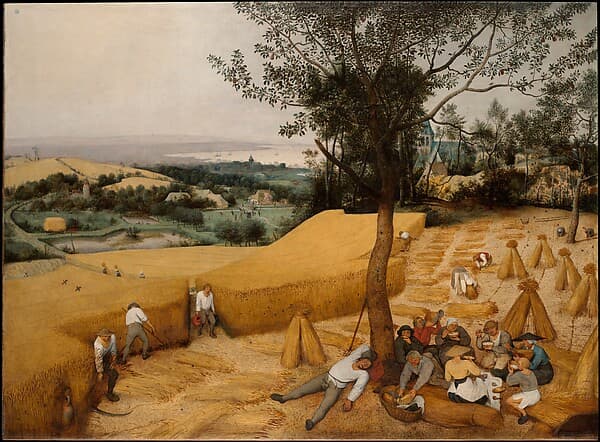
For Jongelinck he painted the cycle of the months in 1565. The subject came from the calendars of old books of hours, where each month had its miniature of seasonal labours, but here each panel measures roughly one metre by one and a half. Five survive: “The Gloomy Day”, “The Hunters in the Snow” and “The Return of the Herd” in Vienna, “Haymaking” in Prague, “The Harvesters” in the Metropolitan Museum of Art. Whether there were six or twelve is still debated; the inventory of Archduke Ernest already listed six in 1569. The winter landscapes of that year are sometimes cited as evidence of the harsh winters of the Little Ice Age. The most copied turned out to be “Winter Landscape with a Bird Trap” (1565): 127 replicas are known.
In his last years the figures grew larger and fewer. “The Parable of the Blind” (1568) directly illustrates the Gospel words about the blind leading the blind; beside it stand “The Peasant Wedding”, “The Peasant Dance”, “The Cripples”, “The Misanthrope” and “The Peasant and the Nest Robber”.
These were the years when the Duke of Alba's troops entered Brussels. In the man in black who watches the soldiers in “The Massacre of the Innocents” many see a portrait of Alba himself. Of “The Magpie on the Gallows” (1568) van Mander writes that Bruegel left it to his wife and that the magpie stood for gossips, whom he would gladly have sent to the gallows. Van Mander also relates that before his death the painter ordered some of his drawings to be burned, their inscriptions being too sharp or too mocking, so that his wife would not have to answer for them.
Bruegel died in Brussels on 9 September 1569 and was buried in the church of Notre-Dame de la Chapelle, the same church in which he had married six years before. His wife, who died in 1578, lies there too, and the memorial tablet with an epitaph was later put up by their son Jan.
Artist works
Works by the artist
Works by Pieter Bruegel the Elder available in this edition of NEOARCA.
Related context
Associations
Works connected through artistic movements, cultural context and period. Priced works available in this market appear first.
Profile notes
Profile and sources
Image
Artist image
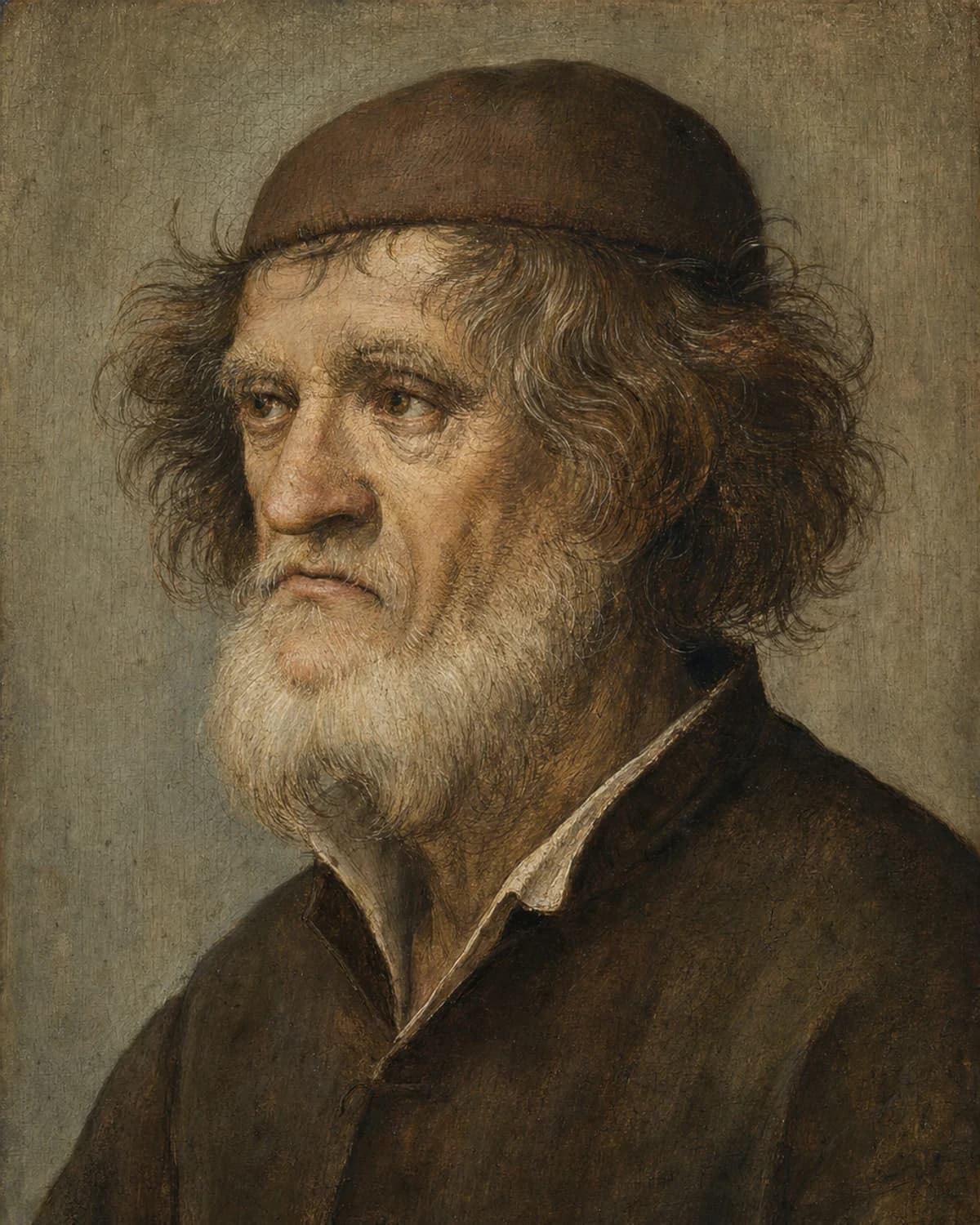
На основе открытого изображения: Pieter Brueghel the Elder; Wikimedia Commons; Public domain.
