
03.10.1867–23.01.1947
Pierre Bonnard
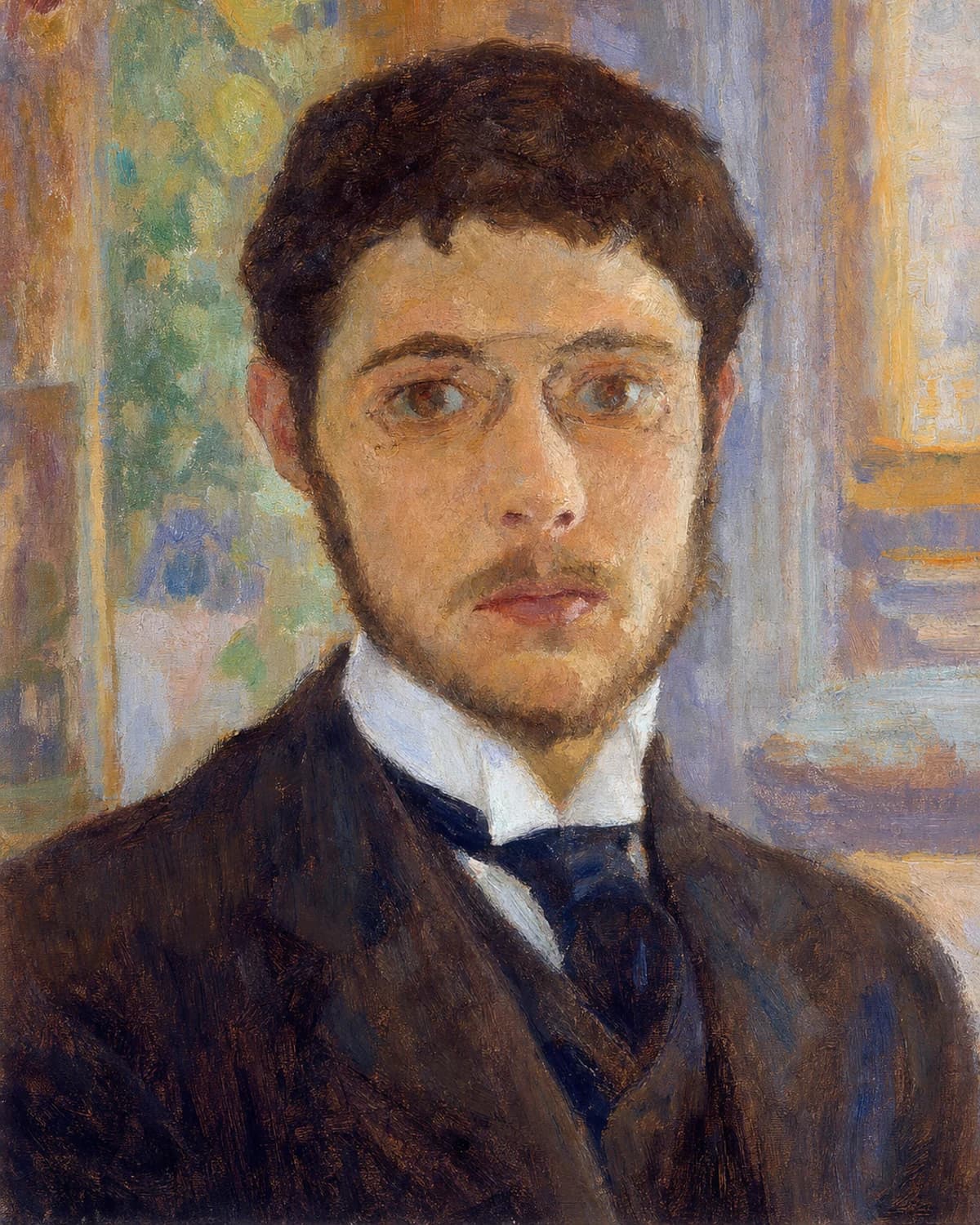
Pierre Bonnard (1867–1947) began as a lawyer and gave up the bar once his poster design for France-Champagne was sold. He belonged to the Nabis, was drawn to Japanese prints, and made 109 lithographs for Verlaine’s “Parallèlement”. His mature paintings were done from memory, from sketches and notes on colour, including in his house on the Riviera.
Biography
Bonnard’s first commercial work was a design for a poster for the firm France-Champagne. It was bought in 1888, when he already held a law degree but had failed the examination for entry to the register of lawyers. The sale helped convince his family that he could make a living as an artist.
Bonnard was born on 3 October 1867 in Fontenay-aux-Roses, near Paris. His father, Eugène Bonnard, was a senior official in the Ministry of War, and his mother came from Alsace. His sister Andrée married the composer Claude Terrasse in 1890, and Bonnard later drew illustrations for his music books. He studied at the Lycée Louis-le-Grand and the Lycée Charlemagne, drew, painted watercolours and made caricatures from childhood, and spent a great deal of time at his parents’ house at Le Grand-Lemps in the Dauphiné. To please his father he took his licence in law in 1886–1887, while attending the Académie Julian at the same time. There he made friends with Paul Sérusier, Maurice Denis, Gabriel Ibels and Paul Ranson. In 1888 he was admitted to the École des Beaux-Arts, where he met Édouard Vuillard and Ker-Xavier Roussel.
In the autumn of 1888 his friends from the Académie Julian formed the Nabis, an informal group with differing views and a shared wish to renew painting. Bonnard then knew almost nothing of the Impressionists or of Gauguin. Sérusier showed him a small picture painted on the lid of a cigar box, made after a visit to Gauguin at Pont-Aven, in flat patches of pure colour. In 1890 Denis put into words the idea that a painting is a flat surface covered with colours in a certain order. The mystical and philosophical leanings of many Nabis were foreign to Bonnard; Aurélien Lugné-Poe, who shared a studio on the rue Pigalle with him, called him the humorist of the group. In 1890–1891 he spent a year in military service, and in 1891 he met Toulouse-Lautrec, showed work at the Salon des Indépendants and began working for the journal La Revue Blanche.
Japanese prints meant more to him than to the others, and among the Nabis he was nicknamed the very Japanese Nabi. In 1890 Siegfried Bing staged an exhibition in Paris of seven hundred prints brought from Japan, and in 1893 the Durand-Ruel gallery showed Utamaro and Hiroshige. From Japanese kakemono, the long hanging scrolls, Bonnard took the vertical format: the series “Women in the Garden” (1890–1891, now in the Musée d’Orsay) was conceived as a single screen, but he showed it as four separate panels. The figures are reduced to flat silhouettes, there is no depth in the picture, the faces are turned away, and everything rests on the patterns of the dresses and the background. His sister and his cousin Berthe Schaedin posed for it. The checkered blouses he often painted he regarded as a find from Japanese prints.
From 1892 he made lithographs and designed furniture, fabrics and fans, and in 1895 a stained-glass window, “Maternity”, was made for Tiffany from his design. In the same year the Durand-Ruel gallery held his first solo exhibition of paintings, posters and lithographs, and La Revue Blanche serialised Peter Nansen’s novel “Marie” with his illustrations.
From 1893 he lived with Marthe de Méligny (her real name was Maria Boursin), who posed for many of his paintings, among them many nudes. They registered their marriage in 1925.
In 1900 his 109 lithographs for Verlaine’s “Parallèlement” appeared, and later came illustrations for a book by Octave Mirbeau (1908), for texts by Claude Anet (1923) and for André Gide (1924). In 1906 the Bernheim-Jeune gallery gave him a solo exhibition. From 1908 Bonnard stayed for long periods in the south, beginning at the house of the painter Manguin in Saint-Tropez, and in 1911 the Russian collector Ivan Morozov commissioned from him the decorative panels “Mediterranean”. In 1918 he and Renoir were chosen honorary presidents of the Association of Young French Artists, and in 1924 the Galerie Druet showed a retrospective of sixty-eight works. In 1925 he bought a house on the Riviera, at Le Cannet.
He did not paint from life. He drew the motif, sometimes photographed it, noted the colours, and made the picture in the studio. “I have all my subjects to hand,” he said. “I take notes. Then I go home. And before I start painting I reflect, I dream.” He kept several canvases going at once, tacked to the walls of his cramped studio, because a stretcher got in his way: he never knew the size in advance. That is why his interiors, bathrooms and tables with the remains of a meal are built so strongly on colour, and why Marthe in them so often almost dissolves into the patterns.
In 1939, because of the war, Bonnard left Paris for the south and stayed there until the war ended. During the occupation, it is said, he refused to paint an official portrait of Marshal Pétain, but accepted a commission for a picture of Saint Francis de Sales, to which he gave the face of the late Vuillard. The retrospective of 1946 was the last in his lifetime. He finished his last painting, “The Almond Tree in Blossom”, a week before his death. Bonnard died on 23 January 1947 in Le Cannet. In 1948 the Museum of Modern Art in New York opened a retrospective originally planned for his eightieth birthday.
Related context
Associations
Works connected through artistic movements, cultural context and period. Priced works available in this market appear first.








Profile notes
Profile and sources
Image
Artist image
На основе открытого изображения: Pierre Bonnard; Wikimedia Commons; Public domain.
