
25.02.1841–03.12.1919
Pierre-Auguste Renoir
Renoir started out as a teenager in a porcelain workshop, painting plates at three sous apiece, and in 1874 showed six pictures at the first Impressionist exhibition. The painter of “Bal du moulin de la Galette” and “Luncheon of the Boating Party” turned to severe drawing in the mid-1880s and spent his last years working in Cagnes-sur-Mer, when the brush had to be placed in his hand.
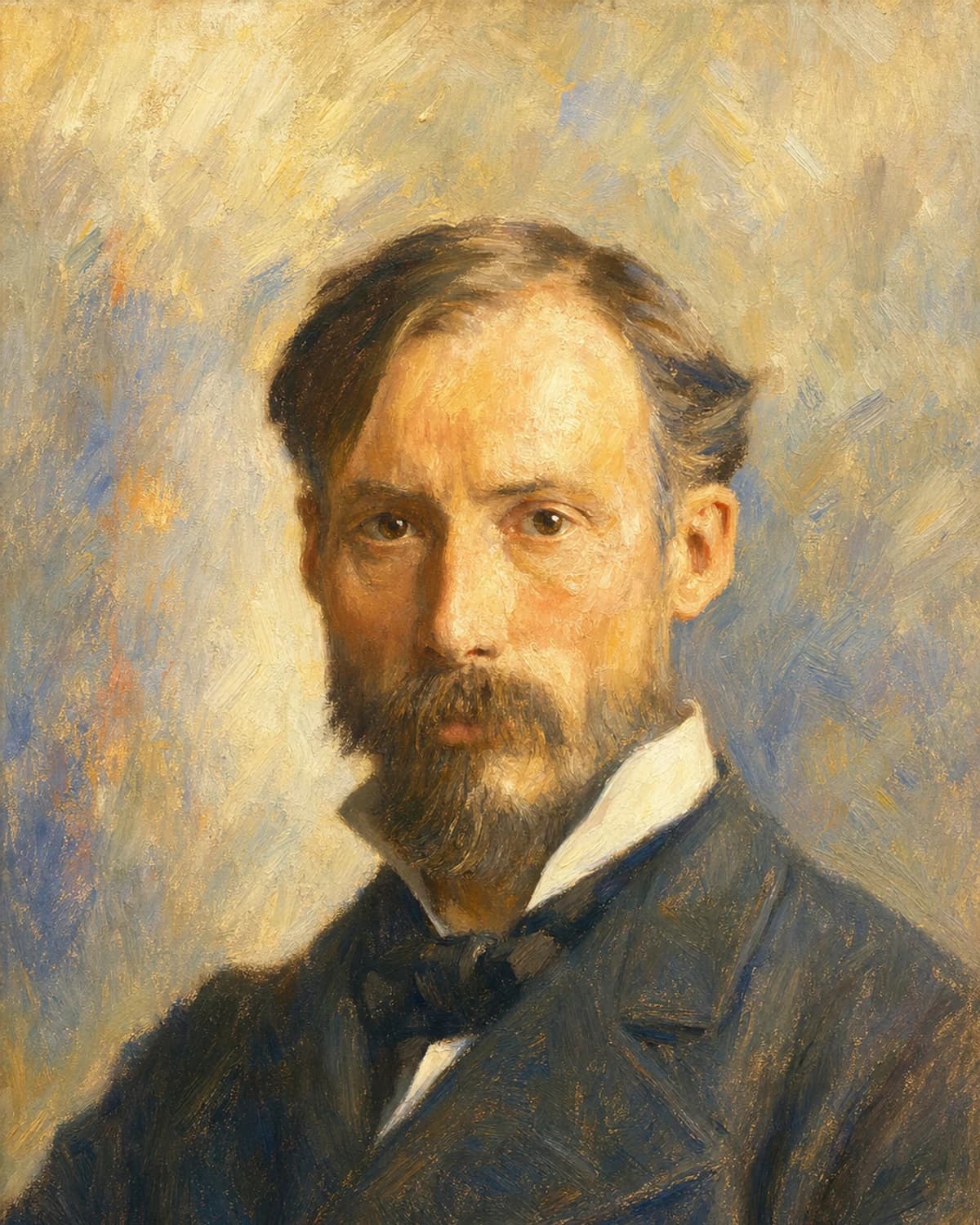
Biography
The thirteen-year-old apprentice in a Paris porcelain workshop was trusted with a best-selling line: dessert plates bearing the image of Queen Marie Antoinette, at three sous apiece. In the workshop they nicknamed him “Monsieur Rubens”. Renoir kept a few of the pieces he painted then for the rest of his life.
He was born on 25 February 1841 in Limoges, the sixth of seven children of the tailor Léonard Renoir and the seamstress Marguerite. In 1844 the family moved to Paris and settled not far from the Louvre. The boy turned out to have such a voice that the choirmaster of his church, the composer Charles Gounod, urged his parents to have him trained in music, but there was no money, and at thirteen he had to go out to work.
In 1858 the factory switched to mechanical printing, and hand painting was no longer needed. Renoir painted fans, hangings for missionaries overseas and the walls of cafés (about twenty of them, he later recalled), and saved money for his studies. His free time went on the Louvre, where at first he looked at ancient sculpture and then came to love Boucher, Watteau and Fragonard. In 1862 he entered the studio of Charles Gleyre and the École des Beaux-Arts. Alfred Sisley, Frédéric Bazille and Claude Monet studied there too, and soon Pissarro and Cézanne joined them. When Gleyre closed his studio in January 1864, Renoir never studied anywhere again. That same year he exhibited at the Salon for the first time, but recognition came only in 1868, with “Lise with a Parasol”. The Salon accepted his early “Esmeralda Dancing among the Vagabonds”, but when the canvas came back to him, Renoir destroyed it.
In 1869 he and Monet painted La Grenouillère side by side, and those sessions left pairs of pictures of one and the same view. There they became convinced that a shadow is never brown or black: it is coloured by the reflected colour of the objects around it.
He spent the war of 1870–1871 in a cuirassier regiment, where he learned to ride. During the Commune, while he was painting on the bank of the Seine, Communards took him for a spy and were about to throw him into the river. He was saved by Raoul Rigault, one of the leaders of the Commune, whom Renoir had once helped.
At the first exhibition of the future Impressionists, which opened on 15 April 1874, he had six paintings and a pastel, among them “La Loge”. The critics treated the exhibition badly, Renoir a little more gently. In 1876 a reviewer for Le Figaro advised that someone should explain to the artist that a woman's torso is not “a mass of decomposing flesh” with green and violet patches. At the third exhibition in 1877 “The Swing” and “Bal du moulin de la Galette” were shown, the latter an open-air dance in Montmartre, not far from where he lived.
Then he drew away from the group's exhibitions and went back to the Salon. The success of “Madame Georges Charpentier and Her Children” at the Salon of 1879 made him a fashionable portraitist. That same year he met Paul Bérard, who became his chief patron and invited him to paint at the Château de Wargemont in Normandy. In 1881 came “Luncheon of the Boating Party”, in which the woman on the left playing with a little dog is his future wife, the seamstress Aline Charigot.
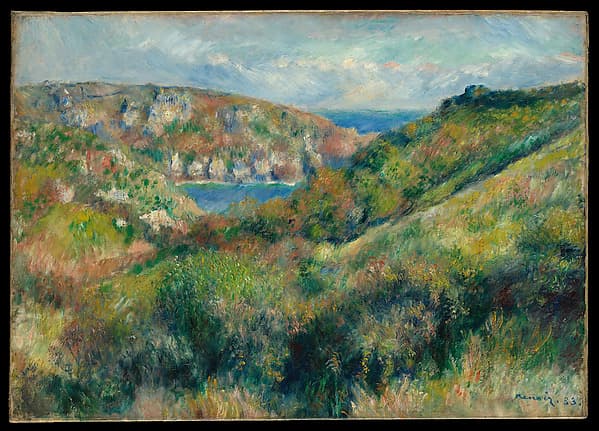
Here the turning point begins, and it seems to me that Renoir himself described it more honestly than any of his biographers. In 1881 he travelled to Algeria, then to Italy, looked at Titian in Florence and Raphael in Rome, and on 15 January 1882 in Palermo painted a portrait of Richard Wagner in thirty-five minutes. After Italy he admitted that he had gone as far as he could with Impressionism and realised he could neither paint nor draw. He spent the summer of 1883 on Guernsey and painted fifteen pictures there in little more than a month. Historians call the following years his “Ingres period”; he himself called them “sour”. The contour became hard, the colours colder. “The Large Bathers” (1884–1887, Philadelphia Museum of Art) was the first picture he built up from sketches and preparatory studies; the models were Aline and Suzanne Valadon, who later became a notable painter herself.
He and Aline Charigot were married in 1890, when their elder son Pierre was five; in 1894 Jean was born, the future film director, and in 1901 Claude, who became a ceramist. He painted the children, his wife and their nanny Gabrielle Renard constantly. In 1892 an exhibition at Durand-Ruel's was a success, and the state bought “Young Girls at the Piano” for the Musée du Luxembourg. His colours became transparent again, then moved towards pink and red. In 1901 he received the Legion of Honour, and in 1911 he was made an officer of the order.
From the early 1890s Renoir suffered from rheumatoid arthritis. In 1907–1908 the family moved to the Les Collettes estate in Cagnes-sur-Mer, on the warm Mediterranean coast (since 1960 it has been a Renoir museum). Little by little his fingers stopped obeying him. The common story that the brush was tied to his hand is wrong: it was placed between his fingers, and the bandages in late photographs protected his skin. For large works he used a movable canvas on a roller. He took up sculpture after Aristide Maillol modelled his bust in 1906 on a commission from Ambroise Vollard. Vollard found him an assistant, the young Richard Guino, who worked the clay under his direction; this is how, among other things, the “Venus Victrix”, 180 centimetres high, came about. At the beginning of 1918 the two quarrelled, and Renoir made his last works with Louis Morel.
In 1917, when “The Umbrellas” was hung in the National Gallery in London, hundreds of British artists and art lovers sent him a letter of congratulation. In August 1919 he came to Paris for the last time, to see his picture in the Louvre beside the old masters. That same year he was made a commander of the Legion of Honour.
On 2 December 1919 he spent several hours painting a still life of freshly cut anemones. Renoir died in Cagnes-sur-Mer in the night of 2 to 3 December and was buried in Essoyes, beside his wife.
Artist works
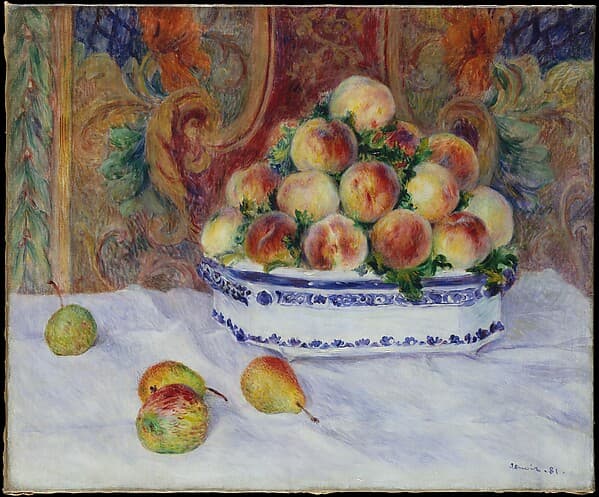
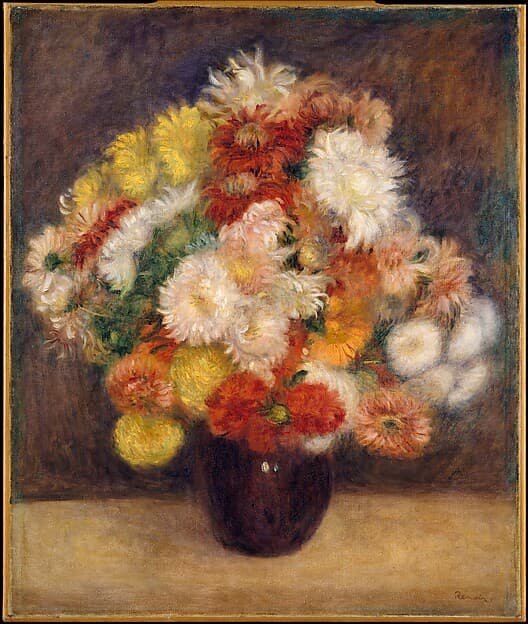
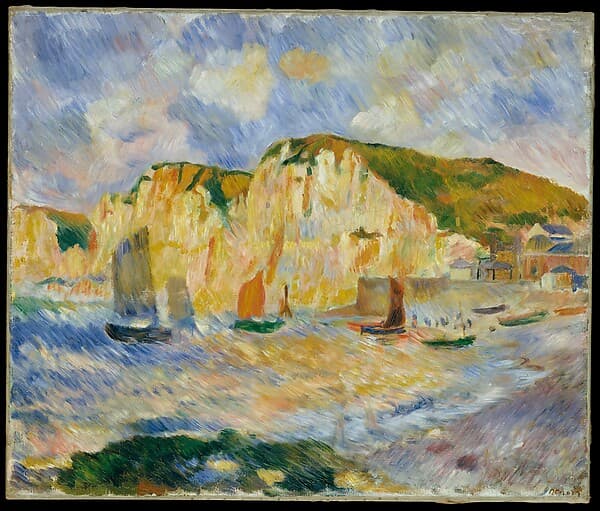
Works by the artist
Works by Pierre-Auguste Renoir available in this edition of NEOARCA.
Related context
Associations
Works connected through artistic movements, cultural context and period. Priced works available in this market appear first.







Profile notes
Profile and sources
Image
Artist image
На основе открытого изображения: Unknown Unknown Musée d'Orsay, Dist. RMN-Grand Palais / Patrice Schmidt; Wikimedia Commons; Public domain.
