
1415–12.10.1492
Piero della Francesca
From 1442 Piero della Francesca sat on the town council of his native Borgo Sansepolcro, while he painted in Arezzo, Ferrara, Rimini, Rome and Urbino. His works include the frescoes of “The History of the True Cross” in Arezzo, “The Flagellation of Christ” and the double portrait of the Duke and Duchess of Urbino. He also wrote three mathematical treatises, among them a book on perspective for painters.
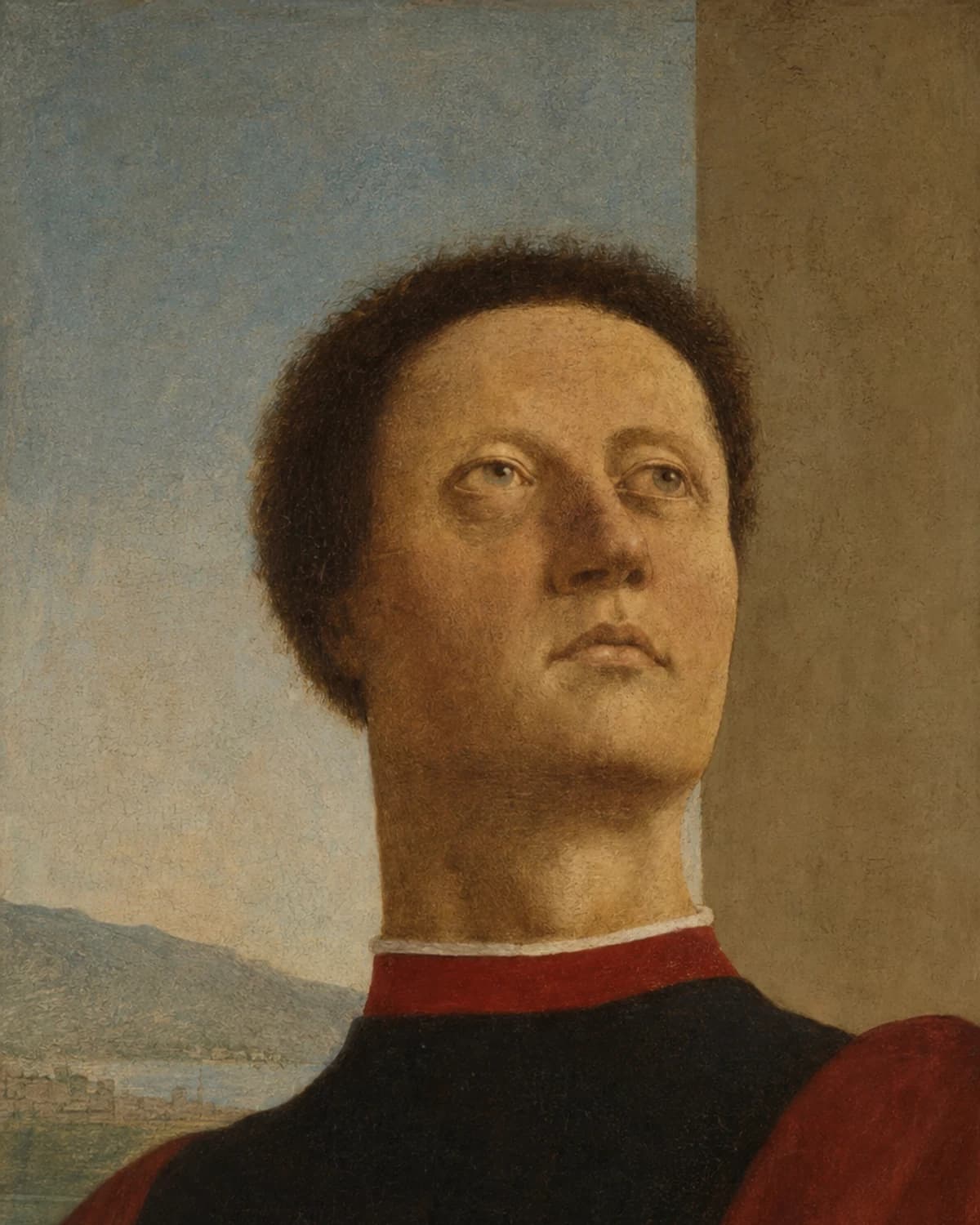
Biography
On 11 January 1445 the Confraternity of the Misericordia in Borgo Sansepolcro commissioned an altarpiece for its church from Piero di Benedetto. Under the contract he was to finish within three years, paint everything with his own hand, and look after the work’s condition for another ten years. In 1462 the confraternity was still paying for the polyptych, and the money was collected on Piero’s behalf by his brother Marco. Fifteen panels planned for three years took more than fifteen.
The year of Piero’s own birth is unknown. The birth records burned in a fire at the town archive, and guesses range from 1406 to 1420; “about 1415” is the date most often given.
His father, Benedetto de’ Franceschi, dealt in cloth; his mother, Romana di Perino, came from nearby Monterchi. Vasari said that the father died before the son was born and that the boy was therefore named after his mother, who was known as “la Francesca”. The documents say otherwise: in January 1438 Benedetto appears as the legal representative of his son, a painter, in a matter concerning the decoration of a chapel in the local abbey, and he died only on 20 February 1464. In the 1430s Piero worked alongside a local painter, Antonio d’Anghiari. Whether Antonio was his teacher is hard to say: not a single work can be securely attributed to him. On 7 September 1439 Piero’s name appears among the assistants of Domenico Veneziano, who was painting the choir of the church of Sant’Egidio in Florence. Those frescoes are lost. The heavy figures of Masaccio, which he saw in Florence, and Domenico’s light palette stayed in his painting to the end.
In 1442 he was living at home again and sat on the town council. Afterwards he went away for long periods, but he came back. In 1449 he worked in Ferrara, in the Castello Estense and the church of Sant’Andrea; there, perhaps, he first saw Flemish painting, to which his early use of oil technique is attributed. Nothing survives of the Ferrara murals. In 1451 in Rimini, in the church that Leon Battista Alberti was rebuilding, he painted on the wall Sigismondo Pandolfo Malatesta praying before Saint Sigismund, as well as a portrait of the same condottiere (now in the Louvre).
In 1452 Bicci di Lorenzo, who had begun painting the main chapel of the church of San Francesco in Arezzo, died, and the commission passed to Piero. The subject comes from medieval legends collected in the “Golden Legend” of Jacobus de Voragine. The first phase of the work lasted until 1458. Then came the journey to Rome, and after it the second phase, with the boldest scenes in their handling of light, among them the nocturnal “Dream of Constantine”. At the end of 1466 the Confraternity of the Annunziata in Arezzo commissioned a banner from him and in the contract cited the success of the frescoes in San Francesco, so by then the cycle, it seems, was finished. In the twentieth century de Chirico, Casorati and Balthus looked back to this geometry and this light, and Bohuslav Martinů wrote the orchestral “Les Fresques de Piero della Francesca”.
In 1458–1459 Piero worked in Rome for Pope Pius II, leaving his brother Marco as his agent in Borgo. The papal treasury paid him for murals in the pontiff’s apartments, but in the sixteenth century they were destroyed to clear the walls for the first of Raphael’s Stanze.
Piero’s dates are shaky in general: there are few documents, and his manner hardly changes over the years. To the end of the 1450s are usually assigned the “Resurrection” in the town hall of Sansepolcro, “The Flagellation of Christ” and the “Madonna del Parto” from the cemetery chapel at Monterchi, his mother’s home town. “The Baptism of Christ”, painted for a priory in Sansepolcro and now in the National Gallery in London, is dated by some to about 1439 because of the Byzantine dignitaries in the background, which recall the Council of Florence, while others move it to 1460. I prefer caution: both dates rest on guesswork.
Piero visited the court of Federico da Montefeltro in Urbino more than once, and in 1469–1472 he certainly lived there. The Duke shared his interest in perspective; at court Piero met Melozzo da Forlì, Justus van Gent and the mathematician Luca Pacioli. For Federico he painted the double portrait: the Duke and his wife Battista Sforza in profile, as on medals, against a distant landscape, and on the reverse the two ride in triumph on allegorical chariots. The portrait of Battista is posthumous, as she died in 1472; the diptych is now in the Uffizi. Urbino holds “The Flagellation of Christ”, where the identity of the three men in the foreground is still argued over, and the “Madonna di Senigallia”. The Montefeltro Altarpiece, now in the Pinacoteca di Brera in Milan, was painted in 1472–1474: the Madonna and Child, six saints, four angels and the patron, Federico, set against architecture resembling Alberti’s church of Sant’Andrea in Mantua.
The early “Abacus Treatise” served as a practical handbook for merchants. The treatise “On Perspective in Painting” was written in the 1470s and 1480s, and the little book “On the Five Regular Solids” was finished in 1485 and dedicated to Guidobaldo da Montefeltro. In the late 1450s he himself copied out seven works of Archimedes in the translation by Iacopo da San Cassiano and supplied them with diagrams; the manuscript, of 82 leaves, is in the Biblioteca Riccardiana in Florence. Pacioli, a Franciscan from the same town, reworked the treatise on the regular solids in his own book “De divina proportione” (1509), illustrated by Leonardo. Vasari later accused him of appropriating Piero’s books.
In his last years he lived mostly in Borgo: from 1477 to 1480 he again sat on the council, in 1480–1482 he headed the Confraternity of San Bartolomeo, and in 1482 he rented a house in Rimini. Perugino and Luca Signorelli came to his workshop. On 5 July 1487 Piero made his will, declaring himself sound “in spirit, mind and body”. Vasari wrote that in old age an eye disease kept him from working.
He died on 12 October 1492 in his own house in Sansepolcro, leaving his possessions to his family and to the Church. He was buried in the abbey of Sansepolcro.
Related context
Associations
Works connected through artistic movements, cultural context and period. Priced works available in this market appear first.
Profile notes
Profile and sources
Image
Artist image
На основе открытого изображения: see filename or category; Wikimedia Commons; Public domain.
