
28.06.1577–30.05.1640
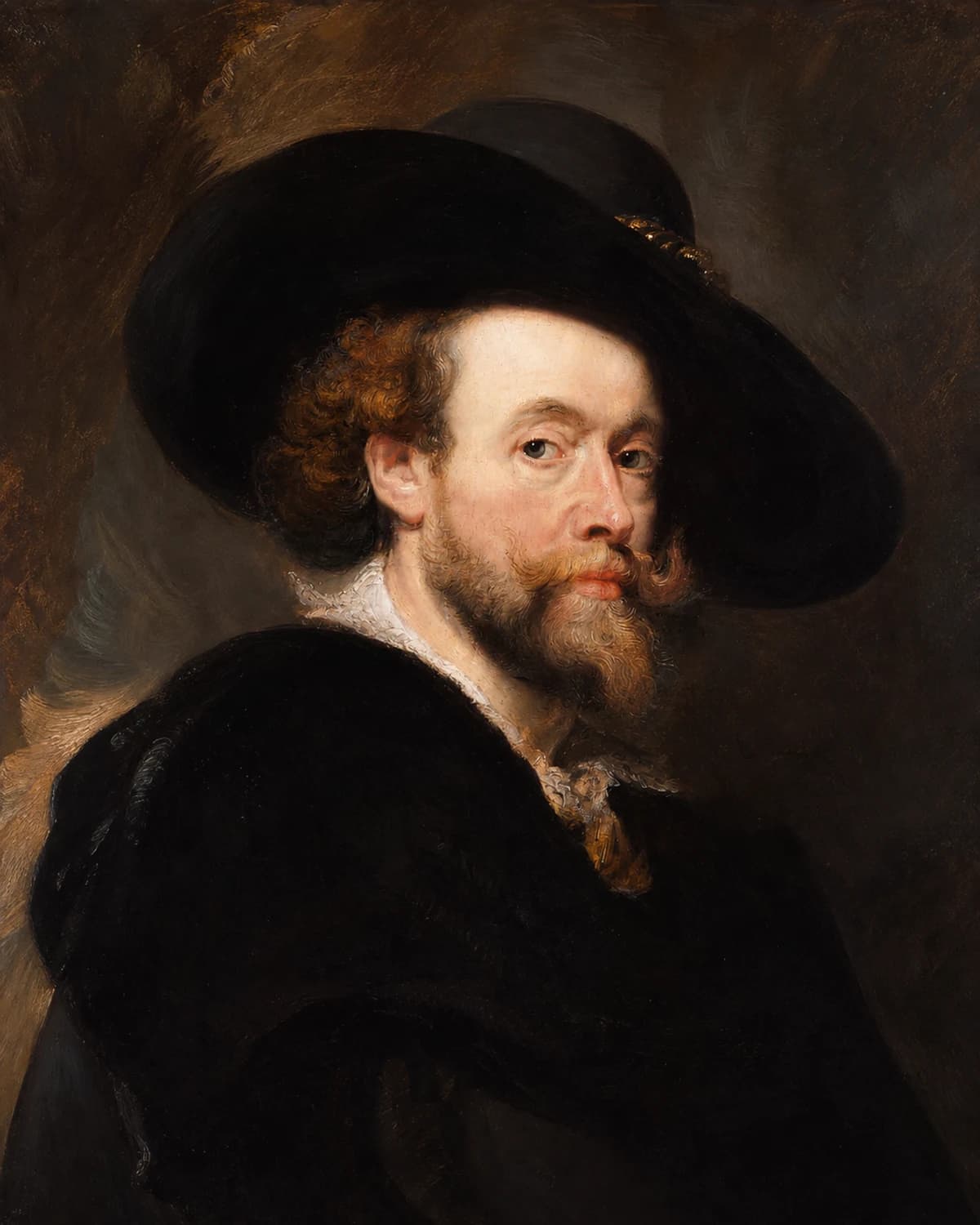
Peter Paul Rubens
Peter Paul Rubens (1577–1640) spent eight years in Italy and then for three decades ran a huge workshop in Antwerp, through which the young Anthony van Dyck also passed. He painted altarpieces, mythologies, portraits and landscapes, and designed cartoons for tapestries. As a diplomat he negotiated between Madrid and London and was ennobled by the kings of Spain and England.
Biography
On 8 May 1600 the burgomaster of Antwerp signed a paper stating that the bearer was in good health and that there was no epidemic in the city. With this document Peter Paul Rubens set off for Italy together with his first pupil, Deodat del Monte. Where the money for the journey came from is not known.
He was almost twenty-three, and he had been registered as an independent master for two years.
His family was from Antwerp, but he was born in exile. His father, the lawyer Jan Rubens, had been an alderman of the city from 1562 to 1568, sympathised with the Calvinists and, during the Duke of Alba’s repression, fled to Cologne with his wife, Maria Pypelincks, and their children. There he became legal adviser to Anna of Saxony, wife of William of Orange, and after being accused of an affair with her spent two years imprisoned at Dillenburg and was then exiled to Siegen. It was in Siegen, on 28 June 1577, that Peter Paul was born. Later the family returned to Cologne and became Catholic again. His father taught the boys Latin and Scripture himself; after his death in 1587 the mother went back to Antwerp with the children.
At Rombout Verdonck’s Latin school Peter read the classics and made friends with Balthasar Moretus, grandson of the publisher Christophe Plantin; the friendship lasted all his life. Around 1590, when his sister Blandina’s dowry had swallowed what remained of the family money, he was placed as a page with the Countess de Lalaing at Oudenaarde. A courtier’s career would have suited him well, but since childhood he had been copying prints after Holbein and Tobias Stimmer, and he insisted on painting. His first teacher was the landscape painter Tobias Verhaecht, who was married to a relative of his mother, but after only a year Rubens left him because he wanted to paint history rather than landscape. He spent about four years with Adam van Noort, then moved to Otto van Veen, who had been to Italy and was court painter to the rulers of the Spanish Netherlands. Van Veen instilled in him the ideal of the learned painter, for whom craft is not enough without theory, antiquity and the Italian masters. In 1598 Rubens joined the Guild of St Luke but stayed on for a while as his teacher’s assistant.
In Venice he saw Titian, Veronese and Tintoretto, and soon found himself in the service of Vincenzo Gonzaga, Duke of Mantua: he painted portraits of the duke’s family and copied pictures from the ducal collection. In Rome he studied the “Laocoön”, Michelangelo, Raphael and Caravaggio, and carried out his first altarpiece commission, “St Helena with the True Cross”, for the church of Santa Croce in Gerusalemme. In 1603 Gonzaga sent him to Spain with gifts for Philip III; there he painted an equestrian portrait of the Duke of Lerma. Then came Genoa, with portraits of the nobility and drawings of the new palaces, published in 1622 as Palazzi di Genova, and Rome again, where he lived with his brother Philip. For the high altar of the Chiesa Nuova he painted two versions: the first canvas is now in Grenoble, the second is painted on three slate panels. Even later he signed his letters in the Italian manner, “Pietro Paolo”, though his mother tongue remained the Brabant dialect.
In 1608 news came that his mother was ill, but he did not find her alive. In September 1609 Archduke Albert and the Infanta Isabella appointed him court painter and allowed him to keep his studio in Antwerp, and on 3 October he married Isabella Brant. In 1610 Rubens moved into a house he had designed himself. The altarpieces “The Raising of the Cross” (1610) and “The Descent from the Cross” (1611–1614) for Antwerp Cathedral quickly made him the leading painter in Flanders. The workshop worked for the whole of Europe. Some pictures he painted himself, in others he took on the hands and faces, and still others his assistants produced from his sketches. The eagle in “Prometheus Bound” was painted by Frans Snyders, and a frequent collaborator was Rubens’s friend, the flower painter Jan Brueghel the Elder. In all, some three thousand paintings are credited to Rubens, many of them painted together with pupils; Michael Jaffé’s catalogue accepts 1,403 works, not counting workshop copies. I would not look for anything underhand in this: it was simply how things were done at the time.
In 1621 Marie de’ Medici commissioned two cycles from him for the Luxembourg Palace. Her own story was installed in 1625 and is now in the Louvre; the cycle on Henry IV was never finished.
Then diplomacy began. In 1624 Philip IV raised him to the nobility. In 1626 Isabella Brant died, and for several years Rubens almost withdrew from painting. From 1627 to 1630 he travelled between Madrid and London in pursuit of peace. During eight months in Madrid in 1628–1629 he copied Titian afresh and became friends with Velázquez. In London he painted the “Allegory of Peace and War” and presented it to Charles I, and in 1630 the king knighted him. Some at court held that a courtier ought not to work with his hands.
In that same year, 1630, the fifty-three-year-old widower married the sixteen-year-old Helena Fourment. Her features can be seen in “The Feast of Venus”, “The Three Graces”, “The Judgement of Paris” and the intimate portrait “Het Pelsken” (“The Little Fur”). In 1635 he designed the decorations for the entry of the Cardinal-Infante Ferdinand into Antwerp and bought the estate of Het Steen at Elewijt, which brought him the title of seigneur. To these years belong the landscapes “A View of Het Steen in the Early Morning” and “Farmers Returning from the Fields”, while in his scenes of peasant festivities one senses Pieter Bruegel the Elder.
Rubens died in Antwerp on 30 May 1640 and was buried in St James’ Church. Above the altar of the family chapel hangs his own painting, the “Virgin and Child with Saints”, and in the floor slab is carved a Latin epitaph written by his friend Gaspar Gevartius, in which Rubens is compared to Apelles.
Artist works
Works by the artist
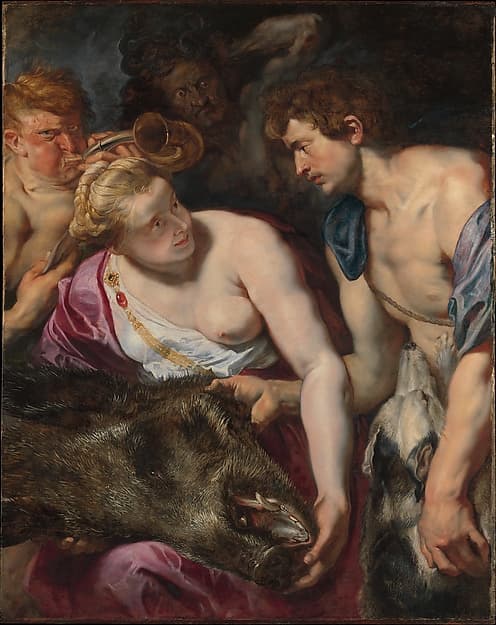
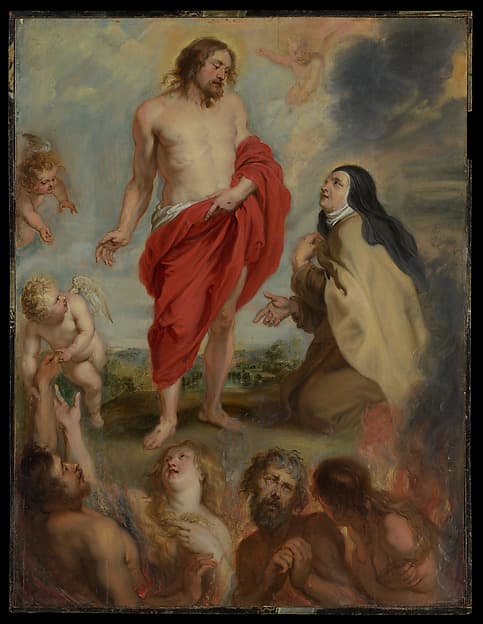
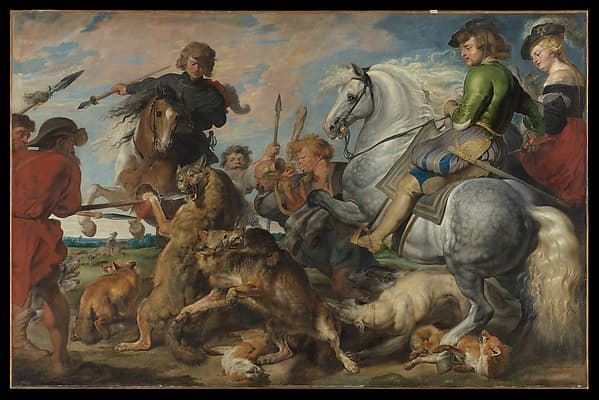
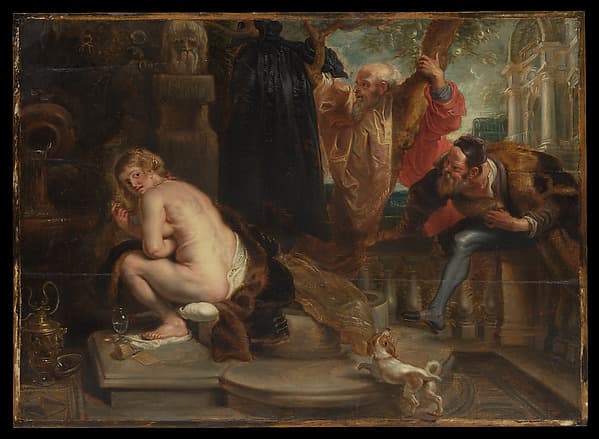
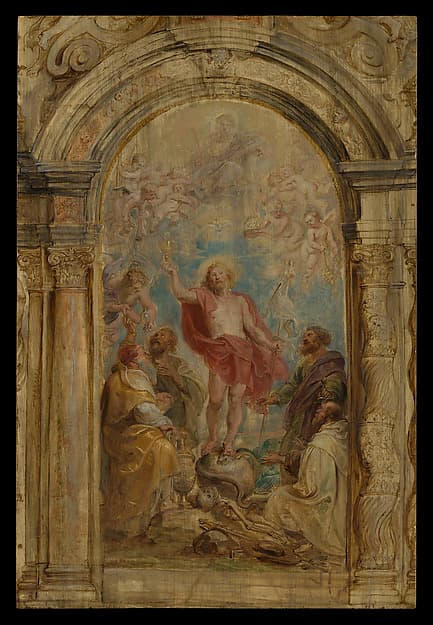
Works by Peter Paul Rubens available in this edition of NEOARCA.
Related context
Associations
Works connected through artistic movements, cultural context and period. Priced works available in this market appear first.
Profile notes
Profile and sources
Image
Artist image
На основе открытого изображения: Peter Paul Rubens; Wikimedia Commons; Public domain.
