
17.05.1845–20.04.1912
Pedro Lira
Pedro Lira (1845–1912), a lawyer by training, studied painting in Santiago and Paris; after his return in 1884 he organised the first exhibition devoted solely to Chilean artists and founded the “Unión Artística” with José Miguel Blanco. His “Foundation of Santiago” won a medal at the 1889 World’s Fair and appeared on banknotes. He wrote Chile’s first biographical dictionary of painters.
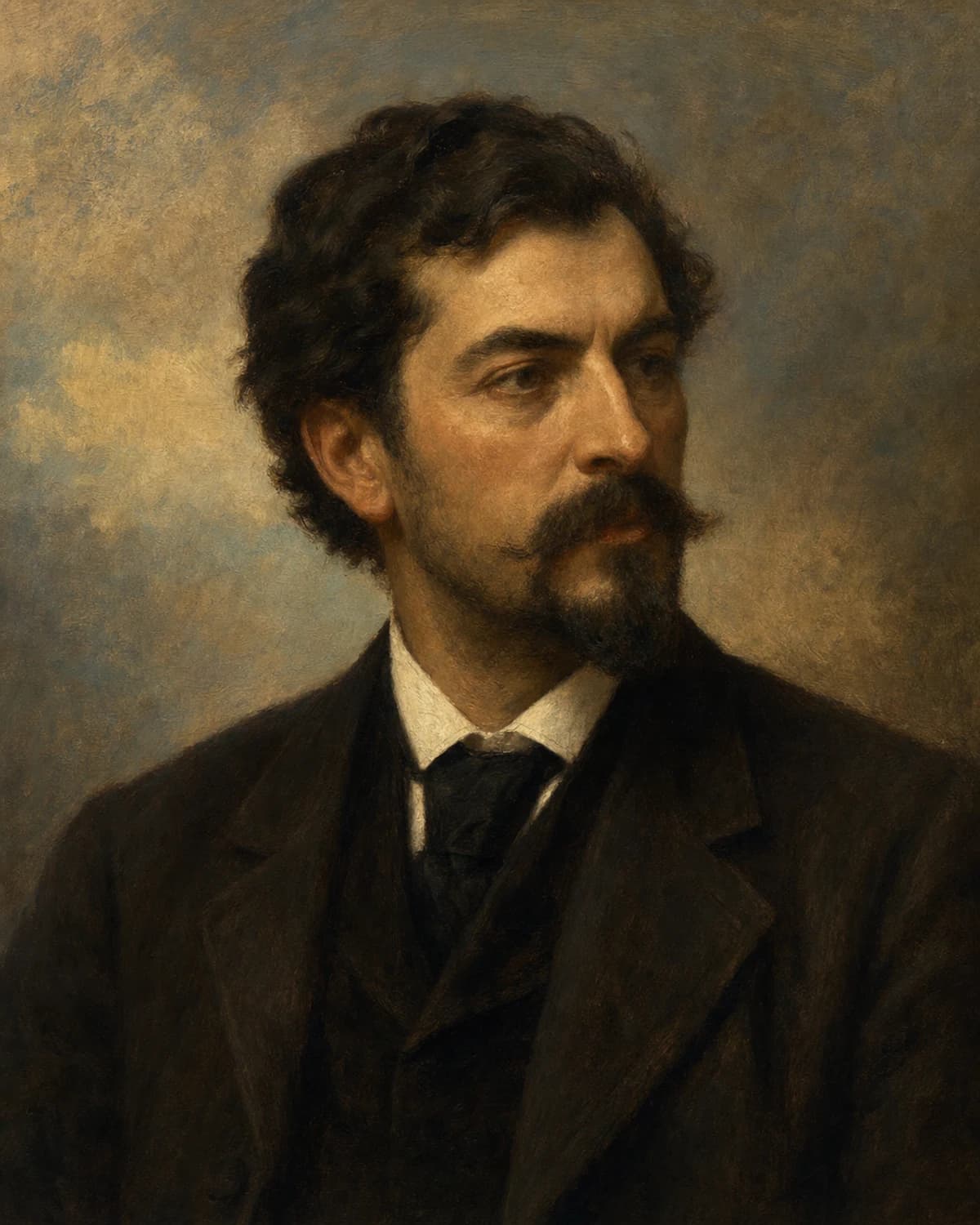
Biography
In 1887 Pedro Lira himself wrote to the Minister of Public Works and asked to be given the decoration of the reading room in the new building of the library of the Instituto Nacional in Santiago. The librarian, Gabriel René Moreno, commissioned six paintings on historical subjects: four small portraits and two large compositions, “The Discovery of America” and “The Foundation of Santiago”. The second won a second medal, in silver, at the Exposition Universelle in Paris in 1889 and is now in the National Historical Museum.
Lira was in his forties, and in Chile he was already known as the man who organised exhibitions.
He was born on 17 May 1845 in Santiago into a well-to-do family: his father, José Santos Lira Calvo, was a politician and a judge of the Court of Appeals, and his mother was Martina Rencoret Cienfuegos. He studied at the Instituto Nacional, then entered the Academy of Painting, directed by the Italian Alejandro Ciccarelli, a Neoclassicist who trained his pupils in historical composition and work from the living model. Around 1862 Lira joined the studio of the landscape painter Antonio Smith while studying law at the University of Chile at the same time. He took his degree in 1867 but never became a practising lawyer. His first public success came at the 1872 exhibition held to mark the opening of the Mercado Central in Santiago and organised by Benjamín Vicuña Mackenna: Lira won a third medal, and in twenty-five days about twenty-five thousand people visited the show. This helped him obtain a grant to study in Europe. In 1873 he left for Paris with his wife, Elena Orrego Luco, and her brother, the painter Alberto Orrego Luco.
Paris in those years was divided between Romantics and Neoclassicists. Lira joined neither camp and in the end chose Jules-Élie Delaunay as his teacher. He lived in France until 1884, mastered oil, etching, drawing and mural painting, admired Delacroix and copied his paintings, among them “The Entry of the Crusaders into Constantinople”. In 1882 he received an honourable mention at the Paris Salon, an award that rarely went to Latin Americans. And yet he went home: he believed that an artistic milieu as good as that of Paris could be created in Santiago.
As early as 1884 he organised the first exhibition showing only Chilean artists, and together with the sculptor José Miguel Blanco he founded the “Unión Artística”, which pressed for more exhibitions and for the creation of a Museum of Fine Arts; at first the museum was housed on the second floor of the National Congress building. On the Paris model Lira set up a salon in Santiago and helped to open an exhibition museum in the Quinta Normal park, where exhibitions were held until 1910. In 1891, during the civil war, he organised an independent salon in defiance of the official competitions, and in 1906 he founded the Salón Libre de Pintura. He compiled the country’s first “Biographical Dictionary of Painters” (1902) and translated Hippolyte Taine’s “Philosophy of Art”.
His hand is hard to reduce to a single tendency. The art historian Antonio Romera, who counted Lira among the four leading masters of Chilean painting, identified four manners in his work: medieval Romanticism, naturalist Romanticism, Realism and open-air painting of colour. They did not follow one another in turn but alternated throughout his life; naturalism is seen in “The Sick Child”, open-air painting in the landscapes of the Quinta Normal and in the picture “In the Garden”. His paintings are usually large and carefully finished. Most of all he painted portraits, above all of women: “The Love Letter”, “On the Balcony”, “Woman with Pins”, “Gypsy Woman”. Only one nude by him is known. It seems to me that this restraint says as much about him as his medals.
In the early 1890s he was appointed director of the Academy of Painting where he had once studied; whether he actually carried out these duties is unclear, but he did teach the senior painting class. His pupils included Pablo Burchard, Pedro Reszka and José Agustín Araya, as well as Celia Castro, the first Chilean woman painter to gain recognition; with her he travelled to Europe in 1889. According to the historian Ricardo Bindis, Lira brought excerpts and clippings to his classes, from the “Divine Comedy” to Balzac. Some of his students called him “Dictator Lira” for his disparaging remarks about contemporaries. He rejected Impressionism, yet he also influenced painters who went further than he did, Juan Francisco González and Alberto Valenzuela Llanos.
Pedro Lira died in Santiago on 20 April 1912. “The Foundation of Santiago” was printed on the front of the thousand-peso note in 1933–1947, on the one-escudo note in 1960, and from 1977 on the five-hundred-peso note, until in 2000 the note was replaced by a coin.
Related context
Associations
Works connected through artistic movements, cultural context and period. Priced works available in this market appear first.








Profile notes
Profile and sources
Image
Artist image
На основе открытого изображения: Pedro Lira Rencoret; Wikimedia Commons; Public domain.
