
11.01.1936–05.03.2026
Pedro Friedeberg
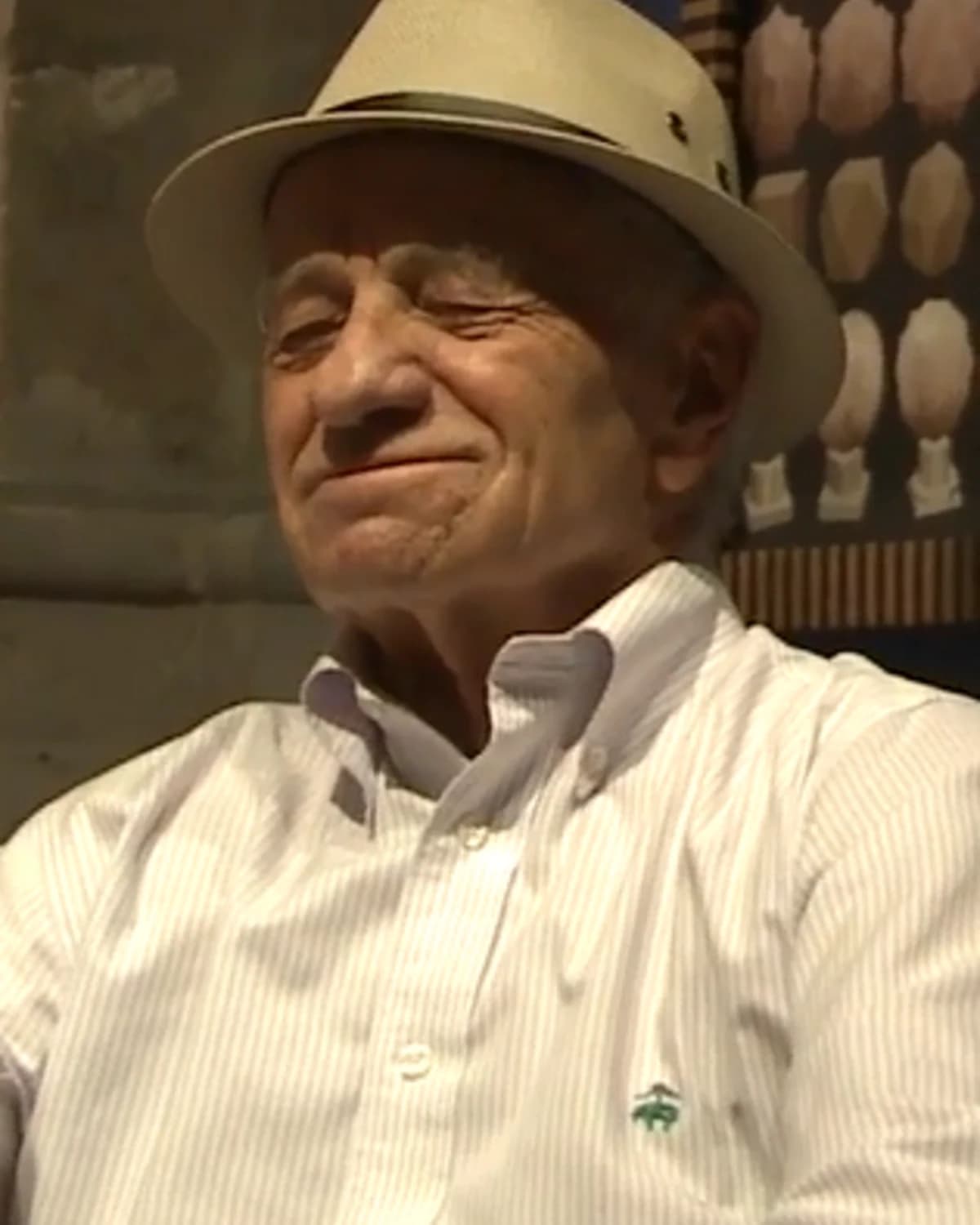
Pedro Friedeberg, born in Florence and raised in Mexico, invented the “Hand-Chair”: the sitter was meant to sit on a gilded wooden palm, with the fingers serving as back and armrests. He left architecture school in his third year, but went on drawing palaces with no way out and houses with artichoke roofs. He belonged to the Mexican surrealist group Los Hartos and painted one canvas a week.
Biography
From the Universidad Iberoamericana in Mexico City he took away mostly failing grades. His professors admired the strict symmetry of Mies van der Rohe, while the student Friedeberg drew circular plans in the manner of Gaudí, houses with artichoke roofs and skyscrapers topped with pears. His work was marked low.
He was born on 11 January 1936 in Florence, to a German-Jewish family. His parents fled Europe at the start of the Second World War, and he arrived in Mexico at the age of three. He hardly ever spoke about his childhood afterwards: he called it “German” and described it with the words “discipline”, “torture” and “punishment”. He was made to learn languages and the violin, and he did not want to be at home. The family was atheist, but once a servant took the boy to a church in secret to have him baptised. From this, by his own joke, came his seven religions, one for each day of the week.
He began to draw early. His mother said that at the age of two he used to sit in front of the church of Santa Maria Novella in Florence and try to copy it. Later he was taken by Renaissance churches, the Leaning Tower of Pisa, the sheets by Canaletto and Piranesi in his father’s albums, and the perspectives of Maurits Cornelis Escher.
After a short period of study in Boston, in 1957 he entered the architecture programme at the Universidad Iberoamericana, partly of his own wish and partly under pressure from his parents. He got as far as the third year. There he met Mathias Goeritz, who appreciated his designs and advised him to pursue art and ignore his parents. In the summers Friedeberg worked as Goeritz’s secretary and helped with his projects.
Through family and friends he came to know the Mexican surrealists. Remedios Varo recommended his work to the Galería Diana, where his first exhibition was held. The sources give the date differently: some say 1959, others 1960, and his age is given as either 22 or 24. In 1961 he joined the group Los Hartos (“The Fed-Up”), whose members also included Leonora Carrington and Alice Rahon. The group drew on Dadaist ideas and rejected the political and social painting that dominated Mexico at the time. Later, with Javier Girón, he organised the “movement” Chinchismo, from the Mexican Spanish word chinche, “bug”: thirty artists were asked to invent words for bugs, the poet Pita Amor was proclaimed their muse, and the whole undertaking mocked the “-isms” of art.
From the 1960s he designed furniture, rejecting the international style then dominant in architecture. His best-known piece appeared in 1962: the chair in the shape of a hand. The first one was made of wood and covered in gold leaf. By his own account, more than five thousand have been sold. He also made tables, sofas and armchairs from fantastic sketches, painted murals for institutions in Mexico and abroad, illustrated books and designed covers. With Sergio Villegas he was art director of the project “Arbol de la Vida” (Tree of Life). He painted with unusual regularity: by his own account, one canvas a week, fifty-two weeks a year, for fifty years.
He had dozens of exhibitions. In the 1960s there were sixteen, in Mexico, France, New York and Portugal, and in 1963 at the Pan American Union in Washington. Among the thirteen solo shows of the 1980s was one at the Museo de Arte Moderno in Mexico City. There were also shows in Barcelona, Haifa, Canada and Colombia, in Germany in 2000 and in Belgium in 2003. His awards: second prize at the Córdoba Biennale in Argentina in 1966, first prize at the Solar Exhibition in Mexico City in 1967, a special award at the 11th Tokyo Biennale of Graphic Works in 1984, and the title “Artistic Creator” from the National System of Mexican and Foreign Creators in 1993. His work is in the collections of the Museum of Modern Art in New York, the Louvre, the Israel Museum in Jerusalem, the Library of Congress and the Smithsonian Institution.
He called his own art eclectic and hybrid. His paintings and furniture are covered in ornament with almost no empty space: Aztec codices, Catholic and Hindu symbolism and occult signs can be recognised in it. Critics reproached him with ornament for its own sake. He replied that ornament is the oldest form of fine art and gives an object an almost religious quality, and he jokingly called his style “Nintendo Churrigueresque”. Art, he said, is not political and not for the people. His only aim, in his words, was to make fun of himself and everyone else. He liked to repeat that after surrealism there was nothing new.
He published his memoirs in Mexico under the title “De vacaciones por la vida, Memorias no autorizadas”, that is, “On Vacation for Life: Unauthorized Memories”.
He died on 5 March 2026 in San Miguel de Allende, in the state of Guanajuato, at the age of ninety. He hoped to be buried in the San Michele cemetery in Venice, where Stravinsky and Diaghilev lie, in a tomb with a white gondola and black feathers.
Profile notes
Profile and sources
Image
Artist image
NotimexTV; Wikimedia Commons; CC BY 3.0.
