
29.06.1861–24.07.1938
Pedro Figari
Pedro Figari (1861–1938), a lawyer, deputy and journalist from Montevideo, won the abolition of the death penalty in Uruguay, reformed the School of Arts and Crafts and only at nearly sixty, having moved to Buenos Aires, began to paint in earnest. His cardboards painted from memory, candombe, pericón, gauchos, colonial patios, funerals, made him within a few years in Buenos Aires and Paris the leading painter of the Río de la Plata of his generation.
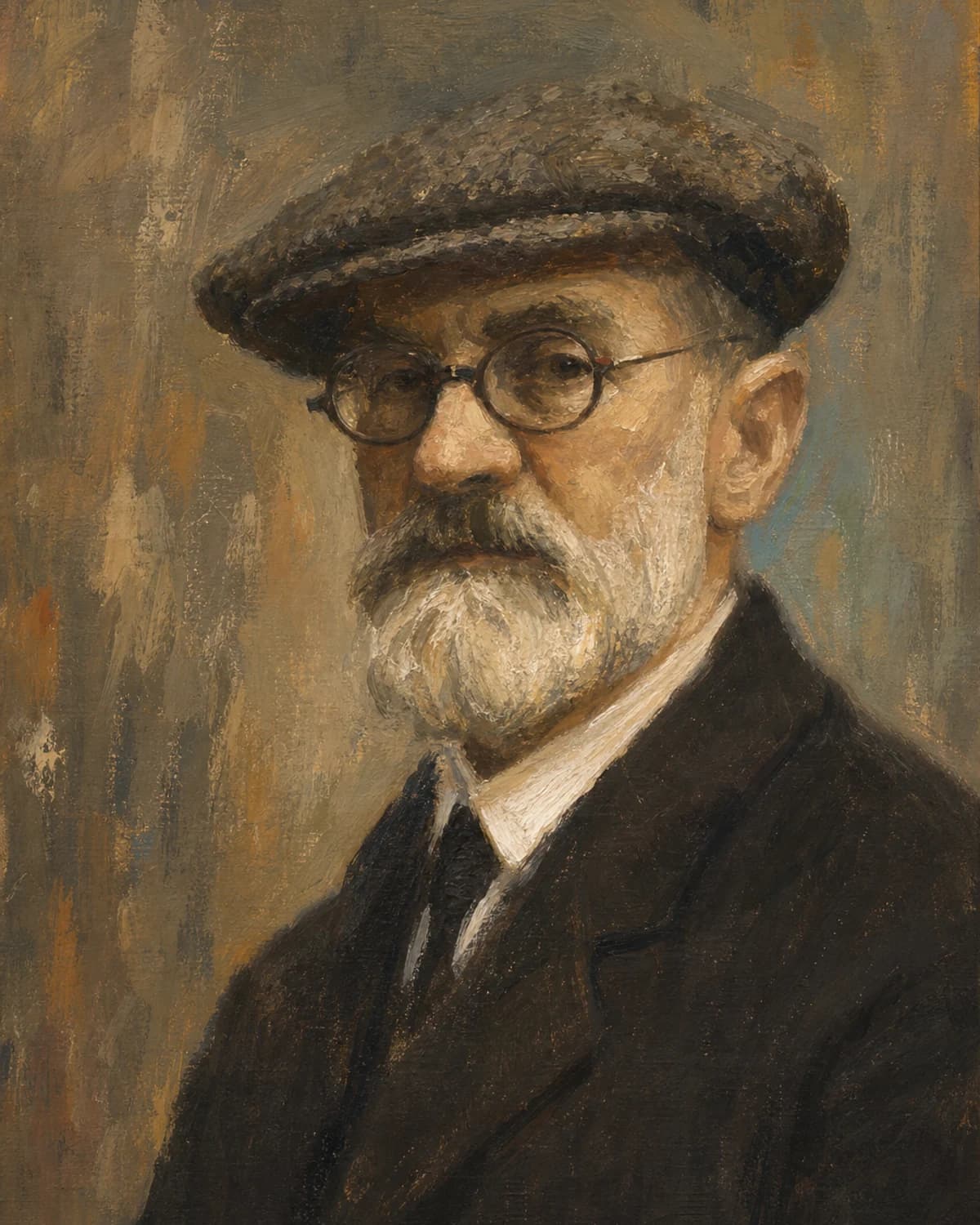
Biography
In 1895 the lawyer Figari took on the defence of Ensign Enrique Almeida, accused of a murder at the corner of Chaná and Arenal Grande streets in Montevideo. The case took four years, the newspapers stubbornly demanded a conviction, and in 1896 he published a book, “A Celebrated Case: The Crime of Chaná Street”, in which he examined who profited from that stubbornness; Almeida was acquitted, and in 1899 a second book appeared, this time on judicial error as such.
There is no painting in this biography yet.
Pedro Figari Solari was born on 29 June 1861 in Montevideo, into the family of the Italian immigrants Juan Figari de Lázaro and Paula Solari. He was drawn to drawing from childhood but went into the law: in 1885 he took his doctorate in law at the University of the Republic and published his thesis, “Agrarian Law”; the following year he married María de Castro Caravia and travelled to Europe for the first time, where he saw the Post-Impressionists. He studied painting with the Italian Godofredo Sommavilla, an academic painter and friend of his parents; by one account in that same year, 1886, by another at about twenty-nine. From 1889 to 1897 he served as defender of the poor in civil and criminal cases, and in 1893 he founded and ran the liberal newspaper El Deber.
Politics took up the next decade and a half. In 1897 he was elected deputy for the Colorado Party for the department of Rocha, in 1900 and 1902 for Lavalleja; he introduced a bill to create a school of fine arts, sat on the Council of State and the Penitentiary Council, and presided over the Ateneo of Montevideo. In 1903 his book “The Death Penalty” appeared, and twenty-two articles in El Siglo in 1905 prepared its abolition in Uruguay in 1907. During the revolution of 1904 he headed the Central Relief Committee for the wounded, set up by Batlle y Ordóñez. In 1912 he published in Montevideo a three-volume philosophical treatise, “Art, Aesthetics, Ideal”, the fruit of two years of near-total seclusion; Charles Lesca translated it into French, and in 1920 the book came out in Paris with a preface by Henri Delacroix.
In 1915 Figari became director of the National School of Arts and Crafts, whose reform he had proposed back in 1910: he opened new workshops, mixed ones among them, replaced boarding with a day regime, abolished punishments and in little more than a year doubled the number of pupils. A craft, he held, cannot be taught apart from art, nor art apart from an “American” cast of mind. He set out the programme in his “General Plan of Industrial Education” and, with his son, the architect Juan Carlos, wrote “Integral Education”. In 1917, meeting resistance from influential people, he resigned.
He began painting in earnest in 1918, when he was nearly sixty, with a few oil sketches, portraits and watercolours behind him, made in spare hours in his youth. In 1921 he left with five of his children for Buenos Aires to do nothing but paint, and in the same year exhibited at the Müller gallery together with his son Juan Carlos. In Buenos Aires he was taken into the circle of the magazine Martín Fierro; he made friends with Borges, Oliverio Girondo, Raúl Monsegur, Manuel and Ricardo Güiraldes. In 1925 he moved to Paris, exhibited at the Galerie Druet and there found real recognition; his studio was visited, so it is said, by Supervielle, Valéry, Bonnard, Vuillard, Torres García. He painted on cardboard, from memory, in colour and patches, with line kept for the drawings: Black dancers at the candombe, the pericón and the cielito on the estancia, gauchos, the pampa and ombú trees, colonial patios, ballroom dances, funerals, bullfights, bowls players. “Funeral” (1921), “Pericón on the Estancia” (1924) and “The Pampa” (1927) are in the Museo Nacional de Bellas Artes in Buenos Aires, where a whole room is given over to his cardboards. He himself said that his painting was not a way of painting but a way of seeing, thinking and feeling, and marvelled that he had managed to paint sensations before fully mastering the technique. To my mind there is no coyness in that admission: his patios and dances really are remembered as a sensation rather than as a scene.
In 1927 the foreign ministry included him in a special mission to King George V with the rank of minister plenipotentiary, and at Buckingham Palace he received the Order of the British Empire. In 1928, after the early death of his son Juan Carlos, he published a poetic essay with drawings, “The Architect”, then stories and the utopian novel “Historia Kiria” (Paris, 1930). In 1932 five of his works represented Uruguay in the art competition of the Olympic Games in Los Angeles. In 1933 he returned to Montevideo with an enormous stock of paintings, and from 1935 he was adviser on art to the Ministry of Public Education.
He opened his last exhibition in Buenos Aires in 1938 and a few days later, on 24 July, died in Montevideo. He is buried in the Central Cemetery. His name is borne by the Museo Figari in Montevideo, by a school of arts and crafts and by a prize awarded annually to Uruguayan artists since 1995; since the same year his portrait and one of his paintings have been printed on the two-hundred-peso banknote.
Related context
Associations
Works connected through artistic movements, cultural context and period. Priced works available in this market appear first.








Profile notes
Profile and sources
Image
Artist image
На основе открытого изображения: Unknown author Unknown author; Wikimedia Commons; Public domain.
