
29.04.1843–07.10.1905
Pedro Américo
Pedro Américo (1843–1905) painted the pictures through which Brazilians still imagine their history: “Battle of Avaí”, “Independence or Death!”, “Tiradentes Quartered”. He studied in Rio de Janeiro and Paris, earned a doctorate in natural sciences in Brussels, taught at the Imperial Academy, sat in the Constituent Congress, wrote novels and spent his last years in Florence.
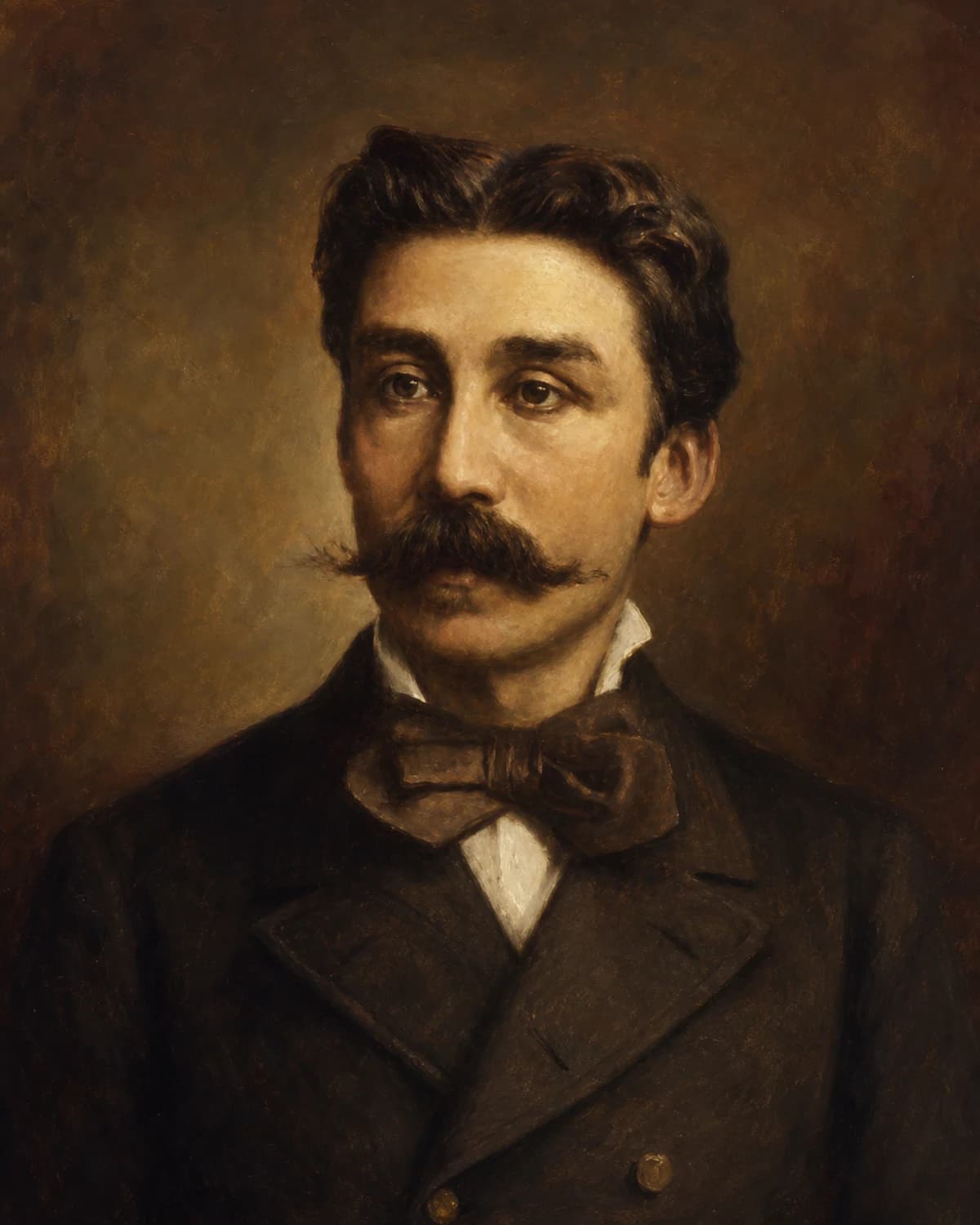
Biography
In 1852 a scientific expedition arrived in the small town of Areia in north-eastern Brazil. Its leader, the naturalist Louis Jacques Brunet, had heard of a local boy who drew remarkably well and decided to put him to the test: he set out a few objects and asked him to draw them in his presence. The likeness was such that Brunet took the nine-year-old Pedro Américo on as the expedition’s draughtsman. For twenty months they travelled across the north-east of the country.
He was born on 29 April 1843 in Areia, in the province of Paraíba, into the family of Daniel Eduardo de Figueiredo, a merchant and violinist of modest means who gave his son books about famous artists. His brother Francisco Aurélio de Figueiredo also became a painter. In 1854, at the age of eleven and armed with letters of recommendation, Pedro was admitted to the Imperial Academy of Fine Arts in Rio de Janeiro, though he first spent some time at the Colégio Pedro II. At the academy he collected fifteen medals, and the director, the painter Manuel de Araújo Porto-Alegre, nicknamed him the “medal collector”.
In May 1859, on a stipend from Emperor Pedro II, he arrived in Paris. At the École des Beaux-Arts his teachers were Ingres, Léon Cogniet and Hippolyte Flandrin. Painting alone was not enough for him. He attended courses in physics and archaeology, took a degree in social sciences at the Sorbonne, enrolled at the Free University of Brussels in 1862 and visited the Salon des Refusés. In 1864 he was called home for a competition for a professorship of drawing. He won it with the painting “Socrates Tearing Alcibiades from the Embrace of Vice”, but did not take up the chair and went back to Europe. In 1865, largely on foot, he travelled from Paris to Strasbourg, Baden, the Netherlands and Denmark, and then visited Morocco, Sicily, the Greek islands and Algeria, where he worked as a draughtsman for the French government. Money was short; he went hungry and drew portraits in cafés. It was then that his first novel, “Holocausto”, came out in French.
In 1868 in Brussels he defended a thesis, “Science and Systems: Questions of Natural History and Philosophy”, and became a doctor of science.
In 1869, on his way home, he married in Lisbon Carlota de Araújo Porto-Alegre, the daughter of his former director, who was then serving as consul there. In Rio he taught archaeology, art history and aesthetics at the academy and ran the numismatics and antiquities sections of the Imperial Museum. None of this brought him fame. That came with the “Battle of Campo Grande”, painted on the wave of patriotism after the Paraguayan War: in August and September 1871 the Rio newspapers wrote about the artist almost every day, and more than sixty thousand people came to see the picture. At the same time Luís Guimarães Júnior published an admiring little book about him titled “A Millionaire of Glories”. By the end of the year Américo was famous throughout the country and had received the Order of the Rose and the title of Historical Painter of the Imperial Chamber.
He painted the “Battle of Avaí” in Florence from 1874 to 1877. In 1875 the unfinished canvas was seen by guests at the celebrations of the fourth centenary of Michelangelo’s birth, and the artist gave a speech in two languages before the statue of David. The Italian government asked him for a portrait for the portrait gallery of the Uffizi, and it hung beside the portraits of his teachers Ingres and Flandrin. In Rio, at the academy’s exhibition of 1879, “Avaí” was hung next to Victor Meirelles’s “Battle of Guararapes”, and the dispute over which of the two battle pieces was better went down in history as the “Artistic Question of 1879”. Critics reproached Américo for an excess of fantasy and for liberties with history, and he was accused of borrowing his composition from an Italian painter. Even Gonzaga Duque, the chief opponent of the academic painters, after tearing the picture apart, conceded that in it the artist had at last broken free of his academic training.
After that he settled in Florence for a long time. Battle subjects interested only the state treasury, and he himself, by his own admission, loved sacred history best. The 1880s produced “Joan of Arc Hears for the First Time the Voice That Foretells Her High Destiny”, “The Arab Violinist”, “The Children of Edward IV” and “Jochebed Carrying Moses to the Nile”. In 1885 he returned to Rio to take the chair of art history, aesthetics and archaeology, and under a contract with the government of São Paulo he painted “Independence or Death!” in Florence in 1888. Dom Pedro sits on a handsome horse in full dress uniform, surrounded by gleaming dragoons. Once again the artist was reproached for untruth and for plagiarism, this time from Meissonier. His own answer was that reality inspires the painter but does not enslave him. To my mind, nothing more precise could be said about his history painting. The picture is in the Museu Paulista in São Paulo.
After the Republic was proclaimed on 15 November 1889 he, like Meirelles, was dismissed from the academy, but he came to terms with the new authorities. For them he painted “Liberation of the Slaves”, “Honour and Fatherland and Peace and Concord” and “Tiradentes Quartered”. In 1890 Américo was elected to the Constituent Congress as a deputy for Pernambuco; he pressed for the founding of museums and universities, but illness kept him from attending the sessions regularly. He kept his savings in government bonds and was ruined in the financial crisis of the early 1890s. In 1894, impoverished and with failing eyesight, he moved to Florence for good and went on working; two more novels came out in 1899 and 1901.
Pedro Américo died in Florence on 7 October 1905. By order of President Rodrigues Alves his body was embalmed and brought to Rio de Janeiro, where people paid their respects for several days at the War Arsenal, and then in the capital of Paraíba. On 9 May 1906 he was buried in his native Areia, in a mausoleum commissioned by the Brazilian Historical and Geographical Institute. The house where he was born is now a museum bearing his name.
Related context
Associations
Works connected through artistic movements, cultural context and period. Priced works available in this market appear first.








Profile notes
Profile and sources
Image
Artist image
На основе открытого изображения: Неизвестен; Wikimedia Commons; Public domain.
