
08.01.1883–03.12.1941
Pavel Filonov
Pavel Filonov (1883–1941), the son of a Moscow coachman, called himself an “artist-researcher” and built his pictures out of the tiniest “atoms” of form and colour. Creator of analytical art and of the school Masters of Analytical Art, and a friend of Khlebnikov, he hardly ever sold his work, hoping to give it to the state for a museum. He died in besieged Leningrad.
Biography
In 1929 the Russian Museum was preparing a solo exhibition of Filonov’s work. His pictures hung in the museum’s galleries for a whole year, the catalogue was prepared twice, there was polemic in the press and argument at closed viewings. The exhibition never opened, although the artist had the support of the influential Isaak Brodsky.
With rare exceptions, Filonov did not sell his pictures. He wanted to give them all to the state free of charge, on condition that a museum of analytical art would be founded on their basis.
He was born on 8 (20) January 1883 in Moscow. His parents, in his own words, were “petty bourgeois of the town of Ryazan”. His father, Nikolai Ivanov, a peasant from Tula province, had no surname until 1880; he was evidently registered as “Filonov” when he moved to Moscow. The son recalled that his father worked as a coachman and cabman, while his mother took in washing. The parents died early, and the younger Filonovs were looked after by their elder sister Alexandra and her husband, Alexander Gue, an engineer of Belgian origin. In 1897, having finished the parish school with distinction, Pavel moved to St Petersburg. There he completed the painting and decorating workshops and worked as a house painter, and in the evenings, from 1898, attended the drawing classes of the Society for the Encouragement of the Arts. From 1903 he studied in the private studio of the academician Lev Dmitriev-Kavkazsky; in 1905–1907 he travelled along the Volga and through the Caucasus and visited Jerusalem. He applied to the Academy of Arts three times, became an auditor at its school in 1908 and left it in 1910.
In that same year, 1910, he exhibited with the Union of Youth and, by his own account, painted his “first picture”, “Heads”, that winter. Then came “Man and Woman”, “Feast of Kings” (1913), “Peasant Family” (1914) and a great many sheets he called “formulas”: the formula of a flower, of a policeman, of the proletariat. His main principles had already taken shape in the article “Canon and Law” (1912). Filonov argued with Cubism: in his view the artist stays with nature and comes to know it by moving from the particular to the general. He regarded every touch of the brush as a “unit of action”, an atom that works through form and colour at once; later he wrote: “Draw every atom stubbornly and precisely.” He told himself and his students to work with very small brushes and the finest pens. In 1913 Filonov designed the tragedy “Vladimir Mayakovsky” at the Luna Park in St Petersburg. At that time he also grew close to Velimir Khlebnikov, became the prototype of the artist in his story “Ka”, painted a portrait of the poet (it has not survived) and illustrated his “Selected Poems” (1914), and in 1915 he published his own poem “A Chant of World Sprouting” with his own drawings. In March 1914 the manifesto “Made Pictures” came out, the first printed declaration of analytical art.
In 1915 he painted the almost non-objective “Flowers of Universal Flowering”. In the autumn of 1916 he was mobilised and sent as a private to the Romanian front; during the revolution the soldier Filonov headed the military revolutionary committee of the Danube region in Izmail. In 1918 he returned to Petrograd, took part in the First Free Exhibition of Works by Artists of All Tendencies and gave two works to the state. Then came “Formula of the Cosmos” (1918–1919), his first pure abstraction, “White Picture” (1919) and “Formula of the Petrograd Proletariat” (1920–1921), which went to the Russian Museum in 1922. His attempt to reorganise the painting and sculpture faculties of the Academy came to nothing, but in 1923 the “Declaration of ‘Universal Flowering’” appeared, with the idea that beyond the visible there is a world of phenomena grasped not by the “seeing” but by the “knowing eye”.
He gathered his school, the Masters of Analytical Art, in 1925; it was officially recognised in 1927. Over the years the MAI had as many as seventy members. They decorated the House of the Press, worked on Igor Terentyev’s production of “The Government Inspector” and in 1932 illustrated the “Kalevala” for the Academia publishing house. From 1921 Filonov’s wife was Yekaterina Serebryakova, who in her youth had been a member of the People’s Will. It seems to me that the school was as much a work of his as the canvases: he taught for nothing and demanded from his students the same slow, atom-by-atom work.
In the thirties he and his students were hounded as “formalists”. Filonov went hungry, saved on everything and went on teaching for free; there was never enough canvas, and he often painted in oil on paper or cardboard. After the exhibition “Artists of the RSFSR over 15 Years” (1932–1933) he hardly exhibited at all. One of his last works, “Faces”, is dated 1940.
Pavel Filonov died on 3 December 1941 in besieged Leningrad and is buried in the Serafimovskoe Cemetery. About three hundred of his works were preserved by his younger sister, Yevdokia Glebova, who gave them to the Russian Museum in 1977.
Related context
Associations
Works connected through artistic movements, cultural context and period. Priced works available in this market appear first.








Profile notes
Profile and sources
Image
Artist image
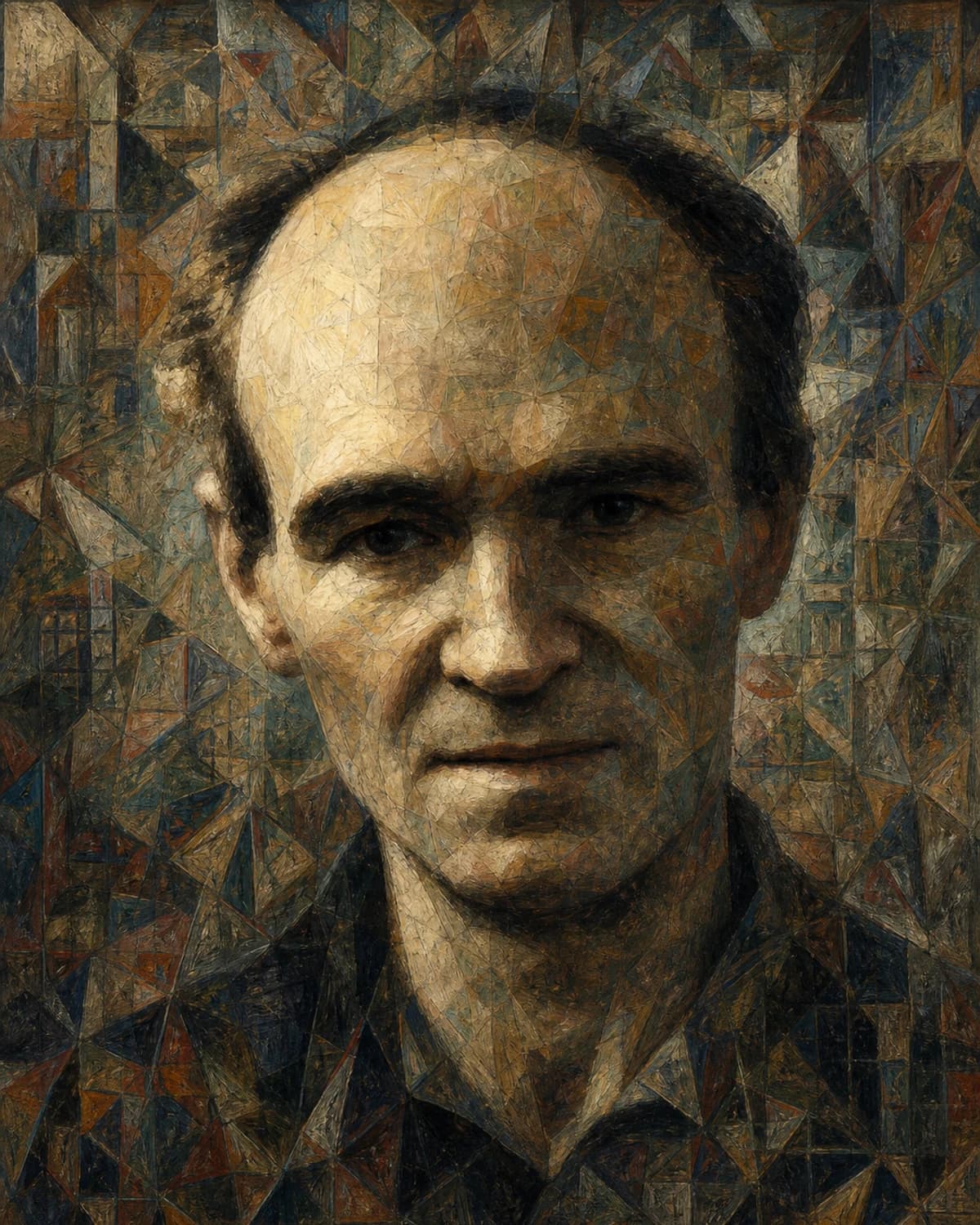
На основе открытого изображения: Unknown author Unknown author; Wikimedia Commons; Public domain.
