
22.06.1815–14.11.1852
Pavel Fedotov
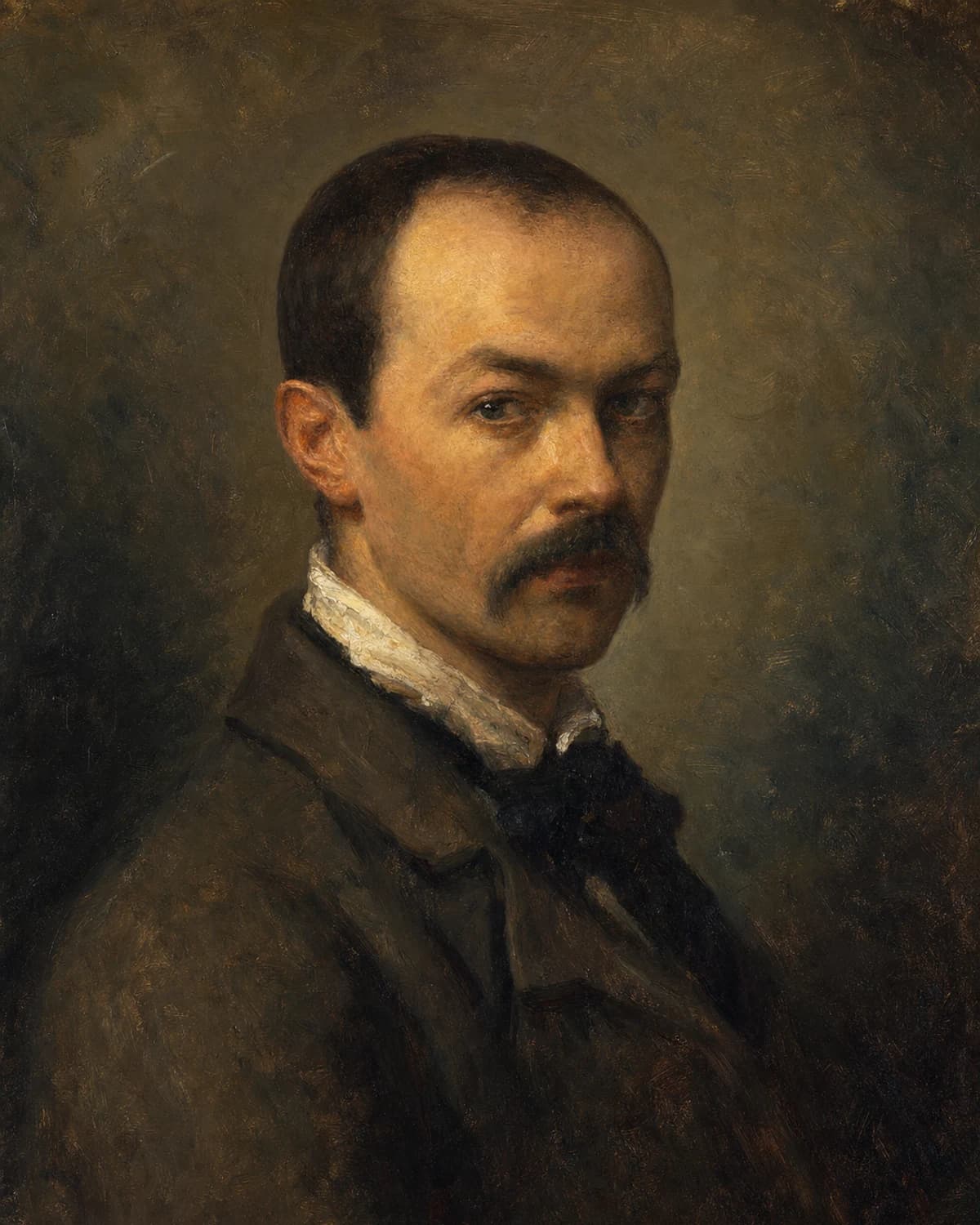
Pavel Fedotov (1815–1852) served for ten years as an officer of the Finland Life Guards Regiment, drawing his fellow officers in his spare time, and in 1844 he resigned his commission for the sake of painting. His three pictures at the Academy exhibition of 1848, “The Fresh Cavalier”, “The Choosy Bride” and “The Major’s Marriage Proposal”, made him an academician. His late works, “The Young Widow”, “Encore, Encore!” and “The Gamblers”, are painted in quite another, troubled key.
Biography
At the Academy exhibition of 1848 three pictures by a retired Guards captain were on show: “The Fresh Cavalier”, “The Choosy Bride” and “The Major’s Marriage Proposal”. Almost at the same moment a poem explaining the meaning of the “Proposal”, “Ratseya”, began to go round St Petersburg in handwritten copies. It had been written by the artist himself. The Council of the Academy unanimously made Pavel Fedotov an academician, laudatory articles appeared in the journals, and his name became known to the wider public.
He was thirty-three. He was only in his third year of painting in oils.
He was born on 22 June (4 July) 1815 in Moscow. His father, Andrei Illarionovich, had served in the army as far back as Catherine II’s reign and retired as a poruchik (lieutenant) with the rank of nobility, but later grew poor and rose no higher than titular councillor. His mother was Natalia Alekseevna, née Kalashnikova; besides Pavel the family had two daughters. At eleven his father placed him in the First Moscow Cadet Corps. He did well, became a non-commissioned officer in 1830 and a sergeant major in 1832, and in his free time drew caricatures of his comrades, of his superiors and of himself. He finished the course with distinction, and his name was entered on the marble board of honour in the assembly hall.
On 13 December 1833 Fedotov was commissioned as an ensign and sent to St Petersburg, to the Finland Life Guards Regiment. He served there for ten years. After three or four years he began attending the evening drawing classes at the Academy of Arts, and at home he made watercolour and pencil portraits of his fellow officers, scenes of regimental life and caricatures; he also, incidentally, played the flute. He knew the face of Grand Duke Mikhail Pavlovich so well that print dealers were glad to buy his portraits of him. In the summer of 1837 he painted a watercolour of the Grand Duke’s meeting with the regiment at the Krasnoye Selo camp, was given leave for the first time in his service in order to do it, and was rewarded with a diamond ring. After it, Fedotov wrote, “artistic pride was finally stamped upon his soul”. He ventured to show his next work, “The Consecration of the Banners in the Winter Palace, Restored after the Fire”, to the Grand Duke, who showed it to his brother, and Nicholas I allowed “the drawing officer” to leave the service for painting, with an allowance of a hundred paper roubles a month.
He took a long time to decide. On 3 January 1844 he was discharged with the rank of captain and the right to wear uniform. A pension of 28 roubles 60 kopecks a month had to cover help for his family in Moscow, models and paints.
At first Fedotov meant to become a battle painter: he already had some skill in the genre, and it promised honour and income. He settled in a poor flat on one of the far Lines of Vasilyevsky Island, painted studies at home and in the Academy classes, and, so as not to be confined to infantry, studied the skeleton and musculature of the horse under the battle-painting professor Alexander Sauerweid. The works he conceived at that time, “French Marauders in a Russian Village in 1812” and scenes of barracks life composed under the influence of Hogarth, remained sketches. It was partly Ivan Krylov who turned him to genre: the fabulist had seen his drawings and advised him in a letter to take up scenes of everyday life. From sketches in his album Fedotov painted in oils “The Fresh Cavalier”, also known as “The Morning of an Official Who Has Received His First Cross”, and “The Choosy Bride”, on the subject of a Krylov fable. Karl Bryullov was delighted when he saw them, and the Academy put the author forward for the title of academician and gave him a grant, on which he finished “The Major’s Marriage Proposal”. It seems to me that the path from “The Fresh Cavalier” to the “Proposal” can be read in the canvases themselves: the clutter of hints and small details gradually gives way to a simple scene in which poses and faces explain everything.
The exhibition added another 300 roubles a year to his pension from the funds of the emperor’s Cabinet. In February 1850 Fedotov went to Moscow to help his relatives, who had fallen on hard times, and there an exhibition was arranged of his paintings and sepia drawings, which pleased the Muscovites even more than the Petersburg show. At the same time another, lyrical Fedotov appeared: “Portrait of Nadezhda Pavlovna Zhdanovich at the Harpsichord” (1849, Russian Museum).
After that things grew harder. The censors banned the publication “In the Evening Instead of Preference”, planned together with his friend Evstafy Bernardsky, who was implicated in the Petrashevsky case, as well as Nekrasov’s “Illustrated Almanac” with his drawings; about the censors Fedotov wrote the fables “The Zealous Sow” and “The Tarpeian Rock”. Patrons began to turn away from him. “A Boarding-School Girl Returns to Her Parents’ Home” remained unfinished, as did “Nicholas I Visits the Patriotic Institute”, begun in its place. “The Young Widow” (1851; second version 1852, Tretyakov Gallery) shows a young woman who has just lost her husband. The unfinished “Encore, Encore!” and “The Gamblers” (both 1852) are full of a sense of absurdity quite unlike the laughter of 1848.
In the spring of 1852 Fedotov fell gravely ill. His friends and the Academy authorities placed him in a private clinic in St Petersburg, the emperor granted 500 roubles for his keep there, and in the autumn acquaintances secured his transfer to the Hospital of All Who Sorrow on the Peterhof Road. It was there that he died on 14 (26) November 1852. He was buried in the Smolensky Orthodox Cemetery in the uniform of a captain of the Finland Regiment. The censorship committee forbade any announcement of his death in the press, and not one of his literary works was published in his lifetime; the poem “Mending Matters, or the Major’s Marriage”, published in Leipzig in 1857, was kept out of Russia. A monument was unveiled on his grave in 1864, the Finland Regiment renewed it in 1893, and in 1936 his remains were moved to the Necropolis of the Masters of Arts at the Alexander Nevsky Lavra.
Related context
Associations
Works connected through artistic movements, cultural context and period. Priced works available in this market appear first.








Profile notes
Profile and sources
Image
Artist image
На основе открытого изображения: Неизвестен; Wikimedia Commons; Public domain.
