
08.02.1876–20.11.1907
Paula Modersohn-Becker
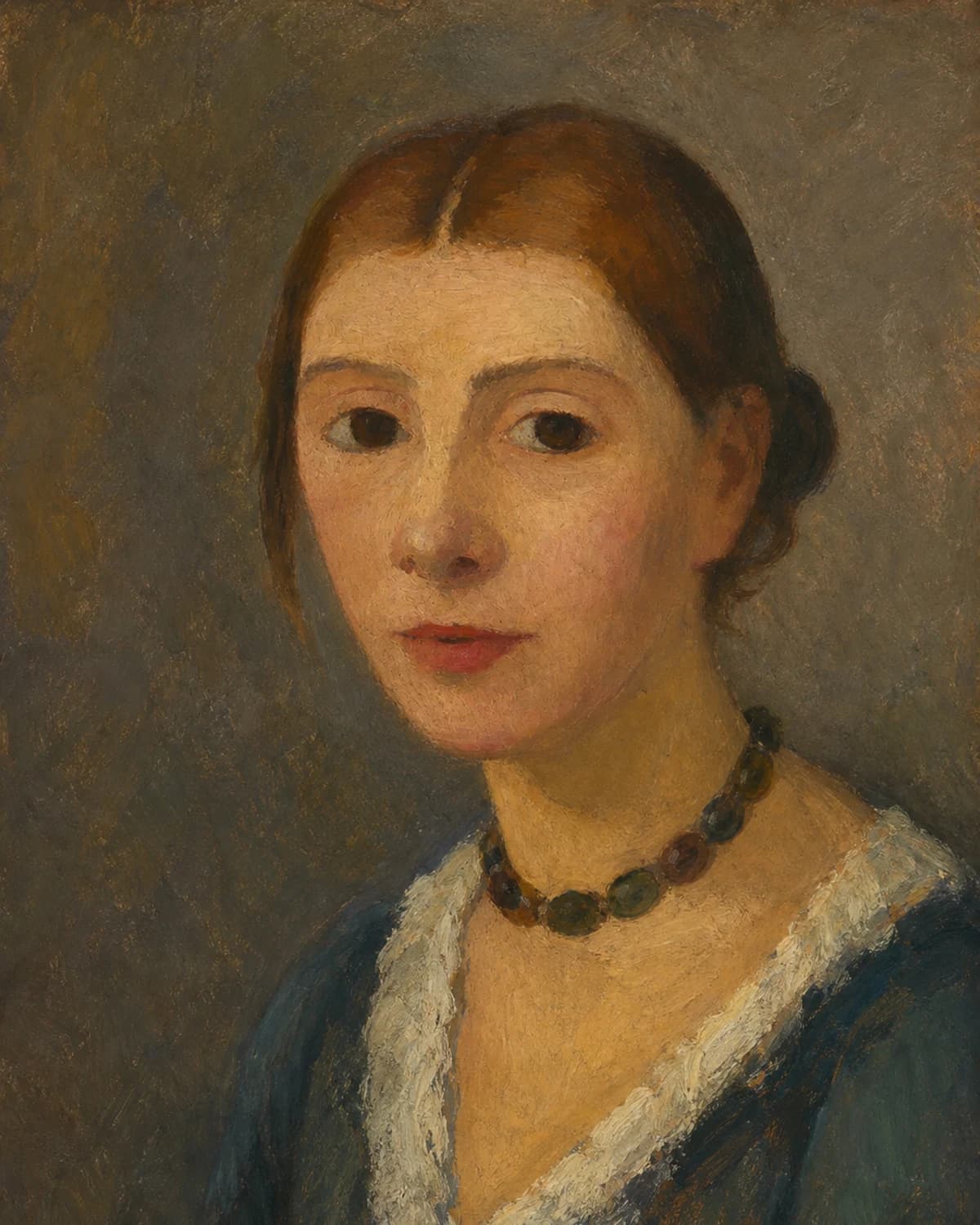
Paula Modersohn-Becker lived to thirty-one and left about 750 paintings and a thousand drawings. She studied in Berlin and Paris, lived in the Worpswede artists’ colony, and twice left her husband for Paris. She was the first known woman painter to make a nude self-portrait; a museum bearing her name opened in Bremen in 1927.
Biography
In December 1899 two of her paintings were taken down from an exhibition at the Kunsthalle Bremen. The critic Arthur Fitger called them “hysterical”, though it was later thought that he was more outraged by the very presence of women in the show. Paula Becker was then a student in Worpswede, and she understood that there was as yet no place in Germany for her simplified forms and colours.
She was born on 8 February 1876 in Dresden, in the suburb of Friedrichstadt, the third of seven children. Her father, Carl Woldemar Becker, was an engineer, and her mother came from the Thuringian nobility, the von Bültzingslöwen family. In 1888 the family moved to Bremen, where her father obtained a post on the railway building board. There Paula got her first studio, and through her mother’s acquaintances, a circle of artists. In 1892 her parents sent her to England to learn the language and housekeeping. In London she studied drawing at a private school in St John’s Wood, but she came home after six months. Her father insisted on a teachers’ training course, which she completed in 1893–1895, and as a concession she was allowed private painting lessons with Bernhard Wiegandt. A series of portraits of her brothers and sisters and her first self-portrait (1893) date from then.
In the spring of 1896 she went to Berlin for a six-week course run by the Association of Berlin Women Artists, since women were not admitted to the Academy of Arts. She stayed on longer, studied painting in 1897 with Jeanne Bauck, and spent much of her time in museums, preferring Dürer, Cranach, Holbein, Titian and Botticelli. She was drawn to large forms and clear line.
In the summer of 1897 her family celebrated her parents’ silver wedding in Worpswede, and the place made a deep impression on Paula. In September 1898 she settled there, at first as a student of Fritz Mackensen. She became friends with the sculptor Clara Westhoff and met Rainer Maria Rilke, and later Otto Modersohn and Heinrich Vogeler, under whose guidance she made several etchings in the summer of 1899. Mackensen did not suit her as a teacher: in her journal she wrote that his people were painted too much like genre scenes.
At the very end of 1899 she left for Paris, where in 1900 she studied at the Académie Colarossi. She went to museums and galleries, saw Cézanne at Ambroise Vollard’s, and by her own account the effect on her was like a thunderstorm. She also saw an exhibition of the Nabis, with their flat painting in which colour carries meaning. Her money soon ran out, she returned to Worpswede, and on 12 September 1900 she announced her engagement to Otto Modersohn, who had been widowed three months earlier.
They married on 25 May 1901. Modersohn had a small daughter, Elsbeth, and Paula tried to combine the duties of wife and stepmother with painting. Her studio was a small room on a peasant farm; she worked from nine until one and again after three, often until late in the evening. “Girl in the Garden Next to a Glass Sphere” and “Head of a Little Girl” were painted then. In the spring of 1902 she noted in her kitchen book that marriage does not make one happier.
In 1903 she returned to Paris for two months and copied ancient and Egyptian models in the Louvre; back in Worpswede she painted still lifes and portraits of infants. In February 1905 she went again, with her sister Herma. She saw works by Gauguin and concluded that her own style had already taken shape. Before 1905 she had ten still lifes, and in 1905–1907 almost fifty, with objects approaching the circle, the ellipse and the trapezoid.
On 23 February 1906 she left Worpswede and her husband and settled in Paris on the Avenue du Maine. She studied drawing again and anatomy at the École des Beaux-Arts, and the sculptor Bernhard Hoetger, on seeing her paintings, was delighted. In 1906–1907 she painted about ninety pictures, among them “Self-Portrait with a Lemon” and “Self-Portrait on Her Sixth Wedding Anniversary”, one of the first nude self-portraits by a woman in the history of art. In September she asked her husband for money to obtain a divorce, but changed her mind a few days later.
In March 1907 Paula returned to Worpswede. Her last finished works were “Poorhouse Woman in the Garden” and “Self-Portrait with a Camellia Branch”. Her daughter Mathilde was born on 2 November, and on 20 November, when she was allowed to get up, an embolism began. According to her husband, her last words were “What a pity”. She was thirty-one.
In her lifetime she sold, as far as is known, only two works: to Rilke and to Vogeler. In 1917 a large exhibition was held in Hanover and her letters and journals were published. The museum in Bremen on Böttcherstraße opened on 2 June 1927, commissioned by Ludwig Roselius, with a building by Hoetger. In 1937 about seventy of her paintings were removed from German museums.
Artist works
Works by the artist
Works by Paula Modersohn-Becker available in this edition of NEOARCA.
Related context
Associations
Works connected through artistic movements, cultural context and period. Priced works available in this market appear first.








Profile notes
Profile and sources
Image
Artist image
На основе открытого изображения: Paula Modersohn-Becker; Wikimedia Commons; Public domain.
