
18.12.1879–29.06.1940
Paul Klee
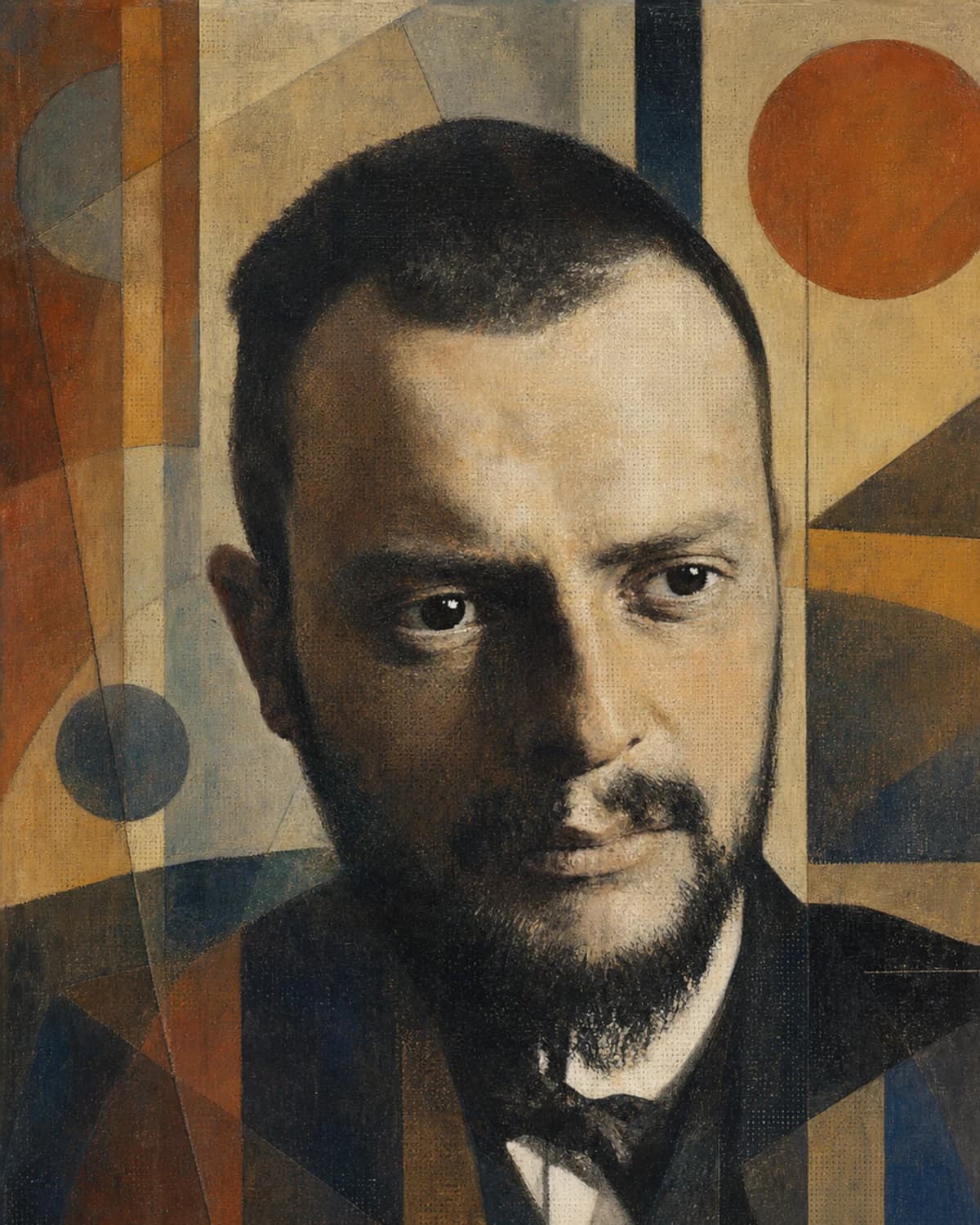
Paul Klee (1879–1940) thought of himself until thirty-five chiefly as a draughtsman and a violinist, and called himself a painter in April 1914 in Tunisia: “Colour and I are one.” For ten years he taught at the Bauhaus alongside Kandinsky, in 1933 he was dismissed from the Düsseldorf Academy and left for Bern. He left behind about nine thousand works, most of them small, in watercolour and ink, with birds, letters, numbers and angels.
Biography
In April 1914, in Kairouan, Paul Klee wrote in his diary: “Colour has taken possession of me; no longer do I have to chase after it. Colour and I are one. I am a painter.” He was thirty-four. To my mind that entry explains more than all his later theories. Behind him lay etchings, drawings scratched with a needle on blackened glass, and years in which, by his own admission, he thought he would never learn to paint. The twelve-day journey with August Macke and Louis Moilliet through Saint-Germain, Sidi Bou Said, Carthage and Hammamet ended at Kairouan; back home he painted his first purely abstract work, “In the Style of Kairouan”, out of coloured rectangles and a few circles.
A few weeks later the war began.
He was born on 18 December 1879 in Münchenbuchsee near Bern, the second child of the German music teacher Hans Wilhelm Klee and the Swiss singer Ida Frick; his citizenship, through his father, was German. From the age of seven he was taught the violin, at eleven he was invited to play with the Bern Music Association, and his parents saw a musician in him. He scraped through the Gymnasium and noted with his usual dryness: “It’s rather difficult to achieve the exact minimum, and it involves risks.” In music he loved only the old, Bach and Mozart; the modern seemed to him a decline, and partly for that reason in 1898 he went to Munich to study painting: first at Heinrich Knirr’s private school, and from October 1900 in Franz von Stuck’s class at the Academy, where Kandinsky was studying in the same months; they were barely acquainted. He drew better than anyone, and colour, it seemed to him, he did not feel at all. From October 1901 to May 1902 he travelled round Italy with his friend Hermann Haller, from Rome and Florence to Naples and Amalfi. In 1903–1905 he made the cycle of etchings “Inventions”, and in the summer of 1906, at the Munich Secession, they were his first public appearance; in 1905 he hit on scratching with a needle on blackened glass and made fifty-seven sheets that way, among them a portrait of his father.
In September 1906 he married the pianist Lily Stumpf and settled in Schwabing, outside Munich. On 30 November 1907 their son Felix was born. Lily gave lessons, while Klee kept house and raised the boy; he set up his studio in the kitchen. His first solo exhibition was held in Bern in 1910 and travelled to three more Swiss cities. In January 1911 Alfred Kubin talked him into illustrating “Candide” (the book appeared only in 1920); in the autumn he met Macke and Kandinsky and joined the editorial circle of the almanac Der Blaue Reiter. Of Kandinsky he noted: “He has an exceptionally beautiful and lucid mind.” At the second Blaue Reiter exhibition, the “Black and White” show of February 1912, seventeen of his graphic sheets were hung. The same year he went to Paris, saw the Cubists and Delaunay’s colour, and began his first experiments in pale watercolour.
Macke was killed in the autumn of 1914. On 5 March 1916 Klee was called up, and the same day he learned that Franz Marc had been killed at Verdun. After training at Landshut he was sent to the airfield at Schleissheim, where he restored the camouflage paint on aircraft and accompanied their transport, and from January 1917 he served as a clerk at the flying school in Gersthofen; there he rented a room in town and went on working. In March 1916 Herwarth Walden’s gallery showed his abstract watercolours, in 1917 a second exhibition sold almost out, and the critics called him the first among the new German artists. Birds appeared in his pictures: at Gersthofen Klee watched the aircraft take off and fall.
In 1919 a post at the Stuttgart Academy eluded him, but the Munich dealer Hans Goltz signed a three-year contract with him and in 1920 showed more than three hundred of his works. In October 1920 Walter Gropius invited him to the Bauhaus. Klee taught there from January 1921 to April 1931: first as form master in the bookbinding workshop, then, together with Kandinsky, who arrived in 1922, in the stained-glass and mural workshops. He began his course with a point that goes for a walk and becomes a line, and in 1925 he published the “Pedagogical Sketchbook”. In 1924 he exhibited in Paris for the first time and was a hit with the Surrealists, in 1925 he moved with the school to Dessau, and in the winter of 1928–1929 he went to Egypt, which impressed him less than Tunisia. “Twittering Machine” (1922), in which open-beaked birds sit on a shaft with a crank, hung in the Berlin National Gallery until it was taken down; after the “Degenerate Art” exhibition it was bought by the Buchholz Gallery in New York, and since 1939 it has been in the Museum of Modern Art. In 1931, as the Bauhaus drifted ever more towards architecture, Klee moved to the Düsseldorf Academy. There he painted “Ad Parnassum” (1932), a hundred by a hundred and twenty-six centimetres: a pyramid of individually stamped dots with a sun above it.
In 1933 a Nazi newspaper called him “a typical Galician Jew”, his flat in Dessau was searched, in Düsseldorf he was asked for papers proving Aryan descent and dismissed. His self-portrait of that year is called “Struck from the List”: dark colours, closed eyes, pressed lips and a large cross on the back of the head. The catalogue for 1933 lists 482 works. At the end of the year, at his wife’s insistence, the family left for Bern. In 1937 seventeen of his works were shown at the “Degenerate Art” exhibition, and a hundred and two were confiscated from German museums.
In 1935 Bern showed 273 of his works; the same year he fell ill. In 1936 the catalogue holds only twenty-five numbers, in 1937 264, in 1938 489, and in 1939 1,254, more than in any other year of his life: the line grew thicker, the forms larger and simpler, the patches of colour fewer. Kandinsky and Picasso came to visit. In “Revolution of the Viaduct” (1937) the arches of a bridge break away from the bank and walk off in disorder, refusing to stand in a chain. “Insula dulcamara” (1938), one of his largest canvases, almost two metres wide, has a white face in the middle. In his last months he drew about fifty angels, and in “Death and Fire” the word Tod can be read in the skull. The last big exhibition in his lifetime was mounted by Zurich in 1940.
Klee died on 29 June 1940 in Muralto, near Locarno; the Swiss citizenship he had applied for in 1933 was granted six days after his death. His urn rests in the Schosshalden cemetery in Bern; the words on the stone were chosen by Felix from his father’s writings: “Here I cannot be grasped: I dwell among the dead no less than among the unborn.” He left about nine thousand works. The Zentrum Paul Klee in Bern, built by Renzo Piano in 2005, shows no more than a hundred and fifty of its four thousand sheets at a time: Klee’s paints, inks and papers fear the light, and the pictures need rest.
Related context
Associations
Works connected through artistic movements, cultural context and period. Priced works available in this market appear first.








Profile notes
Profile and sources
Image
Artist image
На основе открытого изображения: Alexander Eliasberg; Wikimedia Commons; Public domain.
