
23.03.1937–present
Parviz Tanavoli
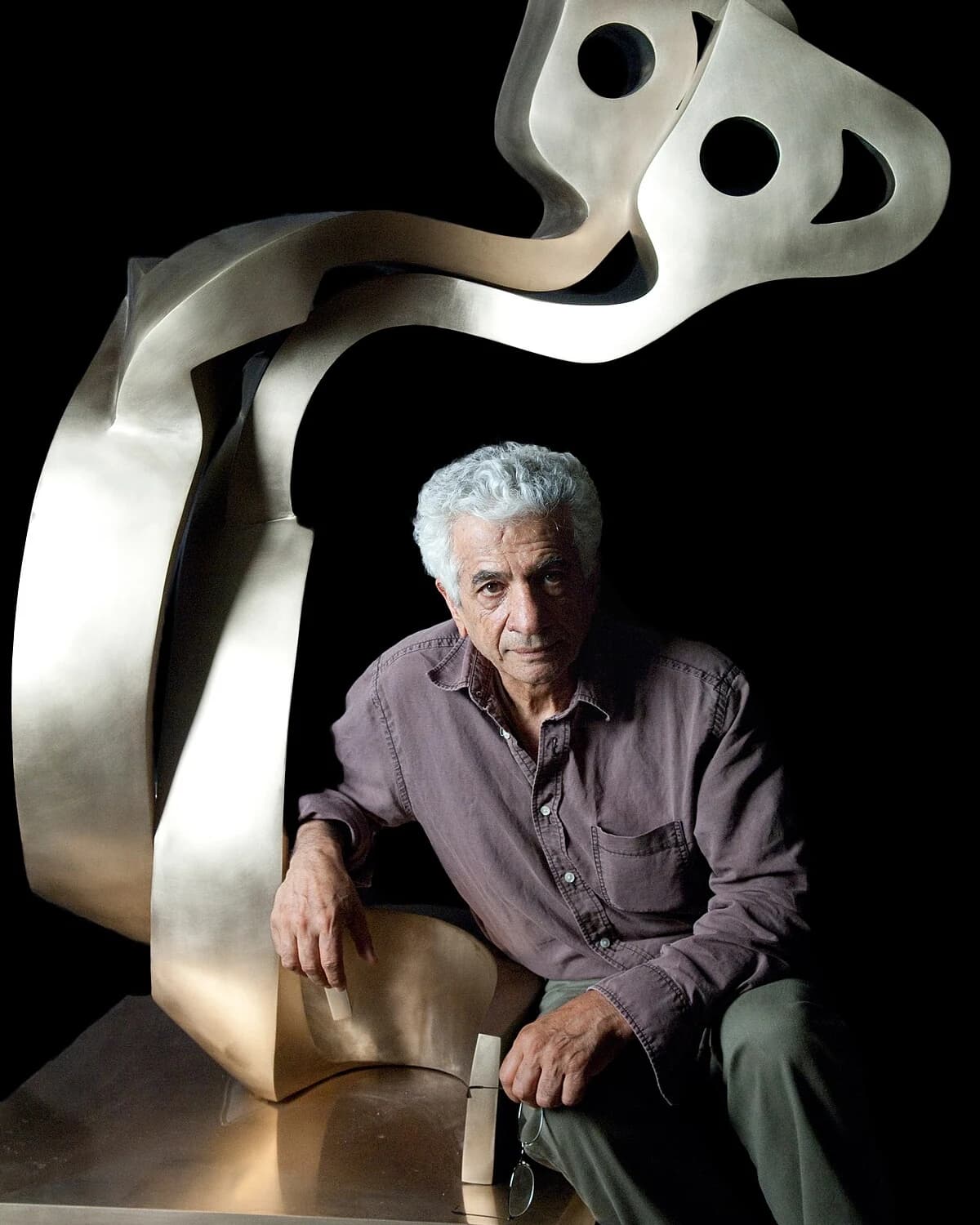
Parviz Tanavoli turned the Persian word “heech” (“nothing”), written in nastaliq script, into a series of sculptures now held by the British Museum and the Metropolitan Museum of Art. One of the founders of the neo-traditionalist Saqqakhaneh movement, he headed the sculpture department of the University of Tehran until 1979 and has written dozens of books on Iranian rugs, locks and crafts.
Biography
The Metropolitan Museum of Art owns a 2007 bronze, “Poet Turning into Heech”. In Persian, “heech” means “nothing”. The word has three letters, and Tanavoli writes them in nastaliq script so that the calligraphic sign grows into the figure of the poet. The museum connects the piece with the poetry of Rumi and with the Sufi idea that everything created comes out of nothingness. In other works of the series the word sits on a chair, finds itself locked in a cage or embraces a human figure.
His name is most often linked with these heeches, and he keeps coming back to them: new ones were shown at Tehran's Art Space Gallery in the summer of 2022, together with works by forty of his students.
Tanavoli was born in Tehran in March 1937. In 1952 he entered the Tehran School of Fine Arts, now part of the University of Tehran, and later went to study in Italy: in 1956–1957 at the Academy of Fine Arts in Carrara, in 1958–1959 at the Brera Academy in Milan, where his teacher was the sculptor Marino Marini. In 1960 he returned home and began teaching sculpture at the College of Decorative Arts in Tehran, of which he was one of the founders. Among his students there was Hossein Zenderoudi, later one of the pioneers of Iranian modernism.
From February 1961 to 1964 Tanavoli taught at the Minneapolis College of Art and Design, where he had been invited by the collector Abby Grey. After his return he became head of the sculpture department at the University of Tehran and ran it until 1979.
The critic Karim Emami described the Saqqakhaneh group as artists with a shared, largely popular aesthetic, and Tanavoli is one of its central figures. He drew the material for this aesthetic from Iranian history and craft. He was especially drawn to locksmithing and old locks: in 1976, with John Wertime, he produced the catalogue “Locks from Iran” for a Smithsonian Institution travelling exhibition. For a time he was cultural adviser to Shahbanu Farah Pahlavi. In 1967, with Kamran Diba and Roxana Saba, daughter of the musician Abolhassan Saba, he opened the Rasht 29 club, named after its street address near the Tehran Polytechnic. Its regulars included the painters Marcos Grigorian, Zenderoudi and Faramarz Pilaram, the poets Sohrab Sepehri and Yadollah Royaee, and the writers Ebrahim Golestan and Sadeq Chubak. To my mind, without this club it is hard to understand how sculptors, painters and poets in 1960s Tehran came to form a single milieu.
His second profession is that of a historian of Iranian craft. His publications number more than forty: books on lion rugs (1985), on Shahsavan rugs and textiles (1985), on pictorial rugs (“Kings, Heroes and Lovers”, 1994), on flatweaves (2002), on the gelims of northern Iran (2012), on images of European women in Safavid and Qajar houses (2016). Oxford published the collection of Persian steel he had assembled as a separate volume in 2000. In 2003 he turned his Tehran house into a museum of his own collection, but it stayed open for only a few months. That same year the Tehran Museum of Contemporary Art mounted a large retrospective of his sculpture.
Since 1989 Tanavoli has held dual Iranian and Canadian citizenship; he lives and works in Tehran and near Vancouver. His works are in Tate Modern, the British Museum, the Metropolitan Museum of Art, the Museum of Modern Art in New York, the Walker Art Center in Minneapolis and the Aga Khan Museum, and heeches stand as public sculpture in Vancouver. One of his best-known pieces, “The Wall (Oh Persepolis)”, is a bronze almost two metres high, covered all over with signs that look like writing and cannot be read.
Sometimes his sculpture became a direct statement. In 2005 he made the small “Heech in a Cage” as a protest against the conditions in which prisoners were held at Guantanamo, and in 2006 he began a work in memory of the victims of the Israel–Lebanon war.
In 2015 the Davis Museum at Wellesley College showed his first solo exhibition in the United States in forty years, and the same year saw the release of Terrence Turner's documentary “Parviz Tanavoli: Poetry in Bronze”. In 2017 the Tehran Museum of Contemporary Art exhibited his lion works together with his collection of lions, and in 2019 the exhibition “Oh Nightingale” took place at the West Vancouver Art Museum. In October 2020 the Tehran municipality gave Parviz Tanavoli's name to the former Mina Street in the Niavaran district. From 1 July to 19 November 2023 the Vancouver Art Gallery showed the retrospective “Poets, Locks, Cages”, covering six decades of his work.
Profile notes
Profile and sources
Image
Artist image
John Gordon; Wikimedia Commons; CC BY-SA 4.0.
