
15.11.1931–14.10.2023
Park Seo-bo
For more than half a century Park Seo-bo worked on the “Écriture” series: he drew pencil line after line into wet ground, and later worked on damp Korean hanji paper. His “Painting No. 1” (1957) is considered the first work of Korean Informel, and he was one of the leading artists and organisers of the Dansaekhwa movement. The National Museum of Modern and Contemporary Art, Korea, gave him retrospectives in 1991 and 2019.
Biography
In 1967 Park Seo-bo watched his three-year-old son Seung-ho write the word “Korea” on a sheet of squared paper over and over again and rub it out. Out of this scene, as he told it, grew the series he worked on for the rest of his life. At first he called it “Myobeop”, that is, “method”, and a few years later, on the advice of the critic Bang Geun-taek, he renamed it with the French “Écriture”, that is, “writing”. For six years he worked on it without showing it to anyone.
He was born on 15 November 1931 in Yecheon County, North Gyeongsang Province, in Korea under Japanese rule, the third of eight children, and his name then was Park Jae-hong. In 1934 the family moved to Anseong in Gyeonggi Province, where his father practised as a local solicitor. The boy drew a great deal and copied Korean masters. His father wanted him to become a lawyer, but the son held his ground and in 1950 entered the College of Fine Arts at Hongik University, in the department of Korean painting under Lee Ungno.
His first year was cut short by the Korean War. During those years his father died, both North Korean and South Korean forces took him, and one winter he walked from Anseong to Masan. The university was evacuated to Busan, and in 1952 Park went back to his studies. He lived half-starved: he drew portraits of American soldiers, slept in empty classrooms and searched rubbish bins for paints and materials. No teachers of Korean painting were left in Busan, and he moved to the department of Western painting, under Kim Whanki. He graduated in 1955 but did not attend the ceremony: that same year, hiding from conscription, he took a new name, Park Seo-bo. He won his case with the army only on 16 May 1961.
While still a student he won prizes at the National Art Exhibition, the state salon, in 1954 and 1955. In May 1956, together with three friends, he hung a poster-manifesto against that salon at the entrance to their own exhibition. In 1957 he joined the Contemporary Artists Association, and its exhibitions took the place of the official one for him. At the third of them, held on 15–23 May 1958 at the Hwashin Gallery, he showed seven numbered works; only the first survives, “Painting No. 1” (1957), now considered the first work of Korean Informel. In 1960 the English-language newspaper The Korean Republic described his method: he bought old tent canvas at the East Gate market, sewed pieces of hemp sacking onto it, sprinkled it with copper or bronze powder, scorched it with a blowtorch and etched it with chemicals.
From August 1960 he wrote for the newspaper Dong-a Ilbo about Pollock, Dubuffet, Hartung and Mathieu. In January 1961 he went to Paris to represent Korea at a UNESCO exhibition of young artists and stayed there a year. He was particularly interested in the Spaniards, Antoni Tàpies and Manolo Millares. Together with his compatriots he persuaded the organisers of the Paris Biennale to admit Korean artists, and in 1963 he went to it as part of the Korean group; in 1965 he represented Korea at the 8th São Paulo Biennial.
After Paris came the dark “Primordialis” series: layers of black and brown paint that he scratched into with palette knives and combs, sometimes with linen glued on. He later explained it as a memory of the war. Jean Fautrier's “Hostages”, which he had seen in a Japanese magazine, reminded him of what he had lived through. In the late 1960s, by contrast, came bright colours and the spray gun: the “Hereditarius” series, with cosmic motifs and the traditional five-colour obangsaek palette. An installation from this series at Expo '70 in Osaka, a row of clothes shaped around an absent body and a coffin with a figure under sand, was judged anti-government and shut down.
He began teaching at Hongik in 1962, became an assistant professor in 1964, and in 1967 resigned and lived in seclusion, reading classical East Asian philosophy. That was when “Écriture” appeared: several layers of wet ground with pencil lines drawn over them, repeating one and the same movement. He said that this repetition allowed him to merge with nature and to leave the traces of that merging on the canvas. The series was first shown in 1973 in Tokyo and Seoul. In 1975 his works were included in the exhibition “Five Korean Artists, Five Kinds of White”, usually considered the first major showing of Dansaekhwa. He disliked pure white for its overly strong character and mixed shades of white. He named the potters of the Joseon era as his predecessors, and the moon jar as his favourite thing in Korean art.
In 1970–1980 he was part of the leadership of the international division of the Korean Fine Arts Association and organised large exhibitions of experimental art. Lee Ufan believed that without his mediation between institutions and artists Dansaekhwa would not have happened. In 1980 he was commissioner of the 11th Paris Biennale. From the early 1980s he himself moved to hanji: he laid sheets under the paint and drew lines with a pencil, with sticks, with iron, simply with his hands. In the 1990s “Écriture” became black and white, and in the 2000s red, yellow and green fields appeared in it, even pastel pink ones. I would read this turn through his own words: the colours, by his own account, he took from nature, and he wanted them to calm the viewer.
From 1985 to 1990 Park was a dean at Hongik. He began building the Hanseodang studio in Anseong in 1980; in 1990 hundreds of works were stolen from it (many were later recovered), and in 1996 about three hundred were lost in a fire. In 1994 he set up his own foundation for art and culture. The National Museum of Modern and Contemporary Art, Korea, held his retrospectives in 1991 and 2019.
Park Seo-bo died on 14 October 2023, in his ninety-second year. Two museums of his work are being built, in Seoul and on Jeju Island.
Profile notes
Profile and sources
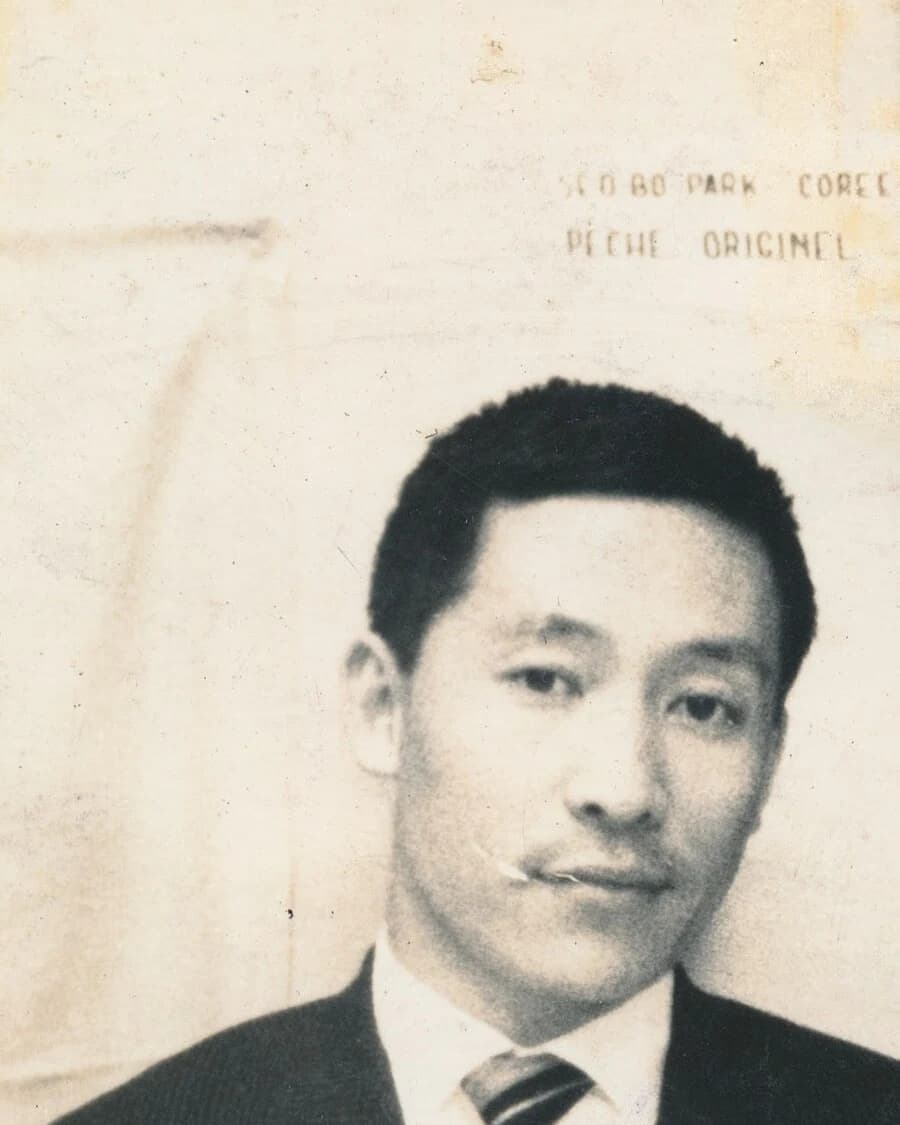
Image
Artist image
선의의 바람; Wikimedia Commons; CC BY-SA 4.0.
