
14.06.1895–22.07.1977
Pan Yuliang
Pan Yuliang (1895–1977), one of the first Chinese women trained in oil painting and life drawing, passed through the schools of Shanghai, Lyon, Paris and Rome, won the gold award of the Rome international exhibition in 1926 and was the first Chinese woman painter to be given a solo exhibition at home. From 1937 she lived in Paris; about four thousand of her works are kept in the Anhui Museum in Hefei.
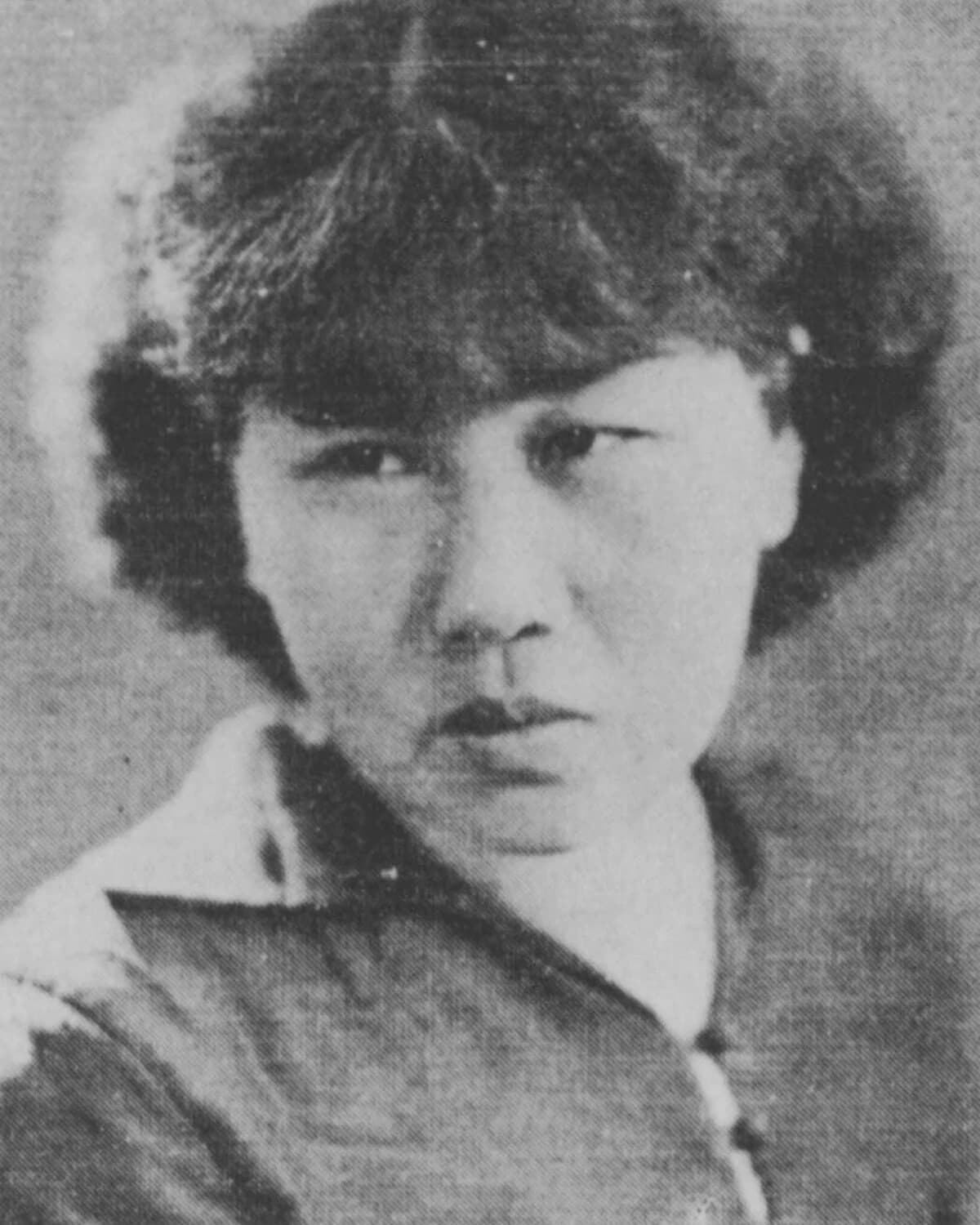
Biography
Pan Yuliang signed her paintings simply “Yuliang”, without a surname, and drew out the last stroke of the character liang longer than it should be. The surname was indeed not her own: it came from Pan Zanhua, a customs official and member of the Tongmenghui, who bought her out of the brothel in Wuhu to which her uncle had sold her at fourteen, and made her his second wife. Out of gratitude she kept the name for the rest of her life.
She was born on 14 June 1895 in Yangzhou, in Jiangsu province, under the name Chen Xiuqing; orphaned early, she was taken in by her mother’s brother, who renamed her Zhang Yuliang. Zanhua was the first to notice her gift for drawing. In 1916 the couple moved to Shanghai, where she learned to read and write, and then she entered the Shanghai Art School, where she studied painting with Wang Jiyuan. Its head was Liu Haisu, a champion of European methods: he introduced open-air classes and drawing from the nude, for which he was nicknamed “traitor to art” and his studio was broken up. Among her fellow students Pan kept to herself; they called her warm-hearted and forthright, at times blunt. She became one of the first women to graduate from the school and, with Liu’s backing, received a government scholarship to France. In 1921 she left for Lyon, for the Sino-French Institute and the École des Beaux-Arts, then moved on to the École nationale supérieure des Beaux-Arts in Paris, and in 1925 won the Rome scholarship and studied at the Accademia di Belle Arti in Rome under Umberto Coromaldi. By then her husband had lost his post, the money stopped, and she lived on a tiny stipend; her teachers and fellow students were already collecting money for her by subscription when, in the spring of 1925, her “Nude” took third place at the Eurasian exhibition of modern painting. In 1926 “Bathers” brought her the gold award of the Rome International Art Exhibition.
She returned home, by one account, in 1927, by another in 1929, when Liu Haisu invited her to teach at the Shanghai school. Between 1929 and 1936 she had five solo exhibitions, the first for a Chinese woman painter; she also taught at the National Central University in Nanjing. The nudes on her canvases, painted under the influence of the Impressionists and the Fauves, drew attacks from officials and conservative critics: women were expected to paint flowers and landscapes, and her past was held against her. She often served as her own model. In those same years she began to bring the methods of Chinese ink painting into oil, and this mixture of line and colour remained her hallmark.
In 1937 Pan Yuliang left Shanghai for Paris and never returned to China, keeping her Chinese nationality through almost fifty years in France. She taught at the École des Beaux-Arts, chaired the Chinese Art Association and exhibited in Britain, the United States, Germany, Japan, Italy, Switzerland, Belgium and Greece; in 1959 she received a gold award in Paris and a silver one in Belgium. She signed no contracts with dealers, so that no one could tell her what to paint, and lived poorly; by old age she was all but ignored both in France, where she was filed under “Chinese painter”, and in China, which she had left so long ago. Among the late works scholars single out “Nude in Red Qipao” (1955) and “Reclining Nude Woman” (1959): the woman in her pictures looks at the viewer calmly and directly, and, it seems to me, there is more of her biography in that gaze than in any subject.
Pan Yuliang died on 22 July 1977 in Paris and was buried in the Montparnasse Cemetery. In 1985 most of her estate was taken to China: to the National Art Museum in Beijing and the Anhui Museum in Hefei, which holds about four thousand of her works, among them 361 oils, 393 ink paintings and four sculptures; some paintings and prints remained in the Musée Cernuschi in Paris. In 1994 Huang Shuqin made a film about her, “A Soul Haunted by Painting”, with Gong Li in the leading role.
Related context
Associations
Works connected through artistic movements, cultural context and period. Priced works available in this market appear first.








Profile notes
Profile and sources
Image
Artist image
Unknown author Unknown author; Wikimedia Commons; Public domain.
