
25.10.1881–08.04.1973
Pablo Picasso
Pablo Picasso (1881–1973), a native of Málaga who lived in France for almost all his adult life, created Cubism together with Georges Braque, glued a piece of oilcloth into a painting (one of the first collages) and began assembling sculpture from sheet metal and wire. He painted “Les Demoiselles d’Avignon” and “Guernica”, designed ballets for Diaghilev and made ceramics at Vallauris. His estate held more than 45,000 works.
Biography
In occupied Paris the Gestapo searched Picasso’s home more than once. The story goes that one officer saw a photograph of “Guernica” in the flat and asked whether he had done that. “No,” Picasso replied, “you did.”
He stayed in the city throughout the war and did not exhibit. Bronze for casts, which the Germans had banned, was smuggled to him by people from the Resistance.
He was born in Málaga on 25 October 1881, at a quarter past eleven at night, the first child of the drawing teacher José Ruiz y Blasco, who painted birds and game and was curator of the local museum. The surname Picasso came from his mother, María Picasso y López; her great-grandfather had come to Spain from Liguria around 1807. According to his mother, the boy’s first word was “piz, piz”, that is, lápiz, pencil. From the age of seven his father taught him drawing and oil painting in the academic way: copies of the masters, plaster casts, the life model. At eight Pablo painted “Picador” and kept the picture all his life. The family moved to A Coruña, then to Barcelona, where the boy was admitted to the La Llotja school of fine arts: he passed the entrance examination, which usually took a month, in a week. Early academic canvases such as “The First Communion” (1896) and “Science and Charity” show how early he had mastered his academic training. He was sent to the Royal Academy of San Fernando in Madrid in 1897 and almost at once abandoned it for the Prado, for Velázquez, Goya and above all El Greco.
In 1900 he came to Paris for the first time. He shared a flat with the poet Max Jacob (Jacob slept at night, Picasso by day), lived in poverty and fed the stove with his drawings. From 1901 he signed his work with his mother’s surname, which was what his Catalan friends called him. In the Blue Period (1901–1904), after the death of his friend Carles Casagemas, came beggars, the blind, emaciated mothers with children: “La Vie” (1903), the etching “The Frugal Repast” (1904). In 1904 he settled in the Bateau-Lavoir, an artists’ tenement in Montmartre, and the cold blue gave way to pinks and oranges, acrobats and harlequins. The harlequin became his personal emblem. “Girl on a Ball” (1905), the painting of this transition, is now in the Pushkin Museum of Fine Arts in Moscow. His chief patron was Gertrude Stein; at her house in 1905 he met Matisse, his friend and rival for life.
In 1907 came “Les Demoiselles d’Avignon”. The three figures on the left derive from Iberian sculpture; he repainted the faces of the two on the right after seeing African objects in June at the ethnographic museum of the Trocadéro. The friends he showed the canvas to were shocked, Matisse thought it a hoax, and the painting was not shown in public until 1916.
Then came the years with Braque. First Analytic Cubism, almost monochrome, brownish grey, in which an object is taken apart into facets; then, in 1912, “Still Life with Chair Caning”, with oilcloth printed with a cane pattern glued onto the canvas and a rope serving as the frame. In the same year Picasso made “Guitar” from sheet metal and wire: sculpture was no longer modelled or carved but assembled. Guitars, violins and bottles remain recognisable, and to my mind he never once arrived at abstraction, although he came very close.
In 1917 in Rome he worked on the designs for “Parade” for Diaghilev’s Ballets Russes. In all, Picasso designed six productions for the Ballets Russes, and in 1918, in the Russian church in Paris, he married one of the company’s dancers, Olga Khokhlova; the witnesses were Cocteau, Max Jacob and Apollinaire. In the summer of 1921 at Fontainebleau, in a garage turned into a studio, he was painting the neoclassical “Three Women at the Spring” and the Cubist “Three Musicians” side by side. In a 1923 interview he explained that his different manners were not stages of development: each subject suggests its own means. In 1925 the Surrealists claimed him as one of their own, but psychic automatism never fully won him over. In the 1930s the harlequin gave way to the Minotaur, the main character of the etchings of the “Vollard Suite”.
In April 1937 German and Italian aircraft bombed the Basque town of Guernica. Picasso painted the huge canvas in about two months, and in July it was shown in the Spanish Pavilion at the World’s Fair in Paris. Dora Maar photographed the process; at his request she painted part of the dying horse herself. He refused to explain the symbols of the painting: that was the viewer’s business. After Franco’s victory “Guernica” went to New York and, by the artist’s wish, stayed at the Museum of Modern Art until 1981, when democracy had been established in Spain.
In 1944 Picasso joined the French Communist Party. On 9 January 1949 he made a lithograph of a dove for the poster of the World Peace Congress, and the “dove of peace” went all over the world; then came “Massacre in Korea”, and in 1962 he received the Lenin Peace Prize. From the autumn of 1947 he worked at the Madoura pottery in Vallauris, where in 1952 he met Jacqueline Roque, his second wife. In the 1950s he reworked the old masters: Delacroix’s “The Women of Algiers”, Velázquez’s “Las Meninas”, Manet’s “Le Déjeuner sur l’herbe”. The fifteen-metre sculpture for Chicago, unveiled in 1967, he gave to the city, taking no money for it. His last paintings and hundreds of etchings of 1968–1971 struck many at the time as careless, and only later were they seen as a forerunner of Neo-Expressionism.
In the spring of 1973 he was helping to select 201 canvases for the festival in Avignon. Picasso died on 8 April 1973 at Mougins, at the villa Notre-Dame-de-Vie; the night before, it is said, he had worked until three in the morning. He is buried at the Château de Vauvenargues near Aix-en-Provence. There was no will; the state took the inheritance tax in works, and they formed the core of the Musée Picasso in Paris.
Related context
Associations
Works connected through artistic movements, cultural context and period. Priced works available in this market appear first.








Profile notes
Profile and sources
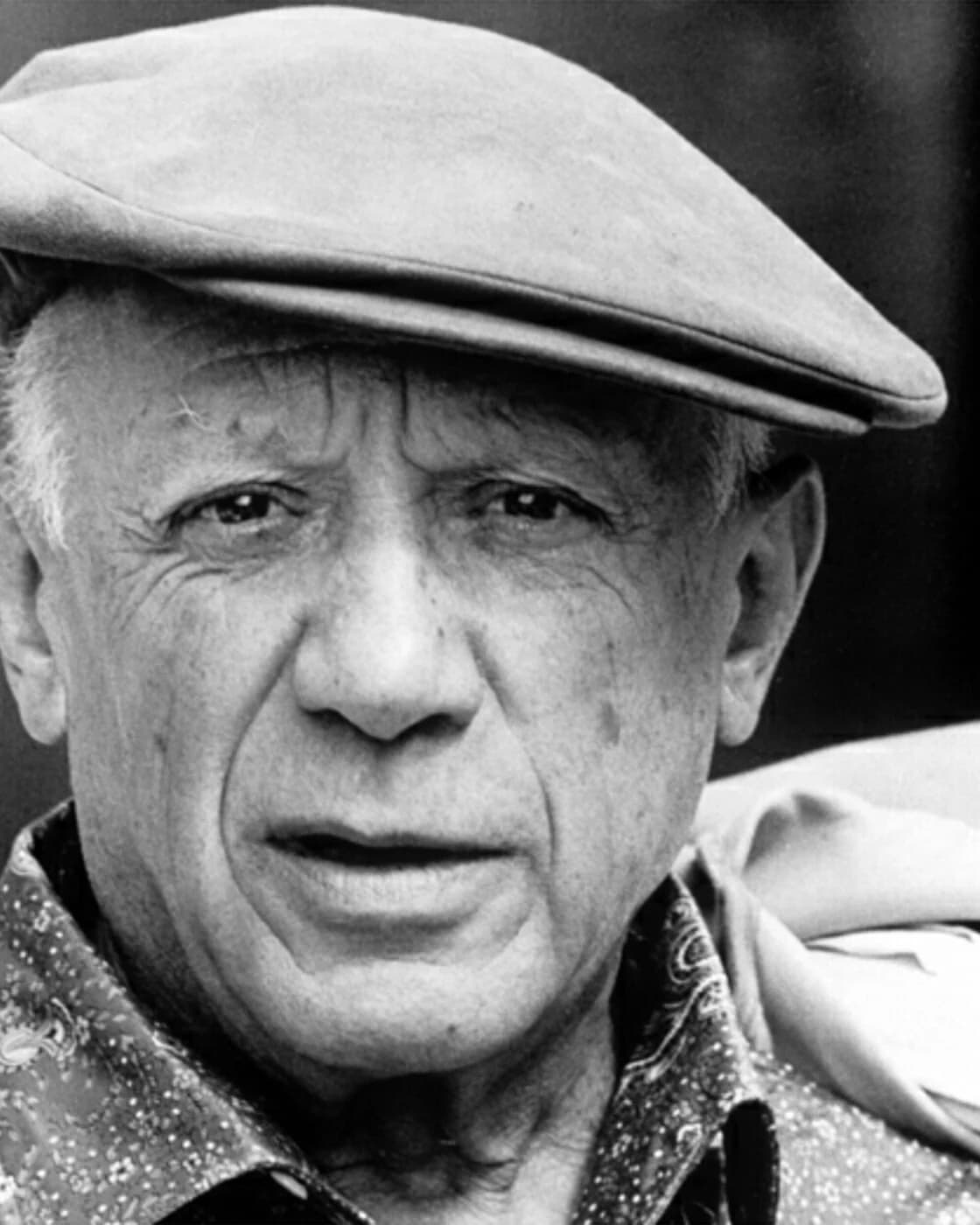
Image
Artist image
Argentina . Revista Vea y Lea; Wikimedia Commons; Public domain.
