
21.01.1938–16.11.2009
Pablo Amaringo
Pablo Amaringo (1938–2009), born in a settlement on a tributary of the Ucayali, healed people for several years as a curandero, then in 1977 gave up the practice and began to paint what he had seen in ayahuasca ceremonies. The book “Ayahuasca Visions”, with his paintings, made him known far beyond Peru, and at his Usko-Ayar school in Pucallpa children were taught to draw free of charge.
Biography
Pablo Amaringo’s first paints were his sisters’ lipstick and cosmetics, cardboard boxes stood in for paper, and he shaded his pencil strokes with lamp soot. A friend from a car workshop brought him blue Permatex, a compound for checking how machine parts fit, and he coloured his drawings with it until someone gave him a few tubes of real paint. To my mind that story already contains all his later painting: industrial colour, patience, and other people’s materials adapted to his own ends.
He was seventeen, and he had begun drawing while recovering from a serious illness treated by a local healer.
He was born on 21 January 1938 (1943 by other accounts) in Puerto Libertad, a small settlement on a tributary of the Ucayali, the seventh of thirteen children. His parents, small farmers, spoke Quechua between themselves and taught their children Spanish; there were healers among his ancestors. When Pablo had finished the second grade his father left the family; the farm was lost and they moved to Pucallpa, where the boy had two more years of school. Ayahuasca, the ritual brew of local healers, he had known since childhood. Then school had to be abandoned for work: at fifteen he was loading cargo in the docks of Pucallpa, he spent almost two years in Brazil, and on returning to the Peruvian jungle he fell ill. Once recovered, he earned a living with portraits until hand-coloured photographs drove them out.
Illness and the long cure led him to the healer’s trade. He became a curandero in the vegetalista tradition, the mestizo healers of the Amazon who learn from plants and from the icaro songs, and from 1970 to 1976 he travelled the region treating people. Then, as he put it, spirits and sorcerers “wounded” him, and in 1977 he gave up both ayahuasca and the practice. From that time he only painted: the worlds seen in the ceremonies he transferred to canvas so that not a single leaf or figure was left indistinct.
In 1985 the anthropologist Luis Eduardo Luna and the ethnopharmacologist Dennis McKenna came to Pucallpa, working on an ethnobotanical project. Amaringo was living in poverty, teaching English to teenagers at home and selling paintings to the occasional tourist. Luna suggested he paint his visions; out of this came their joint book “Ayahuasca Visions: The Religious Iconography of a Peruvian Shaman” (1991, reissued in 1999). With Luna, Amaringo opened the Usko-Ayar school of painting in Pucallpa: he taught his pupils first to see the picture inside themselves and then to put it on canvas, and he took no money for the lessons. The aim of the school he explained simply: by observing and depicting nature, children learn its beauty and learn to respect it; “language is imperfect, the spirit is silent but speaks through images”. In 1992 the United Nations Environment Programme recognised this work in its Global 500 roll of honour.
After the book he wrote almost nothing about his work apart from the occasional interview, and in 2006 he supplied the preface to a book on plant spirit shamanism. His paintings appeared in Graham Hancock’s book “Supernatural” and in documentary films about ayahuasca; he travelled to conferences in California, Costa Rica and Brazil and spoke there about the life of a painter and healer. In his last years the plants and animals of Peru appeared beside the angels on his canvases, rendered down to the smallest detail.
Pablo Amaringo died on 16 November 2009 in Pucallpa, before he could see the exhibition of his paintings that was opening in California.
Profile notes
Profile and sources
Image
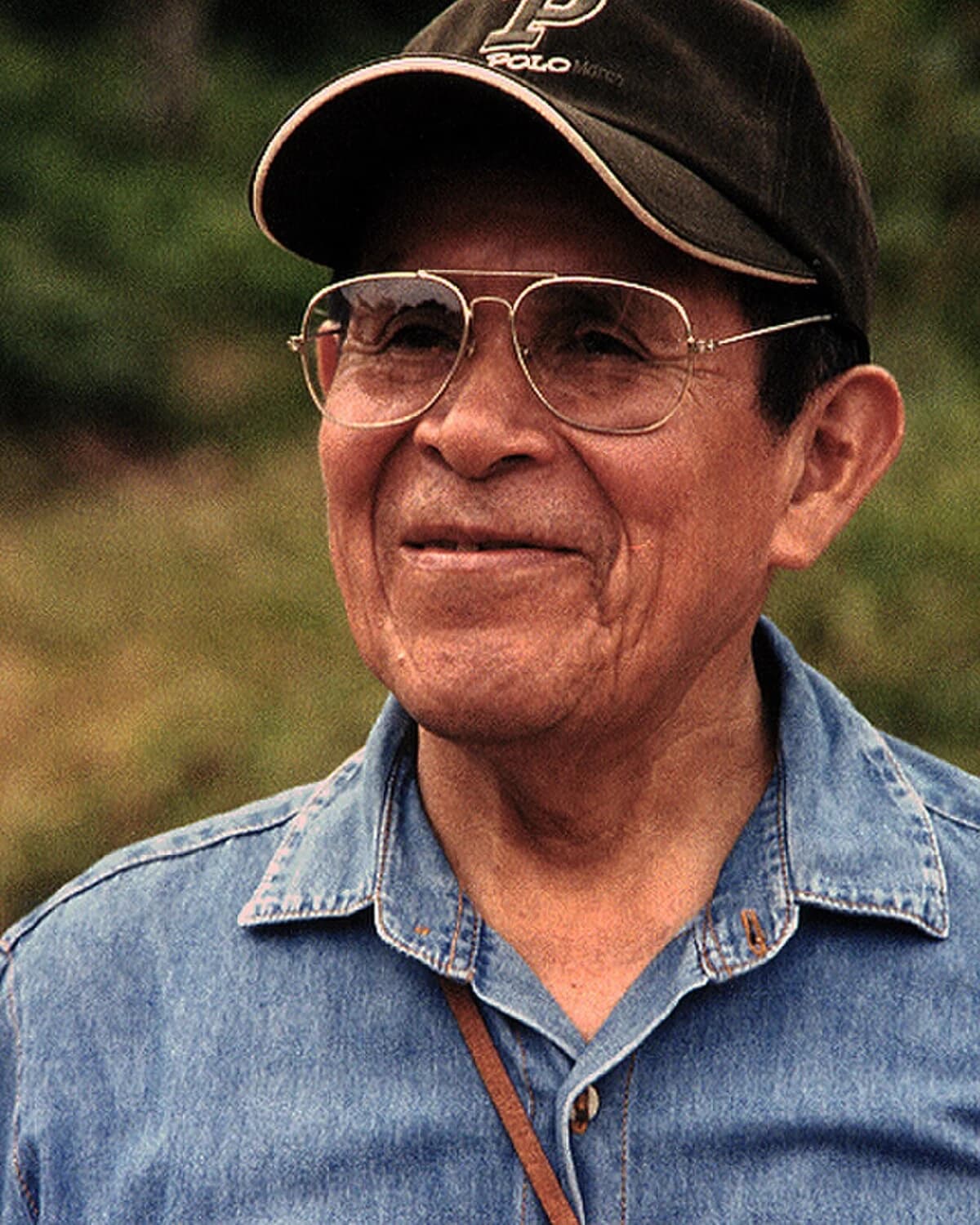
Artist image
Jon Hanna; Wikimedia Commons; CC BY-SA 3.0.
