
06.07.1919–10.03.1999
Oswaldo Guayasamín
The Ecuadorian Oswaldo Guayasamín (1919–1999), eldest of the ten children of a poor carpenter in Quito, painted the suffering, poverty and oppression of the indigenous peoples of Latin America. He worked with José Clemente Orozco, won first prize at the biennial in Barcelona and was named the best South American painter in São Paulo. He gave his collection to the state, and above Quito the Chapel of Man was built with his participation.
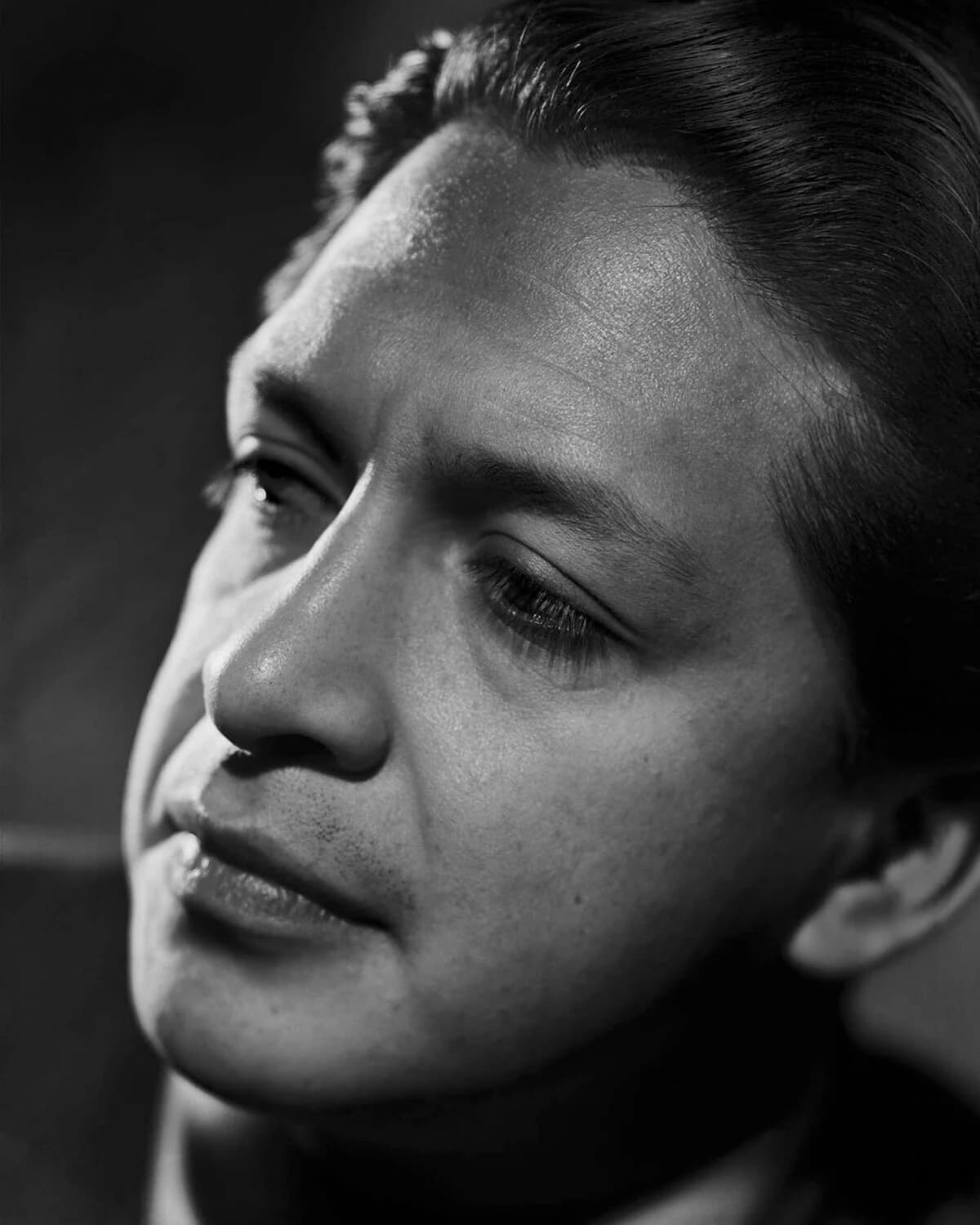
Biography
The surname Guayasamín means “white bird” in one of the dialects of Kichwa. Oswaldo was born on 6 July 1919 in Quito, the eldest of ten children. His father, an indigenous man, worked as a carpenter for most of his life; his mother was a mestiza; both were of Kichwa descent. The family was poor. The boy did badly at school, changed schools several times and of all his occupations cared only for drawing and the guitar; he drew caricatures of his teachers and of the children he played with.
He started painting at about six.
At the School of Fine Arts in Quito he studied painting and sculpture, and architecture as well. In 1941 he graduated with honours. During his student years something happened that he later considered decisive: his closest friend was killed during a demonstration in Quito. Out of this came the painting “Los Niños Muertos” (“The Dead Children”), and out of it too, by his own account, came his view of the society he lived in. In 1942, at twenty-three, he organised his first exhibition himself. One of the first places to show him was the Galería Caspicara, opened by Eduardo Kingman in 1940. The painting “El Silencio” from that show marks a turn: from telling the stories of particular people he moved to images that speak of human suffering in general.
Success brought an invitation to the United States. In 1942–1943 he travelled through the United States and Mexico, met José Clemente Orozco, saw the Mexican murals and worked in Orozco’s studio. Then came Peru, Brazil, Chile, Argentina and Uruguay, and the poverty of the indigenous villages he saw on these journeys passed into his pictures. The influence of Rivera, Orozco and Siqueiros on him is written about constantly. I think there is nothing to dispute here, as long as influence is not confused with imitation: no Latin American artist of the time passed the Mexican murals by, but Guayasamín’s manner was built from his own material. His colour works as a symbol, his indigenous faces are stylised, his forms are distorted, yet the real basis beneath them remains recognisable.
His main cycle was “Huacayñán”, which in Kichwa means “The Trail of Tears”. In two years he painted one hundred and three pictures of the life of the indigenous peoples of Latin America. An almost graphic manner, the image as sign and a sparing palette allowed him to work very fast. After a large exhibition in Quito in 1951 these paintings travelled to many art centres around the world. As early as 1948 he had won first prize at Ecuador’s National Salon of Watercolourists and Draughtsmen; in 1955 he took first prize at the Third Hispano-American Biennial in Barcelona, and at the Fourth São Paulo Biennial in 1957 he was named the best South American painter.
In his canvases the hands often say more than the faces. The themes are almost always the same: suffering, blind despair, fear, oppression and resistance to it, longing. He himself long faced racism and humiliation because of his indigenous origins. Even his landscapes are reduced to signs: mountains, houses and lakes are simplified but recognisable. The portraits are more realistic than the rest: Gabriela Mistral, Fidel Castro, several self-portraits. He was an ardent supporter of the Cuban Revolution and of Castro.
In 1973 the Musée d’Art Moderne in Paris mounted an exhibition of his work, and in 1983 his paintings were shown in Moscow and Leningrad, at the Hermitage. In 1988 the Congress of Ecuador commissioned him to paint a mural on the history of the country; the United States government criticised it because one of the figures wears a German military helmet bearing the letters “CIA”. UNESCO awarded him a prize for a whole life devoted to the cause of peace. He opened his last exhibitions himself in 1995, at the Luxembourg Palace in Paris and the Palais de Glace in Buenos Aires.
Once he had grown wealthy he became a collector: pre-Columbian ceramics, colonial church painting and sculpture, works by Goya and Picasso. All of it was kept in his colonial-style house, to which he designed a modern extension himself. In 1978 he gave Ecuador some five hundred colonial paintings and sculptures, pre-Columbian antiquities and works by Goya and Picasso. In Quito his museum is open and the Guayasamín Foundation is at work.
Oswaldo Guayasamín died on 10 March 1999 in Baltimore; that day in Ecuador the indigenous people, whom he had supported all his life, were on strike. In 2002 the Chapel of Man (La Capilla del Hombre), a building he helped to design, opened next to his house in the hills above Quito. His works are on show there too.
Profile notes
Profile and sources
Image
Artist image
Annemarie Heinrich; Wikimedia Commons; Public domain.
