
30.12.1842–24.02.1910
Osman Hamdi Bey
Osman Hamdi Bey (1842–1910) studied painting in Paris under Gérôme and Boulanger, and back home in Istanbul he ran the Imperial Museum for almost thirty years. He excavated at Sidon and Nemrut Dağı, secured a law against the export of antiquities, founded the Academy of Fine Arts and went on painting; his best-known picture is “The Tortoise Trainer” (1906).
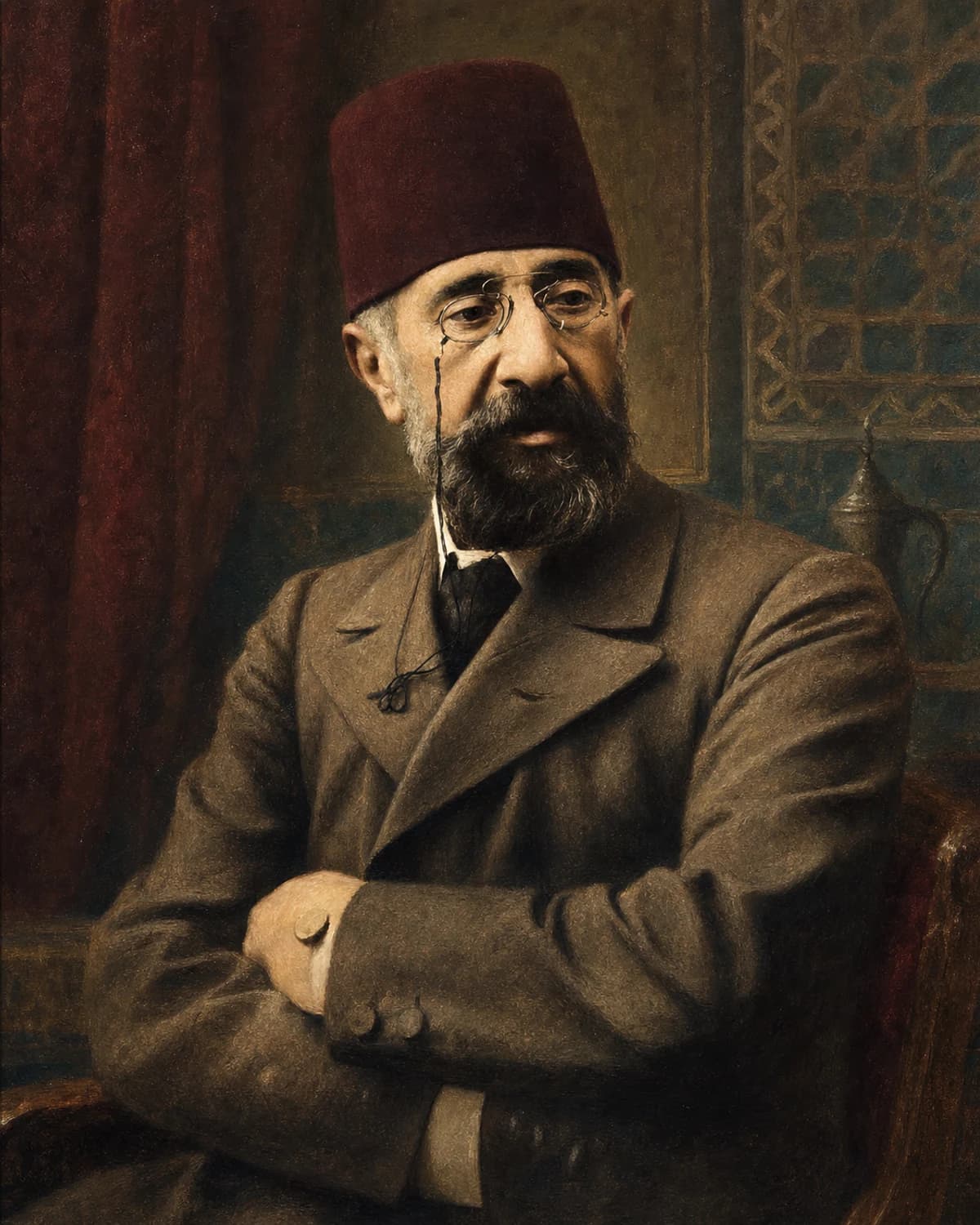
Biography
In a painting of 1906 an elderly man in old-fashioned dress stands in a room of a mosque, training tortoises. The face is the artist's own. In the Tulip Era, at the beginning of the eighteenth century, candles were set on the shells of tortoises at evening festivities, and the painting seems to remember this. The historian Edhem Eldem also found the model for the composition: an engraving of a Korean circus performer from a French travel magazine of 1869. Some see “The Tortoise Trainer” as a reflection on a conflicted national identity, others as Osman Hamdi mocking his own manner and his pupils.
What the tortoises mean is still argued over. I would not pick a single explanation.
Osman Hamdi was born on 30 December 1842 in Istanbul. His father, Ibrahim Edhem Pasha, had been a Greek boy from the island of Chios, orphaned in the massacre there; he was adopted by the Grand Admiral Hüsrev Pasha, and in time Ibrahim Edhem rose to the office of Grand Vizier (1877–1878). His mother, Fatma Hanım, was the daughter of an Istanbul official. Osman Hamdi was proud of his Greek descent and made no secret of it. After primary school in Beşiktaş he studied law in Istanbul and, from 1860, in Paris, but he gave up the law for painting and trained under the Orientalists Jean-Léon Gérôme and Gustave Boulanger. At the Exposition Universelle of 1867 he showed three paintings, “Repose of the Gypsies”, “Black Sea Soldier Lying in Wait” and “Death of the Soldier”; none of them seems to have survived. In Paris he also met a Frenchwoman, Marie, who went with him to Istanbul in 1869 and became his wife.
At home he was put to work at once: in the Baghdad vilayet, in the administration of the reformer Midhat Pasha, and from 1871 in the palace protocol office. For the 1873 World Exhibition in Vienna he and Marie de Launay prepared the album “Popular Costumes of Turkey”, with photographs by Pascal Sébah. In 1875 Osman Hamdi served for a year as the first mayor of Kadıköy.
In 1881 he was appointed director of the Imperial Museum, and from then on antiquities were his main concern. In 1882 he founded the Academy of Fine Arts so that Ottoman artists could train without leaving the empire; today it is the Mimar Sinan Fine Arts University. In 1884, at his urging, a law was issued that banned the export of antiquities and declared them the property of the state; until then agents of the European powers had often carried finds away under dubious permits or by means of bribes. He led the first scientific excavations carried out by a Turkish team: at Nemrut Dağı in 1883, at the sanctuary of Hecate at Lagina, and at Sidon (now in Lebanon), where he found the sarcophagi of the royal necropolis, among them the so-called Alexander Sarcophagus. To house them, work began in 1881 on the building of today's Istanbul Archaeology Museum, which opened in 1891. In 1892 his book on the royal necropolis of Sidon was published in Paris. The University of Pennsylvania gave him an honorary degree in 1894, and in 1902 Osman Hamdi presented the university's museum with a painting of the excavations at Nippur.
He never gave up painting. From 1880 he exhibited in Paris, Vienna, Berlin, Munich and London, and in Istanbul he set up a salon of his own. He painted in the manner of his Parisian teachers, but he often put himself and his family into his pictures, and his people of the East read, study and trade: so it is in “Girl Reciting the Qur'an” (1880), “Young Emir Studying” in Liverpool and “Persian Merchant” in Berlin. In his lifetime his paintings were seen more often in Europe than at home. “The Tortoise Trainer” is now in the Pera Museum in Istanbul.
Osman Hamdi Bey died on 24 February 1910 in the Istanbul quarter of Kuruçeşme. His brother, Halil Edhem, succeeded him at the museum.
Related context
Associations
Works connected through artistic movements, cultural context and period. Priced works available in this market appear first.








Profile notes
Profile and sources
Image
Artist image
На основе открытого изображения: Unknown author Unknown author; Wikimedia Commons; Public domain.
