
21.06.1886–07.11.1918
Olga Rozanova
Olga Rozanova (1886–1918) began with neo-primitivist cafés and townscapes and ended with non-objective “colour painting”: her “Green Stripe” (1917) is compared with American abstraction that appeared decades later. With Aleksei Kruchenykh she made eighteen Futurist books; she was secretary of Malevich’s Supremus, and in 1918 she ran the art industry section of Narkompros.
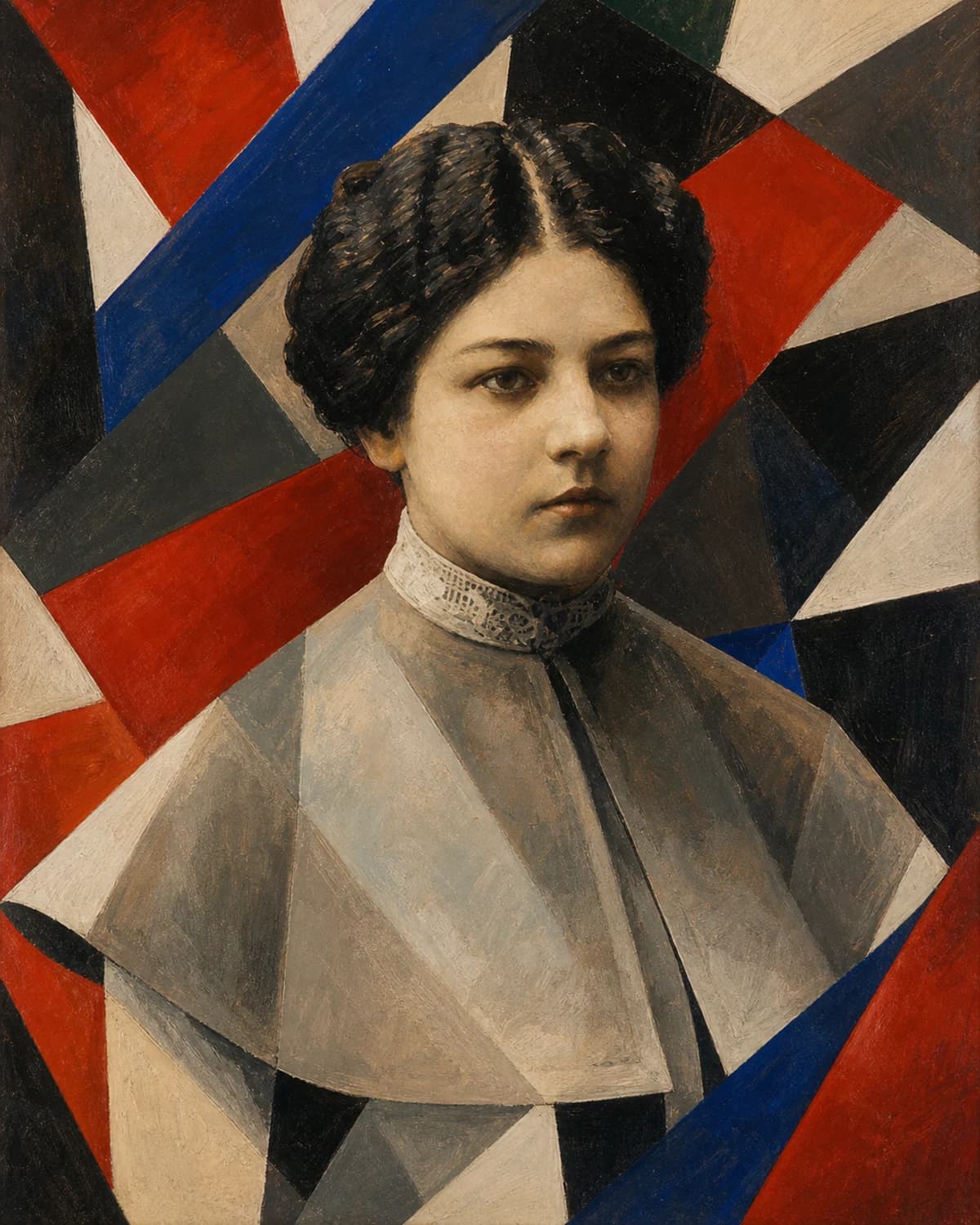
Biography
For Olga Rozanova’s funeral in November 1918, Kazimir Malevich and Ivan Kliun made a mourning flag, a Suprematist one. She was buried at the Novodevichy Convent, next to Chekhov’s grave. When Chekhov’s remains were later moved, Rozanova’s grave was lost.
She had been exhibiting for only seven years.
Rozanova was born in the district town of Melenki, in Vladimir Governorate, in the summer of 1886, but the exact day is uncertain: some sources give 21 June (3 July), others 22 June (4 July). The date of her baptism is better established: 26 June (8 July), in the local Intercession Cathedral. Both her parents came from the clerical estate. Her father, Vladimir Yakovlevich, a priest’s son, served as the district police chief; her mother, Elizaveta Vasilyevna, née Orlova, was a priest’s daughter. Olga was the youngest of the children. In 1896 she was sent to Vladimir to live with her aunt, Maria Vasilyevna Orlova, in a house on Borisoglebskaya Street (now Muzeinaya), and there she spent eight years at the girls’ gymnasium. Her father died in 1903; in her last year before graduating she boarded at the gymnasium, did well in her studies and wrote poetry.
In November 1906 Rozanova went to Moscow and enrolled at Anatoly Bolshakov’s private art school on Myasnitsky Proezd. In the summer of 1907 the Stroganov School turned her down. An obituary of 1919 claims that she did study there after all, briefly and without enjoyment; the scholar Nina Gurianova suggests she attended as an auditor. She gained more from the school of Konstantin Yuon and Nikolai Ulyanov, which she joined at the end of 1907. Lyubov Popova, Nadezhda Udaltsova and Aleksei Kruchenykh studied there too. She never went abroad to study, and for a woman artist of her circle that was something of an exception.
Petersburg began in 1910, when she met Nikolai Kulbin and, through him, Mikhail Matyushin and Elena Guro. The Union of Youth was taking shape in their flat, and Rozanova was among its founders. In 1911 she moved to the capital, looked in briefly at Elizaveta Zvantseva’s school, where Dobuzhinsky and Petrov-Vodkin taught, and gave it up. In April of that year her “Still Life” and “Café” hung at the Union’s exhibition. In “Café” a man and a woman sit on opposite sides of a small table: he props his head on his hand, she holds a glass, the paint is laid on thickly and the outlines are heavy. From then on she took part in all the group’s exhibitions and wrote for its almanac, and in 1913 it published her article “The Bases of the New Creation and the Reasons Why It Is Misunderstood”. To my mind it is one of the clearest texts of the early avant-garde: Rozanova lays out the road to abstraction in stages, from intuition, through the personal transformation of what is seen, to pure creation.
In 1912 she met Velimir Khlebnikov and Aleksei Kruchenykh. With Kruchenykh she was later bound by both work and a long, intermittent personal relationship. Together they devised a particular kind of Futurist book, in which drawing and text literally grow into one another on the page. “Te li le” (1913–1914) was printed by colour hectograph. Collage appeared in “Transrational Boog” (1915) and in the album “War” (1916). In all there were eighteen such books.
In the spring of 1914 Marinetti invited her to Rome. At the Free International Futurist Exhibition at the Sprovieri gallery the Russian section was represented by four artists: Rozanova, Archipenko, Kulbin and Exter. Among her works was “The Factory and the Bridge”, a piece plainly inspired by Italian Futurism. In 1915 in Petrograd she showed at “Tramway V”, and in December at “0,10”, where “Metronome” was exhibited. The “Playing Cards” series dates from the same time.
In 1916 Rozanova became secretary of the Supremus society, headed by Malevich. With Exter, Popova, Udaltsova, Kliun, Puni and others she made designs for the peasant craft workshops at Verbovka and Skoptsy that Natalia Davydova had set up. She wrote zaum poetry. The influence ran both ways: it was under her sway that Kruchenykh turned to non-objectivity and pasted together a book of colour collages, “Universal War”.
By 1917–1918 her painting had moved into pure colour. She herself called this series “colour painting”. “Green Stripe” is dated sometimes to 1917, sometimes to 1918, and is occasionally titled “Non-Objective Composition”: a pale field crossed by a vertical green stripe with soft edges. It seems to me that beside the “Black Square” it is a thing of a different nature: with Malevich it is form, with Rozanova it is a glow.
The revolution drew her into work at once. After February she joined the board of the Professional Union of Artist-Painters of Moscow, served in the Union of Towns, and then wrote articles for the newspaper “Anarchy”, such as “Suprematism and Criticism”. For 1 May 1918 she embroidered banners for the decoration of the city. On 22 June 1918 she was appointed head of the art industry subsection of the IZO department of Narkompros, and together with Alexander Rodchenko she set about reorganising the craft industries of Mstera, Bogorodsk and Ivanovo. In the autumn she worked on decorating Moscow for the first anniversary of the October Revolution. She died on 7 November 1918 in the Soldatenkov Hospital.
Her posthumous exhibition was held in Moscow from December 1918 to March 1919. An art school in Ivanovo-Voznesensk was named after her straight away. Her works are held, among other places, at the Museum of Modern Art in New York, the Philadelphia Museum of Art, the Thyssen-Bornemisza Museum and the Carnegie Museum of Art, and in 2024 the Russian Museum mounted a large exhibition of her work. Her aunt’s house in Vladimir was long thought to have been demolished; in 2017 Aleksei Areskin, a member of staff at the regional archive, found it through the documents. Since 2021 it has been under state protection, but it is in a dangerous state of disrepair.
Related context
Associations
Works connected through artistic movements, cultural context and period. Priced works available in this market appear first.








Profile notes
Profile and sources
Image
Artist image
На основе открытого изображения: Unknown author Unknown author; Wikimedia Commons; Public domain.
