
02.09.1875–09.08.1952
Olga Della-Vos-Kardovskaya
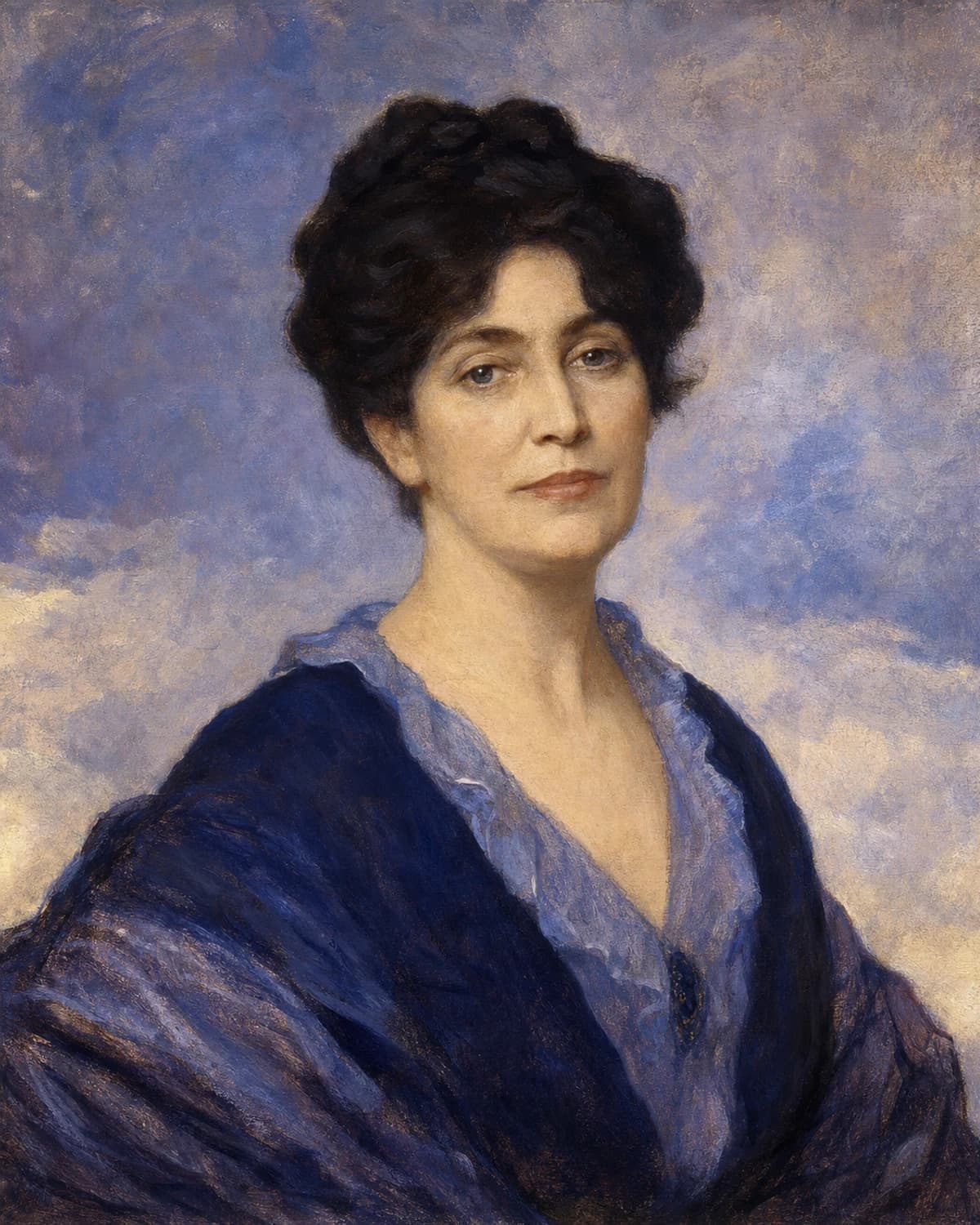
Olga Della-Vos-Kardovskaya (1875–1952), a pupil of Repin and the wife of the painter Dmitry Kardovsky, painted portraits of people of the Silver Age: her Nikolai Gumilev (1909) and Anna Akhmatova (1914) are in the Tretyakov Gallery. After the revolution she lived in Pereslavl-Zalessky and Moscow, did a great deal of book illustration, and spent her last years in Leningrad.
Biography
Olga Della-Vos-Kardovskaya painted Nikolai Gumilev in 1909 and Anna Akhmatova in 1914. Both portraits are now in the Tretyakov Gallery. In the same years she painted the poet Vasily Komarovsky (1911), her husband, the painter Dmitry Kardovsky (1913, also in the Tretyakov Gallery), her ten-year-old daughter Ekaterina in the picture “Little Woman” (1910), and in 1917 a self-portrait now in the Russian Museum.
She began in Kharkov, with a landscape painter.
She was born on 2 (14) September 1875 in Chernigov, the daughter of Ludwig Karlovich Della-Vos, a state councillor who headed the Chernigov Audit Chamber; the following year he became an actual state councillor, and later he headed the audit chamber in Kharkov. Her uncle, Viktor Karlovich Della-Vos, was the first director of the Imperial Moscow Technical School. Her mother, Maria Stepanovna, née Toshkovich, came from a Bulgarian family in Odessa. In 1891–1894 Olga studied in Kharkov at the private school of the landscape painter Egor Schreider. From 1894 to 1899 she attended the Higher Art School of the Academy of Arts, under Vasily Savinsky, Ivan Tvorozhnikov and others, and from 1898 Ilya Repin’s studio. She made her debut in 1897 at an exhibition of the Society for the Encouragement of the Arts with studies for the painting “Joan of Arc”. In April 1899 she married Dmitry Kardovsky, a fellow student, and, without finishing the Academy, left with him for Munich, intending to study at Anton Ažbe’s school.
How regular this study was is hard to say. In February 1900 her daughter Ekaterina was born in Munich, and from then on Olga Lyudvigovna learned painting mostly on her own. The family then lived at Alupka in the Crimea and in 1902 returned to St Petersburg. From 1902 to 1917 she exhibited at the Academy exhibitions, with the New Society of Artists, founded and led by her husband, with the Union of Russian Artists (1911–1916) and with the Zhar-tsvet society, and her pictures travelled to provincial towns and were shown abroad. Among the works of these years are “At the Dacha in the Crimea” and “Lady in a Riding Habit” (both 1902), “In the Room” (1903), which shows the Kardovskys’ flat on Vasilyevsky Island, “The Laundress” (1904), views of Tsarskoye Selo and Pavlovsk, “Apple Trees” (1914) and the trading rows of Rostov (1915). In 1912 she made a short trip to Switzerland and painted a small town with a bridge there.
From 1918 to 1924 she lived without a break in Pereslavl-Zalessky, on her husband’s estate. In 1923 her portrait of Innokenty Khalepsky, a member of the Revolutionary Military Council, was shown at the exhibition for the fifth anniversary of the Red Army, and the same year she took part in an AKhRR exhibition. In 1924 the Kardovskys moved to Moscow, where she taught a drawing class at the Art and Industrial Workshops. In 1924–1925 her pictures were in the exhibition of Russian art in New York, in 1925, 1926 and 1928 at the Zhar-tsvet exhibitions, and in 1927 at the large Moscow exhibition for the tenth anniversary of the revolution. She worked a great deal as a book illustrator. Among her landscapes of these years are the hills of Pereslavl (1926) and sheaves (1933). She also painted portraits of her contemporaries, the actor Vasily Kachalov (1937) and the writer Leonid Leonov. In 1938 a joint exhibition of the Kardovskys was held in the halls of the Academy of Arts of the USSR in Moscow. During the war they went back to Pereslavl-Zalessky, where Dmitry Nikolayevich died in 1943. After 1945 she lived in Leningrad.
Olga Lyudvigovna died in Leningrad on 9 August 1952 and is buried in the Bogoslovskoye Cemetery. In 1953 a memorial exhibition of her work was held at the Museum of the Academy of Arts. The main collections of her work are in the Pereslavl-Zalessky Museum-Reserve, the Tretyakov Gallery and the Russian Museum, and almost all of it was given to them by the Kardovskys’ daughter and grandchildren.
Related context
Associations
Works connected through artistic movements, cultural context and period. Priced works available in this market appear first.








Profile notes
Profile and sources
Image
Artist image
На основе открытого изображения: Olga Della-Vos-Kardovskaya; Wikimedia Commons; Public domain.
