
14.03.1872–29.08.1935
Oleksa Novakivskyi
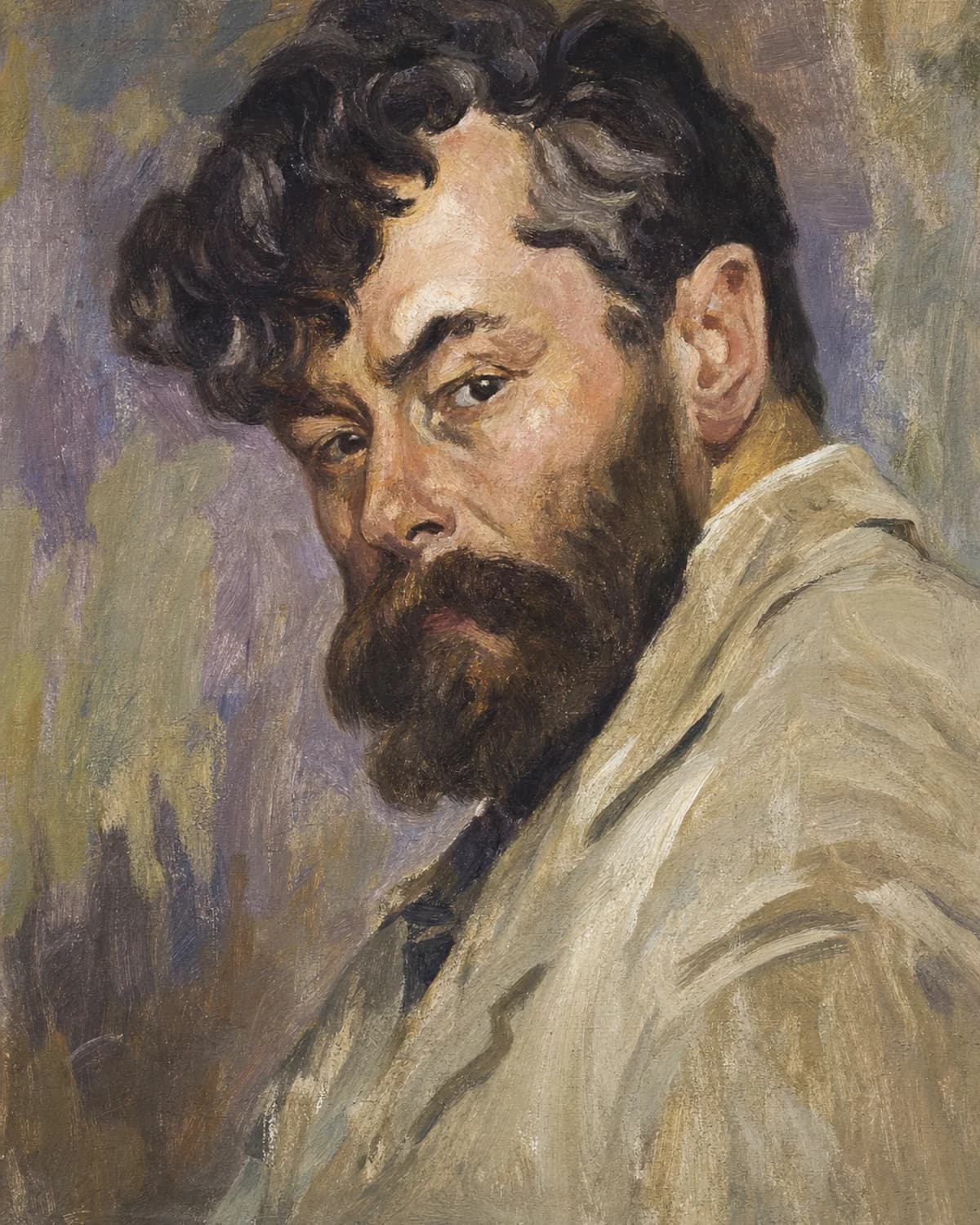
Oleksa Novakivskyi (1872–1935) was born into a forester's family in a Podolian village, studied in Odessa and at the Kraków Academy, and lived near Kraków for ten years. In 1913, at the invitation of Metropolitan Andrey Sheptytsky, he moved to Lviv, where he founded an art school that trained dozens of Galician painters. His works include “Self-Portrait with a Brush”, the portrait of his wife “My Muse”, and the panels “Science” and “Folk Art”.
Biography
The first exhibition at which Novakivskyi showed his work took place in 1901 in Kraków, at the Society for the Development of Ruthenian Art. Few people noticed him then. Recognition came only ten years later.
He was born on 14 March 1872 (2 March, Old Style) in the village of Sloboda-Obodivka in the Podolia Governorate of the Russian Empire, now Nova Obodivka in Vinnytsia Oblast. His father was a forester on the estate of a noble Polish family. According to the sources, the gifted boy was noticed by one of the local landowners, who paid for his education. From 1888 to 1892 Novakivskyi studied in Odessa with the decorative painter Filip Klimenko, then moved to Kraków and until 1900 studied at the Academy of Fine Arts. His teachers are said to have included Jan Matejko, Leon Wyczółkowski and Jan Stanisławski; the sources differ on exactly who they were.
For about ten years he worked in the village of Mogiła near Kraków, now part of Nowa Huta. He lodged in the house of an elderly widow and later married her daughter, Anna-Maria Palmowska. She posed for many of his pictures; from this period come “Children” (1905), “Koliada” (1907–1910), “Spring” (1909) and “Sunset in the Forest” (1910). In 1911 his first solo exhibition opened in Kraków, with more than a hundred works, and it brought him recognition. His painting grew out of Impressionist principles; Polish and Ukrainian writers place it in Kraków Post-Impressionism, and it seems to me that the second description is closer to what one sees on his canvases: planes of colour and line matter more here than light.
Metropolitan Andrey Sheptytsky took an interest in his pictures and suggested that he move to Lviv. In 1913 Novakivskyi settled there and soon began to teach. The sources give different dates for the founding of his school: 1913 or 1923. Among those who studied there were Leonid Perfetsky, Roman Selsky, Sofia Zaritska, Stepan Lutsyk, Hryhorii Smolsky, Stefania Gebus-Baranetska, Mykhailo Moroz, Sviatoslav Hordynsky and many others; Ukrainian writers regard it as one of the notable features of the artistic culture of Galicia. On 10 August 1914 Sheptytsky married Novakivskyi to Anna-Maria Palmowska. They had two sons. She died in April 1925, and her likeness kept returning in his work for several more years.
His first solo exhibition in Lviv, in 1921, was a great success. Polish critics received it warmly, though they saw in him a Ukrainian epigone of the Kraków school. In 1924–1925 he was dean of the art faculty of the Secret Ukrainian University in Lviv, an underground institution of higher education. Works named from these years include “St. George's Cathedral” (1925), “Music” (1929), “Dovbush” (1931), and portraits of Dmytro Levytsky, Metropolitan Sheptytsky and Osyp Barvinsky. Among his other works are the panels “Folk Art” and “Science” (1915–1916), “Awakening” (1912) and “Nude with a Red-Haired Woman”. In 1932 his students formed the art group RUB, with an artistic and ideological programme.
Novakivskyi died in Lviv on 29 August 1935 and was buried in the Lychakiv Cemetery.
In 1940 twenty of his paintings from the collection of the Sheptytsky museum were taken to Moscow for an exhibition marking the anniversary of the Soviet annexation of Western Ukraine; they never returned to Lviv, and their fate is unknown. The Oleksa Novakivskyi Memorial Art Museum was opened in his Lviv house in 1972.
Related context
Associations
Works connected through artistic movements, cultural context and period. Priced works available in this market appear first.








Profile notes
Profile and sources
Image
Artist image
На основе открытого изображения: Oleksa Novakivsky; Wikimedia Commons; Public domain.
