
11.01.1911–30.12.2003
Nora Heysen
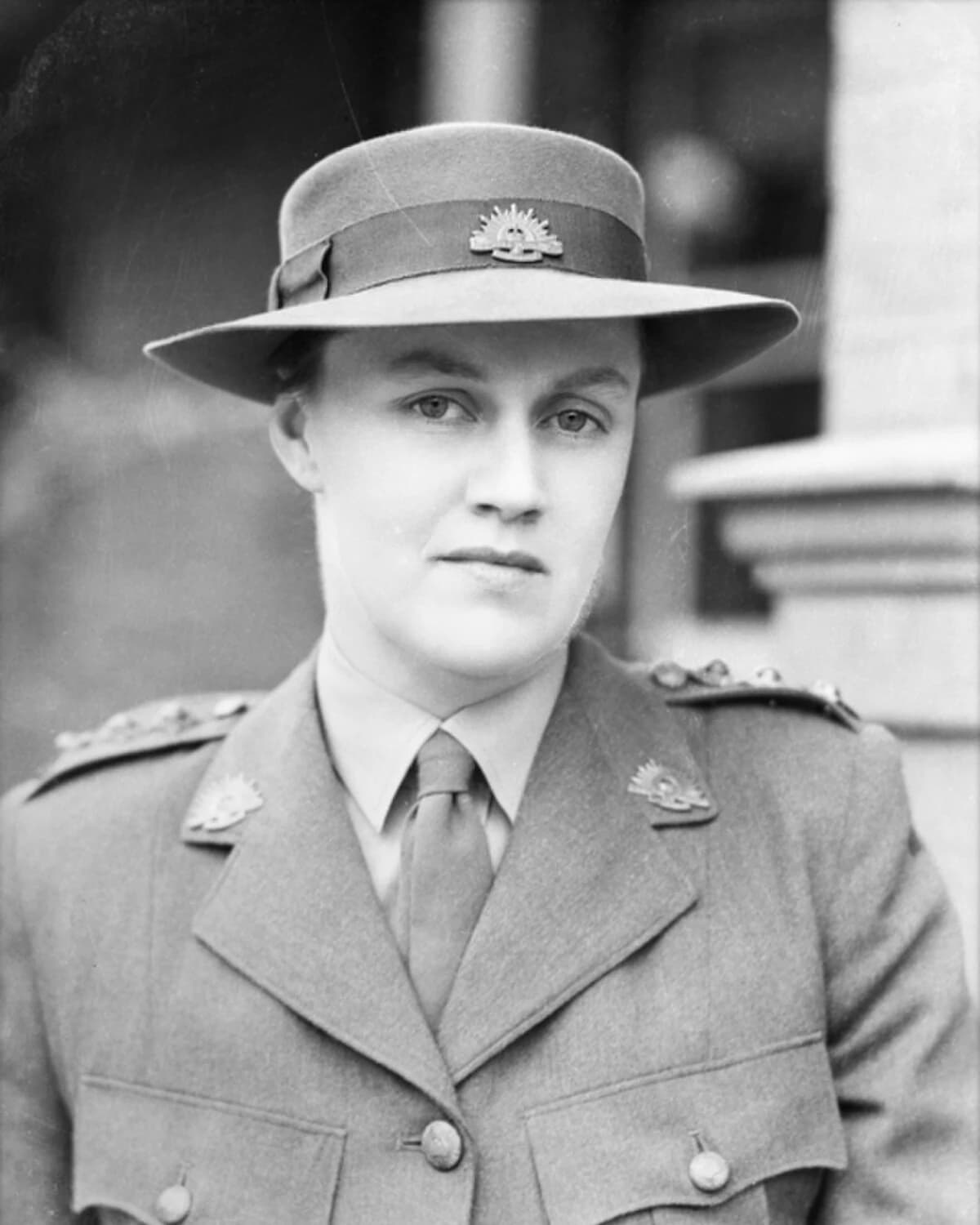
Nora Heysen (1911–2003), daughter of the landscape painter Hans Heysen, became in 1938 the first woman to win Australia’s Archibald Prize for portraiture. In 1943 she became the first Australian woman appointed an official war artist: she painted women serving in the army, navy and air force, and from 1944 she served in New Guinea. Of her early work, the still lifes are now especially valued, “Eggs” (1927) among them.
Biography
In 1939 The Australian Women’s Weekly ran a piece about her under the headline “Girl Painter Who Won Art Prize is also Good Cook”, complete with three of her favourite recipes. A year earlier Nora Heysen had become the first woman to win Australia’s Archibald Prize for portraiture.
She was born on 11 January 1911 in Hahndorf, South Australia, the fourth child of the landscape painter Hans Heysen and his wife Selma, née Bartels, and grew up in the family home, The Cedars, in the Adelaide Hills. The children were taught drawing at home by the artist Mary Anstie Overbury; her parents saw that Nora was the most gifted of them and encouraged her. From 1926 to 1930 she studied at the School of Fine Arts in Adelaide under F. Millward Grey. For the next three years she went there two days a week and spent the rest of her time working in her own studio. As early as 1930 her paintings were bought by the art galleries of New South Wales and South Australia. That same year she made twenty-four pen, ink and wash drawings for Katie Langloh Parker’s collection of legends “Woggheeguy”. In 1931 she spent two weeks studying at the Julian Ashton Art School in Sydney.
Her first solo exhibition was held in Sydney in 1933, and with the proceeds she went to study in England.
In 1934 the Heysens travelled to London as a family; her parents went home, but Nora stayed until 1937 and studied at the Central School of Arts and Crafts under Bernard Meninsky. She went to the National Gallery, the National Portrait Gallery and the Tate and wrote to her father about what she saw there. Homesick, she invited a friend, the sculpture student Everton Stokes, to share her London flat, and painted her portrait. On her return she went briefly to Adelaide and then moved to Sydney.
For the 1938 Archibald Prize she entered two portraits, and the prize went to “Madame Elink Schuurman”. The painter Max Meldrum criticised the win publicly, and a dispute followed.
On 12 October 1943 Heysen was appointed a war artist with the honorary rank of captain. Her brief was a narrow one, she later recalled: to show the women’s war effort. She was lent now to the air force, now to the navy, now to the army, and painted women at everything they did. From April 1944 she was stationed in New Guinea, and she was discharged there in 1946. Her years of service produced more than a hundred and seventy works, among them a portrait of Private Gwynneth Patterson of the Australian Army Medical Women’s Service (1944).
After the war she spent some time in London, returned to Sydney in 1948, and went on painting, exhibiting and travelling. In 1993 the Australia Council gave her its Award for Achievement in the Arts, and in 1998 she was made a Member of the Order of Australia. Nora Heysen died on 30 December 2003 in Sydney.
Her work is held by the National Gallery of Australia, the Australian War Memorial, the National Library, the National Portrait Gallery and several state galleries. In 2019 the National Gallery of Victoria showed father and daughter together in the exhibition “Hans and Nora Heysen: Two Generations of Australian Art”. The critic John McDonald called her career a stop-start affair but observed that the daughter’s star was now rising while the father’s was in decline. He singled out as her signature work the still life “Eggs” (1927), painted when she was sixteen. I like the irony: for the first woman to win a prize for portraiture, the critic’s choice of her key work is a still life. “Still Life with Quinces” (1933), in the same critic’s words, is painted with the precision of an old master.
Related context
Associations
Works connected through artistic movements, cultural context and period. Priced works available in this market appear first.








Profile notes
Profile and sources
Image
Artist image
Ronald Keith Monro; Wikimedia Commons; Public domain.
