
1983–present
Njideka Akunyili Crosby
Njideka Akunyili Crosby (born 1983) grew up in Enugu and Lagos, moved to the United States at sixteen and works in Los Angeles. Her large works on paper combine painting, drawing, collage and transfers of photographs from Nigerian magazines and family snapshots: rooms where things Nigerian and American sit side by side. In 2017 she received a MacArthur Fellowship.
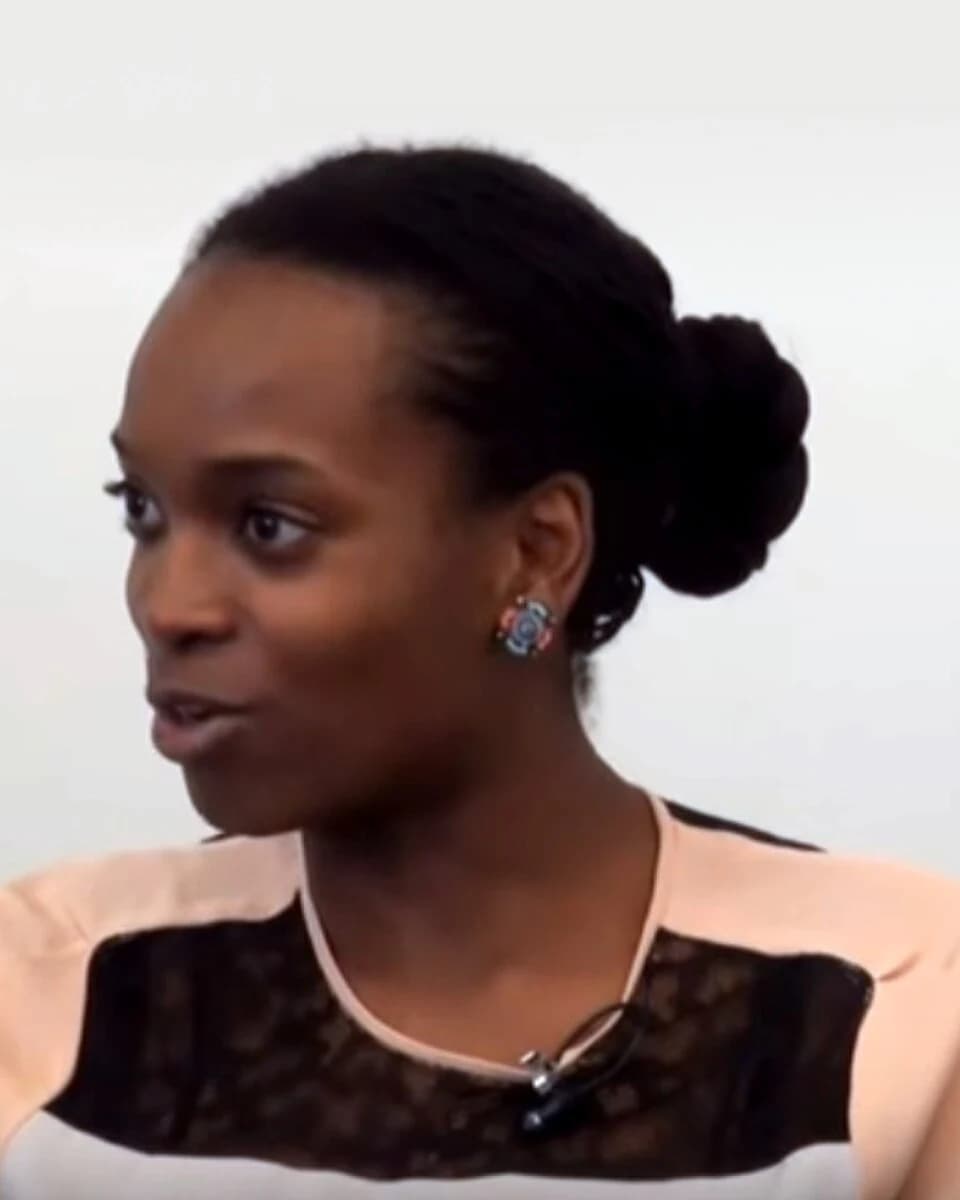
Biography
A young woman lies on a bed in an empty room, surrounded by patterns tied to her Nigerian heritage. “The Rest of Her Remains” was made in 2010, while she was still studying at Yale: drawing, painting, photocopies transferred onto paper and collage, with the figure’s dress assembled in papier collé from cut-out, ready-made paper. The pose and the placing of the body repeat Édouard Manet’s “The Dead Toreador”. The woman on the bed is the artist herself, only younger.
The title speaks of the rift between an American life and a Nigerian childhood.
Njideka Akunyili was born in 1983 and grew up in Enugu, in an Igbo family, speaking two languages, Igbo and English, from childhood. At thirteen she went to Lagos to attend Queen’s College in Yaba; there she had access to far more Nigerian, British and American popular culture, which accounts for the kinship between her work and art that draws on pop culture. In 1999, at sixteen, she moved to the United States. A year went on preparing for the admission tests and on classes in American history, science and calculus; then she went back to Nigeria to serve the required year of National Service, and only after that did she begin her studies in Philadelphia.
She took her first oil painting class at the Community College of Philadelphia, and her teacher, Jeff Reed, persuaded her to apply to Swarthmore College. There she studied art and biology and planned to go into medicine. In her final year she found that she enjoyed her art classes more than organic chemistry, and in 2004 she graduated having already decided to become an artist. Then came the Pennsylvania Academy of the Fine Arts (a certificate in 2006) and the Yale School of Art, where she took her master’s degree in 2011.
Straight after Yale she was given a residency at the Studio Museum in Harlem, known for its support of young artists of African descent. There she met the New York artist Wangechi Mutu, who became her mentor. The residency year went on experiments with drawing and figure painting and on the study of contemporary art, postcolonial history and diaspora studies.
She gathers her material herself: photographs she has taken in Nigeria, family snapshots, pages from popular Nigerian magazines. The images are transferred onto paper with acetone and pasted in as collage, and on top come acrylic, charcoal, fabric and coloured pencil. These transfers make up the characters’ dresses, the wallpaper, floors and curtains, so that the hairstyles, fashions, architecture and furniture of two cultures end up in a single room. Transfer blurs a photograph and makes it less sharp, and she likes this: it is how, as she sees it, information gets lost when a person moves from one cultural space to another. As she works she keeps two viewers in mind, an American and a Nigerian, and she regards the works themselves as the autobiography of someone who cannot be fitted into any ready-made frame. In most of the scenes the women are in command of the situation, and she particularly wanted to show interracial marriage. Mutu, from whom she learned to build one image out of many others, uses them to speak of fracture. I think Akunyili Crosby’s aim runs the other way, and she herself calls it syncretism.
Among those she learned from she names Édouard Vuillard and Chris Ofili and the African photographers J. D. ’Okhai Ojeikere and Malick Sidibé. Kerry James Marshall showed her how to join African domestic intimacy with Western painting and, in her words, gave her the confidence to take the European tradition in her own direction. From Chinua Achebe came the idea that the English language can be bent and rebuilt so that it can carry the African experience; her works on paper do the same to the European picture.
Before her first museum solo show there were an exhibition in Minneapolis (2013) and the Smithsonian American Art Museum’s James Dickey Contemporary Art Prize (2014). In 2015 the curator Jamillah James, formerly of the Studio Museum, organised her exhibition at the Hammer Museum in Los Angeles. The same year she took part in the New Museum Triennial in New York and received its Next Generation prize, and the Studio Museum awarded her the Joyce Alexander Wein Artist Prize. In 2016 came a solo exhibition at the Norton Museum of Art in West Palm Beach, the Prix Canson and a place among the Financial Times Women of the Year; in 2017, the fellowship of the John D. and Catherine T. MacArthur Foundation. Then followed exhibitions at the Contemporary Arts Center in Cincinnati (2017), the Baltimore Museum of Art and the National Portrait Gallery in London (2018), the Istanbul Biennial and Prospect.4 in New Orleans (2017), and the main exhibition of the 58th Venice Biennale (2019). Since 2014 she has been represented by the Victoria Miro gallery in London, and since 2018 also by David Zwirner.
In 2018 her mural was wrapped around the building of the Museum of Contemporary Art on Grand Avenue in Los Angeles; she was the second artist to make such a work under a new museum programme. In 2019 Swarthmore College awarded her an honorary doctorate. In 2021 she made a work commissioned by the Metropolitan Museum of Art for the exhibition “Before Yesterday We Could Fly”, in 2022 she took part in “Women Painting Women” at the Modern Art Museum of Fort Worth, and in 2023 the Huntington showed a selection of her work chosen by the New Yorker critic Hilton Als.
In April 2026 the Obama Foundation named her among the artists commissioned to make works for the Obama Presidential Center in Chicago. Her work, with a portrait of Barack and Michelle Obama, is intended for the museum’s main lobby; the center’s opening was scheduled for 19 June 2026.
Profile notes
Profile and sources
Image
Artist image
Bronx Museum Teen Council; Wikimedia Commons; CC BY 3.0.
