
13.11.1905–04.03.1952
Nil Khasevych
Nil Khasevych (1905–1952), a native of Volhynia, studied graphic art in Warsaw under Władysław Skoczylas and in the 1930s exhibited prints and bookplates in Lviv, Prague, Berlin, Chicago and Los Angeles. A member of the OUN and the Ukrainian Supreme Liberation Council, in the 1940s he drew and cut in wood propaganda graphics for the underground publications of the UPA.
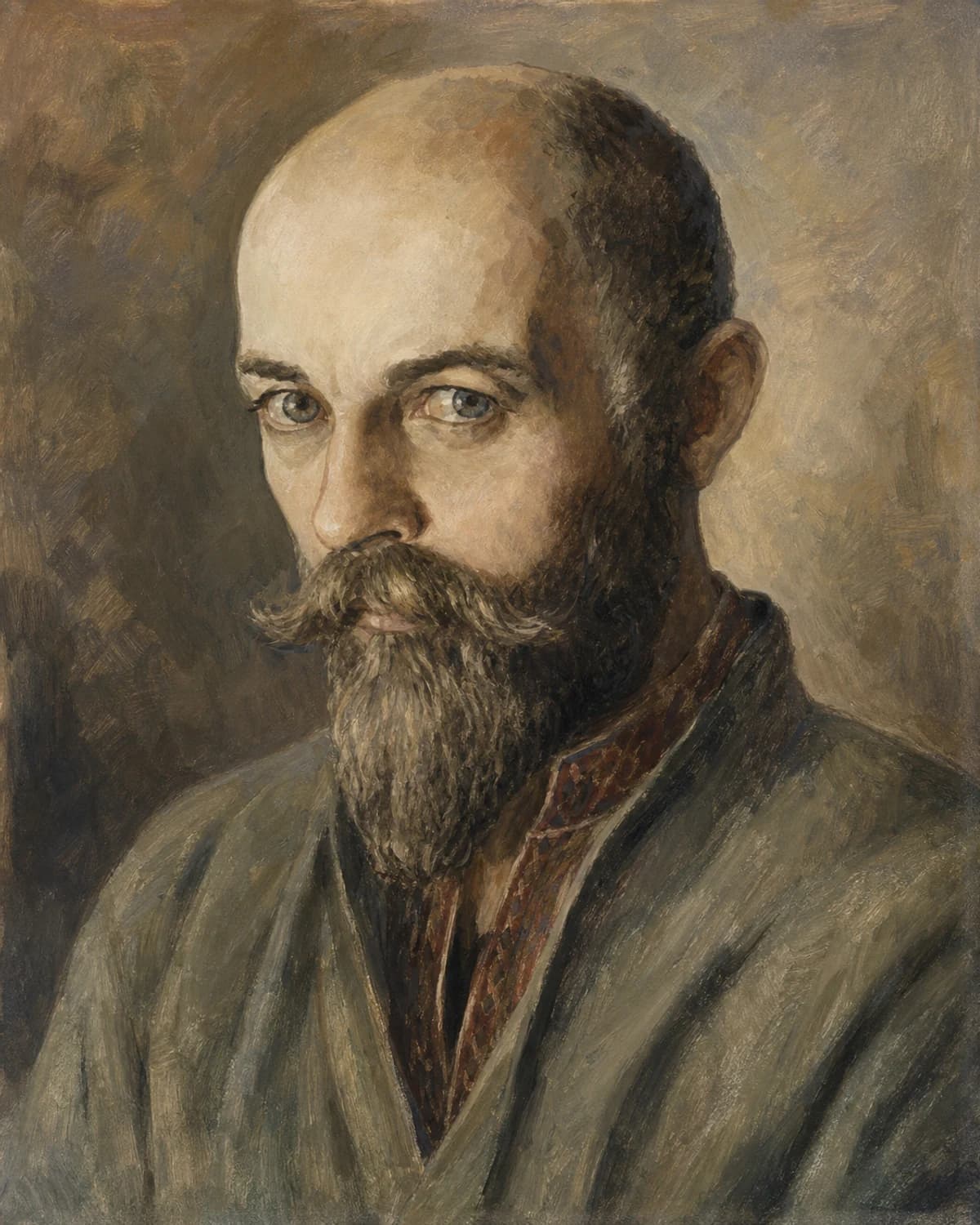
Biography
As a student at the Warsaw School of Fine Arts, Nil Khasevych copied out the Peresopnytsia Gospel with a goose quill, following the example of Heorhiy Narbut and in this way mastering Cyrillic lettering. In an essay written in February 1933 he explained why this mattered: “drawing is absolute truth”, and in this language, he believed, everything could be expressed. The interest in letters and inscriptions that grew out of this training, I think, ran through all his later graphic work.
He was born on 12 (25) November 1905 in the village of Dyuksyn in Rovno district, Volhynian Governorate, the son of Anton Ivanovych Khasevych, a deacon and psalm-reader, and his wife Fedoriya. His two elder brothers, Anatoliy and Fedir, became priests. Nil too was meant for the seminary in Zhitomir, but the revolution got in the way, and he went instead to a private Ukrainian gymnasium in Rovno, travelling there along the railway line or by cart. In 1918, on the way to town, their cart was hit by a train at a level crossing. His mother was killed, and Nil lost his left leg and carved himself a wooden prosthesis. He went on studying, painted icons, having learned the craft from masters in Rovno, and worked in Vasyl Len’s studio. The compensation paid by the French company that owned the railway allowed him to go to Warsaw to study.
In 1925 he passed the Rovno gymnasium examinations as an external student and entered the Warsaw School of Fine Arts (an Academy from 1932), at first as an auditing student; he became a full student in 1930. He was taught painting by Miłosz and Mieczysław Kotarbiński, graphic art by Władysław Skoczylas and weaving by Stanisław Czajkowski; as his specialism he chose “graphics and weaving”. A fellow student, Petro Mehyk, remembered him as short, poorly dressed, with a stick and a home-made wooden leg. During his student years Khasevych became one of the founders and the secretary of “Calm”, an association of young Ukrainian artists. In 1931 his painting “Washerwomen”, in which he showed his neighbours doing the laundry, received a Vatican award; in 1932 his portrait of Hetman Mazepa won a diploma from the Academy; and in 1937 he received a cash prize at an international exhibition of prints in Warsaw.
Gradually he moved from oil painting to wood engraving and the bookplate. His work was printed in Polish magazines, among them Znicz, and he showed it at thirty-five exhibitions, in Lviv, Prague, Berlin, Chicago and Los Angeles, where it won diplomas. In 1939 the album “Bookplates of Nil Khasevych” was published in Warsaw. Besides bookplates he worked in easel and book graphics and illustrated books.
He had to give up his studies for lack of money. Back in Volhynia, he taught at a primary school, worked as a bookkeeper at a village cooperative, and went on drawing and exhibiting.
Shortly before the Second World War Khasevych joined the Organisation of Ukrainian Nationalists, and during the war he went into the OUN and UPA underground, where he was known under the pseudonyms “Bei-Zot”, “Staryi”, “333”, “Levko”, “Dzhmil” and “Rybalko”. There he ran an underground printing house that turned out brochures, leaflets and postcards on a home-made press, worked in the editorial office of the journal “To Arms” and drew for the satirical publications “Ukrainian Pepper” and “Horseradish”. He designed flags, seals and forms, several types of “bofony” (the underground’s money receipts), including the Volhynian series in denominations from 10 to 1,000 karbovantsi, awards, and a coat of arms with the trident in a cartouche. His experience as a bookplate artist helped him to fuse image and inscription into one whole. He taught wood carving to young members of the underground; an album of their work survives with notes such as “corrected by Khasevych”. In 1942–1943 his painting “Sleep, Lads, Sleep…” was shown at an exhibition of Ukrainian artists in Lviv, and in 1944 he completed the cycle “Volhynia in Struggle”. He was a member of the Ukrainian Supreme Liberation Council, and in 1948 he himself received the Silver Cross of Merit and the medal he had designed.
In 1951 the engravings he had made in the underground reached delegates to the United Nations General Assembly, and in 1952 they were published in Philadelphia as the album “Graphics in the Bunkers of the UPA”. A special MGB task force was set up to track the artist down.
Nil Khasevych died on 4 March 1952 in a hiding place on a farmstead near the village of Sukhovtsy, twelve kilometres from Klevan. Where he is buried is unknown.
In June 1992 most of his works were transferred from the archives of the Security Service of Ukraine to the Lutsk Museum of Local History, and in 2008 a further hundred and three prints, with the wooden blocks for them, went to the National Museum of the History of Ukraine in the Second World War.
Related context
Associations
Works connected through artistic movements, cultural context and period. Priced works available in this market appear first.








Profile notes
Profile and sources
Image
Artist image
На основе открытого изображения: Ніл Хасевич; Wikimedia Commons; Public domain.
