
28.08.1794–23.08.1873
Nikolay Maykov
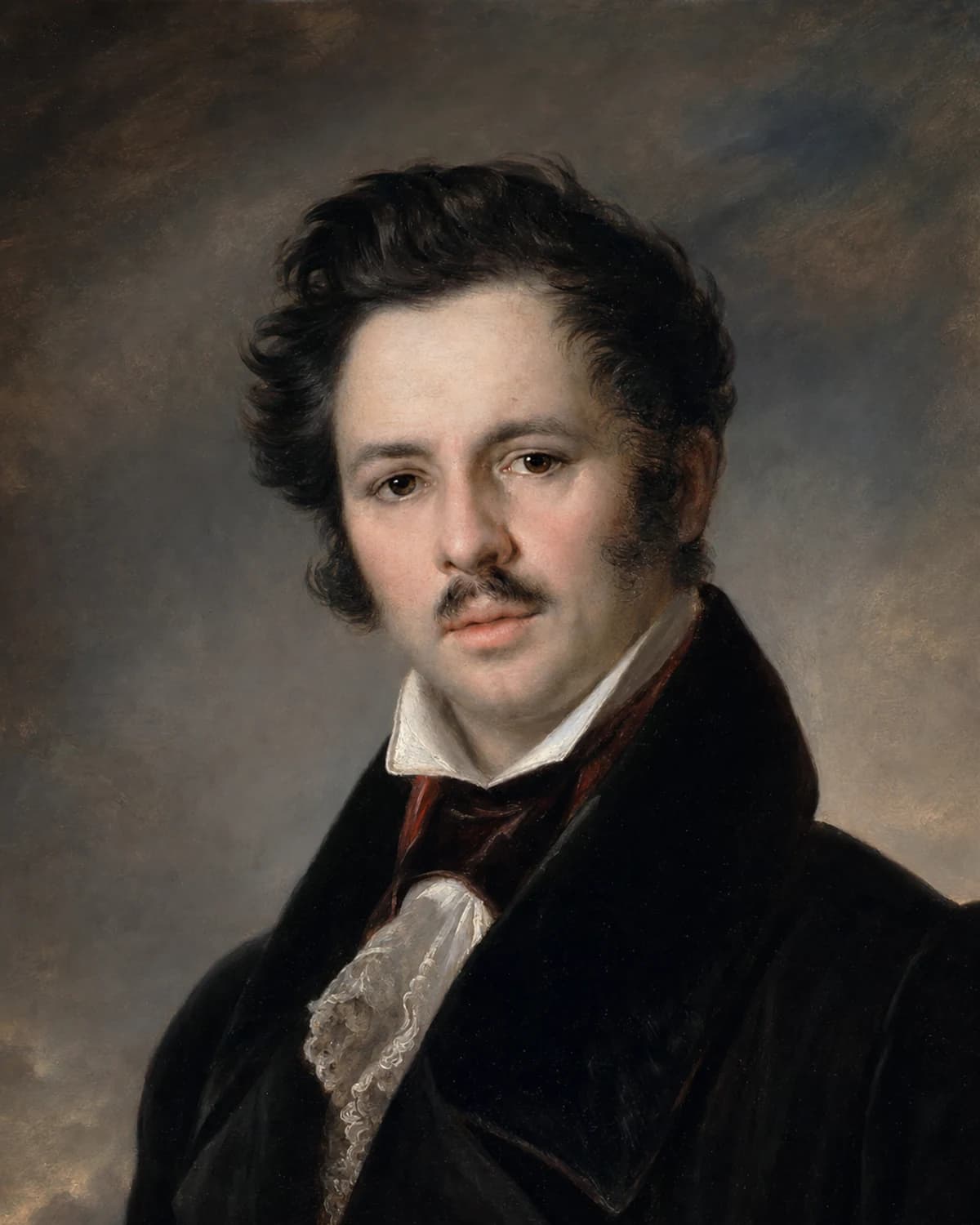
Nikolay Maykov (1794–1873) came to painting from the army: he began to draw while recovering from a wound received at Borodino, and he never had a formal art education. In 1835 he was made an academician for an altarpiece in the Trinity Cathedral of the Izmailovsky Regiment. He painted icons and ceiling panels for Saint Isaac’s Cathedral, portraits and decorative murals, and a literary circle met in his house.
Biography
Nikolay Maykov became an academician without having spent a single day at the Academy of Arts. In 1835 Emperor Nicholas I ordered that the title be conferred on him for an altarpiece in the Trinity Cathedral of the Life Guards Izmailovsky Regiment, and the Academy’s Council complied.
He was born on 28 August 1794 (8 September, New Style; 28 August, Old Style), according to the generally accepted data in Moscow; the Russian Museum puts a question mark beside Moscow, and the Russian Academy of Arts names Saint Petersburg. Older genealogical literature also gives 1796. His father, Apollon Maykov, was a poet and a director of the Imperial Theatres; his mother, Natalia Ivanovna, came from the Serebryakov family.
From 1801 the boy studied at the Second Cadet Corps in Saint Petersburg. He did not complete the full course: in 1812 he was sent to the army in the field. At Borodino he was wounded in the leg and was sent to recover at his father’s estate near Yaroslavl. There, out of boredom or inclination (Ivan Goncharov, on Maykov’s own account, reported it in just this way), he began to draw. Back with the army, he went through the campaigns abroad, sketching soldiers’ life and portraits of fellow officers, and in Paris he first tried oil paints. He wanted to go on from there to Italy to study art, but the journey never took place. In 1821 he retired as a major of the Hussar Regiment of the Prince of Orange.
After that he taught himself. In Moscow he copied well-known painters, including works in the Yusupov collections; he lived in the city and in Nikolskoye, outside it. In 1820 he married Evgenia Petrovna Gusyatnikova, later a writer. In 1834 the family moved to Saint Petersburg.
In the capital Nicholas I took notice of him. On the emperor’s commission Maykov painted icons for the Izmailovsky cathedral, and the title of academician recognised a finished work, not a completed course. Later he worked for more than ten years for Saint Isaac’s Cathedral, painting icons for the chapel of Saint Alexander Nevsky and four ceiling panels for the side aisles. Some of his images were afterwards replaced by others designed to be reproduced in mosaic. According to the Saint Isaac’s Cathedral museum, seven of his original works survived there as of 2020: “The Last Supper” above the royal doors of the Alexander Nevsky chapel, “Saint Olga”, “Saint Vladimir” and the ceiling panels “Faith”, “Hope”, “Love” and “Wisdom”. In “The Last Supper” the museum’s description singles out the figure of Judas in the foreground; in October 2020 the painting was taken down for restoration and a photographic copy hung in its place. According to the reference work by Andrey Somov, he also painted “The Descent of the Holy Spirit”, “The Epiphany” and “The Adoration of the Magi” for the small church of the Winter Palace, “The Agony in the Garden” for Countess Sofia Panina, and the iconostases of the churches of Saint Nicholas and Saint Vladimir in Sevastopol.
The secular part of his work is smaller in volume but varied. He painted portraits of his son Vladimir, of his father (1836) and of Nicholas I (1840), and the pictures “Bacchante with a Cup” and “Venus”. Goncharov recalled bacchantes, a female figure in the Yelagin Palace, and ceiling paintings with medallions in Princess Yusupova’s house on Liteyny Prospekt in Saint Petersburg. Goncharov admired his colour and explained his weaknesses by the lack of schooling. The Russian Museum holds “Head of Christ” (about 1840) and “Virgin and Child” (late 1840s to early 1850s).
The Maykovs’ house in Saint Petersburg became a meeting place for writers. Goncharov, Nikolay Nekrasov, Ivan Panaev, Ivan Turgenev, Dmitry Grigorovich and Fyodor Dostoevsky came there. For the family’s handwritten journal “Snowdrop” (1835–1838) Nikolay Apollonovich drew illustrations, headpieces and vignettes together with his son Apollon; the almanac “Moonlit Nights” followed (1839). He also wrote memoirs, which Elena Gayntseva studied and published in 1997. Of his five sons, four reached adulthood: the poet Apollon, the critic Valerian, the writer and publisher Vladimir, and the literary historian Leonid.
In the last two or three years of his life Maykov went almost blind and could not finish the pictures he had begun. He died on 23 August 1873 (4 September, New Style) in Saint Petersburg. Goncharov published an obituary in the newspaper “Golos” on 29 August; the funeral, by his account, took place on 27 August, Old Style, at the cemetery of the Novodevichy Convent.
Related context
Associations
Works connected through artistic movements, cultural context and period. Priced works available in this market appear first.








Profile notes
Profile and sources
Image
Artist image
На основе открытого изображения: Vasily Andreevich Tropinin; Wikimedia Commons; Public domain.
