
25.12.1859–17.12.1930
Nikolay Kasatkin
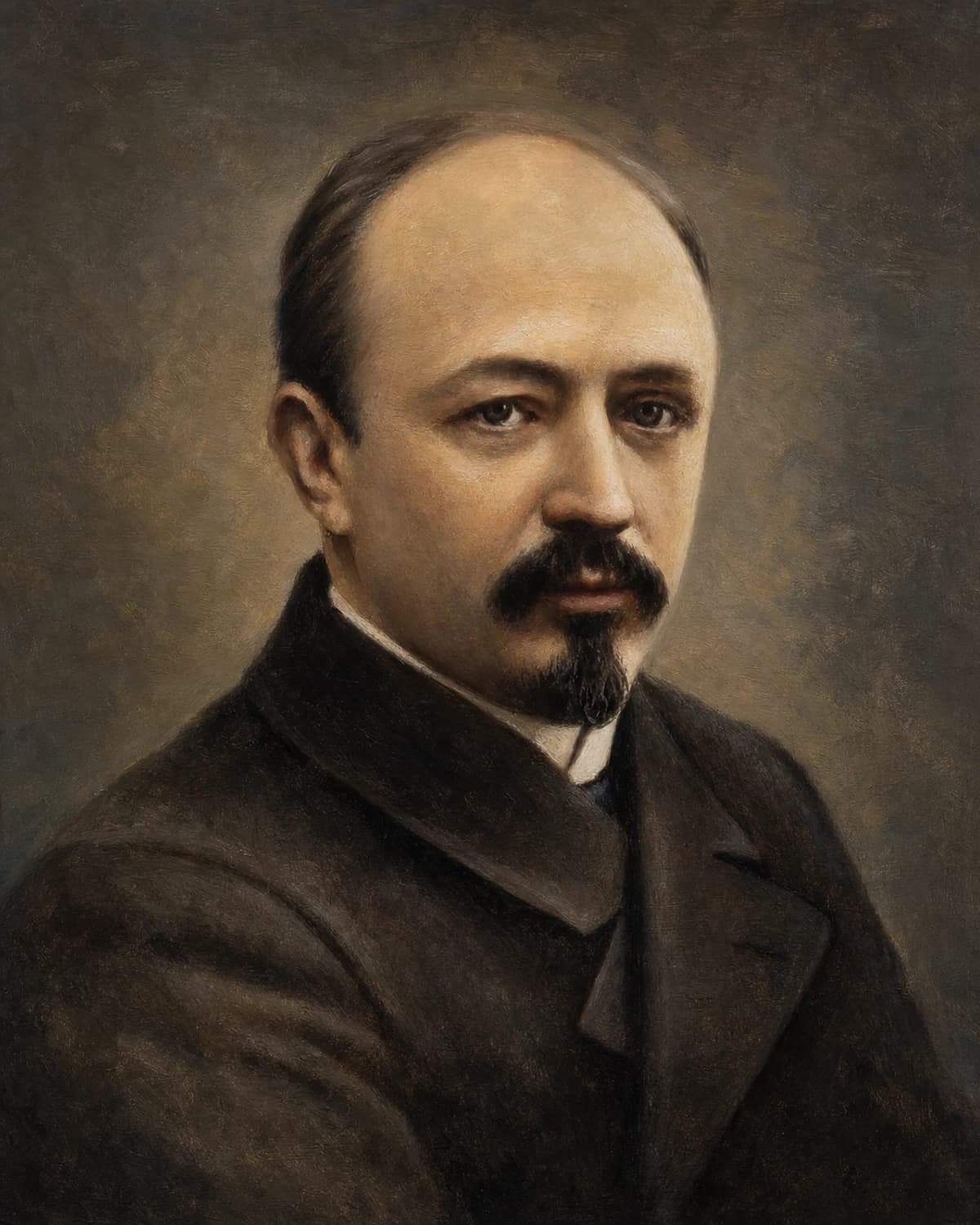
Nikolay Kasatkin (1859–1930) painted miners, workers and their families: his trips to the Donbas in 1894 and 1895 produced “The Woman Miner”. For twenty-three years he taught at the Moscow School of Painting, Sculpture and Architecture, worked with Sytin’s publishing house for about thirty years, and in 1923 became the first to receive the title of People’s Artist of the Republic.
Biography
Nikolay Kasatkin received the large silver medal, the highest award of the Moscow School of Painting, Sculpture and Architecture, in 1883 for his painting “Beggars at the Church Door”. Together with the medal he was given the title of artist. Behind him lay ten years of study under Vasily Perov and Illarion Pryanishnikov.
His father, Alexei Alexandrovich, was an engraver and lithographer, and printing stayed with the son all his life.
Kasatkin was born on 13 (25) December 1859 in Moscow, and almost his whole life was spent in that city. He entered the School in 1873. Immediately after he graduated, Ivan Sytin, Russia’s largest book publisher, invited him to join his firm, and the artist worked with it for about thirty years: he drew for “Russian History in Pictures”, for the first desk calendar and for the jubilee publication “The Great Reform”, marking the fiftieth anniversary of the abolition of serfdom, and he taught lithography.
In 1891 he began to exhibit with the Peredvizhniki and became a member of their Association. That same year saw “A Worker’s Family”, followed by “Hard Going”, also known as “The Stormy Petrel” (1892), “The Smithy” (1897), and “Women Prisoners at a Visit” and “A Worker from the Urals” (1899). In 1894 and 1895 he travelled to the Donbas, and out of these trips grew his mining pictures, among them “The Woman Miner”. From 1894 to 1917 Kasatkin taught at his old School; his students included Boris Ioganson and Vasily Meshkov. In 1898 he became an academician, and in 1903 a full member of the Academy of Arts. At the Exposition Universelle of 1900 in Paris he won a silver medal, and in 1904 he took part in the World’s Fair in St Louis. The Revolution of 1905 gave rise to a whole series: “Alarm”, “The Worker Militant”, “After the Search”, “The Student”, “The Spy’s Last Journey”. He was called “the Gorky of painting”, and to my mind the nickname speaks above all of his choice of subjects: blacksmiths, women prisoners, miners, working families.
After 1917 the School was closed and merged into the Free State Art Studios as the Second Studios. Kasatkin went on teaching, now for the education department of the Sokolniki district council. In 1922 he joined the Association of Artists of Revolutionary Russia and remained in it until 1926, and in 1923 he became the first to receive the title of People’s Artist of the Republic. In 1924 he was sent to England to paint the life and struggle of the workers there. His late successes are single portrait-types: “Off to Study: Pioneer Girl with Books” (1926) for the Museum of the Revolution, “Komsomol Girl, Student of the Workers’ Faculty”, “Komsomol Girl, Pioneer Leader”, “Hero of the Defence of the USSR”.
On 17 December 1930 Kasatkin was at the Museum of the Revolution, explaining his new painting “Sigida”, or “The Kara Tragedy”, about the political convict Nadezhda Sigida. There, during this presentation, he died suddenly. On 19 December his body was cremated. Where his ashes were buried I have not been able to verify: the sources name only Moscow, and even that with a reservation.
Related context
Associations
Works connected through artistic movements, cultural context and period. Priced works available in this market appear first.








Profile notes
Profile and sources
Image
Artist image
На основе открытого изображения: Unknown author Unknown author; Wikimedia Commons; Public domain.
