
1830–03.05.1904
Nikolai Nevrev
Nikolai Nevrev (1830–1904) graduated from the Moscow School of Painting and Sculpture and made his name with scenes of everyday life in the 1860s: a merchant’s name-day, a village requiem, the sale of a serf in “From the Recent Past”. From the mid-1870s he painted Russian history, from Roman of Galicia to the trial of Patriarch Nikon. A Peredvizhnik from 1881; many of his pictures are in the Tretyakov Gallery.
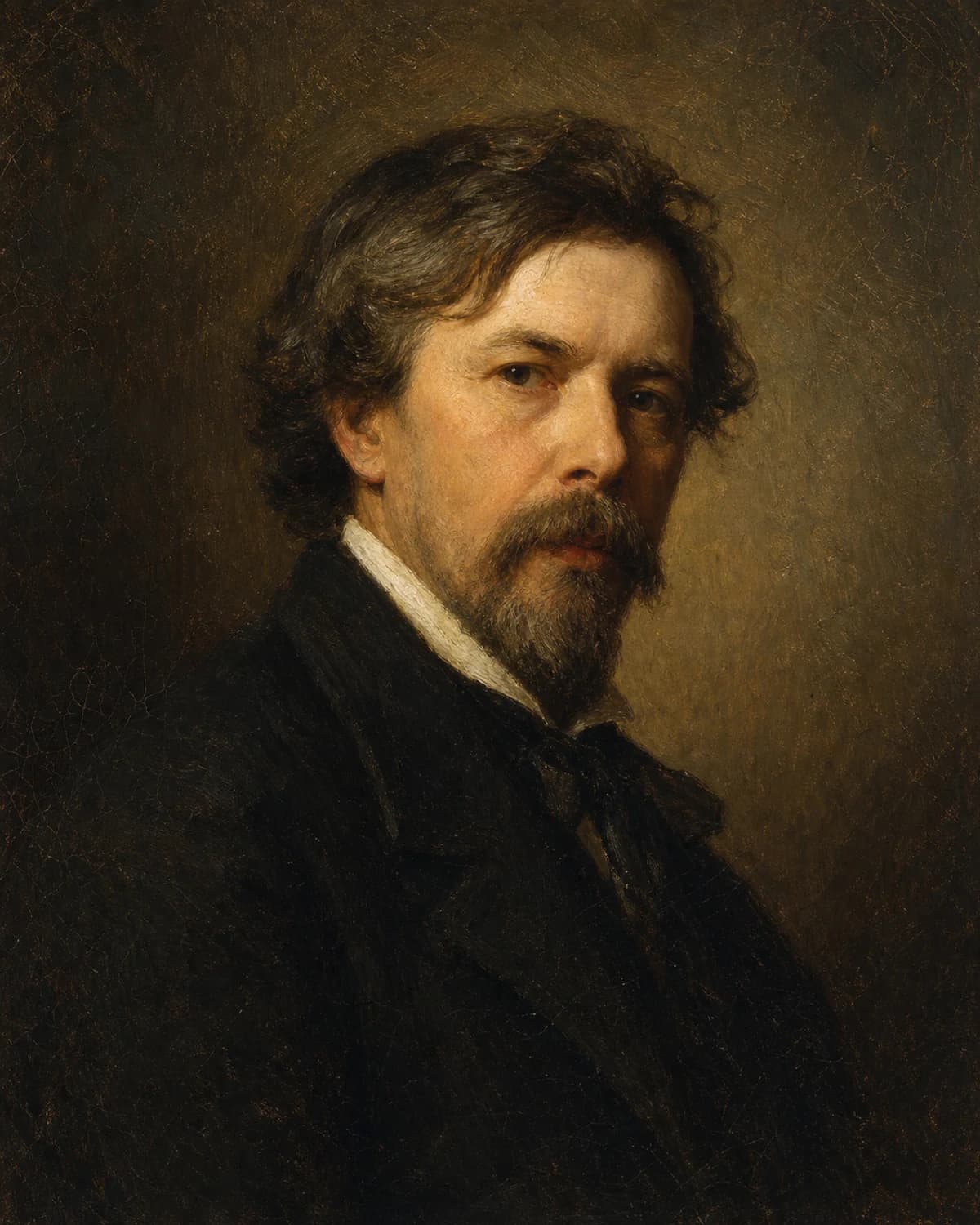
Biography
In 1866 Nikolai Nevrev painted two pictures that are now in the Tretyakov Gallery. One is called “The Protodeacon Proclaiming Long Life at a Merchant’s Name-Day Party”; the other, “From the Recent Past”, shows the sale of a serf.
The artist was then about thirty-six, and until then he had painted mostly portraits.
Nevrev was born in Moscow in 1830 into a merchant family. His first drawing lessons came from his stepfather, a drawing teacher. In 1850–1855 he studied at the Moscow School of Painting and Sculpture under Mikhail Scotti, a Russian painter of Italian origin, and left with the title of Free Artist.
He lived in Moscow all his life. He began with portraits, then turned to scenes of Russian popular life, and his best-known genre works were painted in the 1860s: “Requiem in a Village Cemetery” (1865), “The Protodeacon…” and “From the Recent Past”. Some pictures of those years were a critique of church morals. Later came “The Civil Servant’s Legacy”, “A Pilgrim in a Merchant Family”, “Two Friends” and “The Voivode”, after Mickiewicz’s poem, and in 1889 “Division of the Inheritance” and “The Matchmaking”, both also in the Tretyakov Gallery. Each such scene carries a moral lesson. His genre works, I think, remain his best even in the later years.
From the mid-1870s Nevrev turned more and more to subjects from Russian history. “Prince Roman of Galicia and the Papal Envoys” (1875) is now in the National Art Museum of Belarus in Minsk, “The False Dmitry at Wiśniowiecki’s” (1881) in the Tretyakov Gallery. They were followed by “Xenia Godunova Presented to the False Dmitry” (1882), “Patriarch Nikon on Trial” (1885), “Zakhar Lyapunov and Vasily Shuisky” (1886) and a picture with a long title, “Yaroslav the Wise Sending His Daughter Anna to Marry King Henry I of France” (1888). In 1881 he joined the Association of Travelling Art Exhibitions.
In 1887–1890 Nevrev taught at the Moscow School of Painting, Sculpture and Architecture. By some accounts, in 1889 he became curator of the Tretyakov Gallery, and after Pavel Tretyakov’s death in 1898 he was offered its directorship, but declined, citing his age and health.
In his last years he was very poor. Nevrev died on 3 (16) May 1904 on his estate of Lyskovshchina in Mogilev province, in his seventy-fourth year. Today his house museum operates in the village of Lyskovshchina in the Kruglyany district of the Mogilev region, an international open-air painting festival is held in his honour in the same region every year, and in 1980, for the artist’s 150th anniversary, the USSR issued a 6-kopeck postage stamp, shared with Konstantin Flavitsky.
Related context
Associations
Works connected through artistic movements, cultural context and period. Priced works available in this market appear first.








Profile notes
Profile and sources
Image
Artist image
На основе открытого изображения: Nikolai Nevrev; Wikimedia Commons; Public domain.
