
15.02.1831–01.06.1894
Nikolai Ge
Nikolai Ge (1831–1894) made his name with “The Last Supper”: in 1863 it was bought by the emperor, and the Academy of Arts made its author a professor. He was among the founders of the Society of Itinerant Art Exhibitions and painted “Peter the Great Interrogating Tsarevich Alexei” and a portrait of Herzen. His late Gospel paintings, beginning with “What Is Truth?”, were removed from exhibitions at the demand of the authorities.
Biography
When the canvas of “What Is Truth?” (1890) was X-rayed, another painting was found beneath Christ and Pilate. It was “Mercy” (1880), in which Nikolai Ge had painted Christ as a ragged beggar. The critics savaged it, and the artist destroyed the picture, as it turned out, simply by painting a new one over it.
There are several such stories in his life: Ge’s paintings were banned, taken abroad, shown in private flats and lost.
Ge was born on 15 (27) February 1831 in Voronezh, the son of a landowner, Nikolai Osipovich Ge; his great-grandfather, a French nobleman named Mathieu de Gay, had moved to Russia at the end of the eighteenth century. His mother died of cholera when the boy was three months old, and he was brought up by his grandmother and a serf nurse. At the First Kiev Gymnasium his teachers noticed that he drew well, but after finishing school in 1847 he followed his father’s advice and entered the faculty of physics and mathematics at Kiev University, later transferring to St Petersburg. In 1848–1849 he drew in the Hermitage, and in 1850, against his father’s will, he left the university for the Academy of Arts.
At the Academy he studied under Pyotr Basin and spent long hours copying his beloved Bryullov. For “Achilles Lamenting Patroclus” he received the small gold medal in 1855, and for “Saul at the Witch of Endor” the large one in 1857, with the right to travel abroad. In the autumn of 1856 he married Anna Zabello, and in the spring of 1857 the couple, without waiting for the stipend, left for the place “where there is breadth, where there is freedom”. In Paris Ge saw the Salon and the posthumous exhibition of Paul Delaroche; in Rome he met Alexander Ivanov, whose influence is already visible in the sketch “Return from the Burial of Christ” (1859). He was dissatisfied with his sketches on ancient subjects, went to Naples to paint studies, and in 1860 moved to Florence.
In 1861 he began “The Last Supper”. First he modelled a sculptural sketch to see how the figures stood, and only then began to “sculpt” the volume with light. He painted the head of the apostle John from his wife and Peter from himself, while for Christ he reworked portraits of Alexander Herzen and the singer Kondratyev. The underpainting took a week, followed by months of work. In the autumn of 1863 the picture was shown at the Academy’s exhibition in St Petersburg. The official press saw in it “the triumph of materialism and nihilism”, and the censors forbade its reproduction. Nevertheless the canvas was bought by the emperor, and the Academy made Ge a professor.
He returned to Florence and painted sketches on Gospel subjects. At the end of 1866 Herzen called on him unexpectedly, and Ge, in his own words, was struck dumb with joy. He painted the portrait of this émigré, regarded in Russia as a state criminal, in five sittings, and critics consider it the best in the artist’s legacy. “The Messengers of the Resurrection”, on the other hand, was rejected by the Academy for its exhibition in 1867; friends showed the picture at an art club without any success, and “Christ in the Garden of Gethsemane” met the same reception.
At the end of 1869 Ge returned to Russia and became one of the founders of the Society of Itinerant Art Exhibitions. For the first Itinerant exhibition he painted “Peter the Great Interrogating Tsarevich Alexei Petrovich at Peterhof” (1871), and the picture was bought by Pavel Tretyakov. Until 1875 he lived in St Petersburg, painted Turgenev, Nekrasov, Saltykov-Shchedrin, Kostomarov and Antokolsky, and modelled a portrait of Belinsky. The history paintings of those years, “Catherine II at the Coffin of Elizabeth” and “Pushkin at Mikhailovskoye”, were less successful.
In 1875 he left the capital for good and bought a small farmstead near Pliski station in Chernigov Governorate. Until 1879 he hardly painted: he farmed, thought about religion and morality, and wrote that art must not be traded. Debts nevertheless forced him to take on commissioned portraits of the local rich, the sugar manufacturer Tereshchenko and his wife, his neighbour the landowner Petrunkevich.
What brought him back to work was Leo Tolstoy’s article “On the Moscow Census”, which he read in 1882. Ge went to meet its author, painted his portrait in 1884, later modelled a bust of him and made drawings for the story “What Men Live By”. It seems to me that his last paintings are hard to imagine without this friendship: “Leaving the Last Supper” (1889), “What Is Truth?” (1890), “Conscience. Judas” (1891), “The Judgment of the Sanhedrin” (1892), “Golgotha” and several versions of “The Crucifixion”.
Almost all of them caused a scandal. The newspapers greeted “What Is Truth?” with something close to a campaign of persecution; on 6 March 1890 Konstantin Pobedonostsev reported to Alexander III that the picture was “blasphemous”, and it was removed from the exhibition, after which one of the artist’s admirers took it around Europe and America. In 1894, at the emperor’s demand, “The Crucifixion” was removed from the Twenty-Second Itinerant Exhibition, and people went to see it in the private flats of Ge’s friends in Moscow and St Petersburg. In 1899 the artist’s son took the canvas to Switzerland, where its trail is lost; an unfinished version of 1892 is in the Musée d’Orsay in Paris. In 1893 Ge painted a self-portrait, now in Kiev.
Nikolai Ge died on 1 (13) June 1894 at his farmstead, Ivanovsky, and was buried there. He had bequeathed his works to a Swiss benefactress, Béatrice de Vattville, but after her death in 1952 they were not found in her château. His drawings turned up in Swiss second-hand shops in the 1970s, and in 2011 fifty-five sheets entered the Tretyakov Gallery.
Related context
Associations
Works connected through artistic movements, cultural context and period. Priced works available in this market appear first.








Profile notes
Profile and sources
Image
Artist image
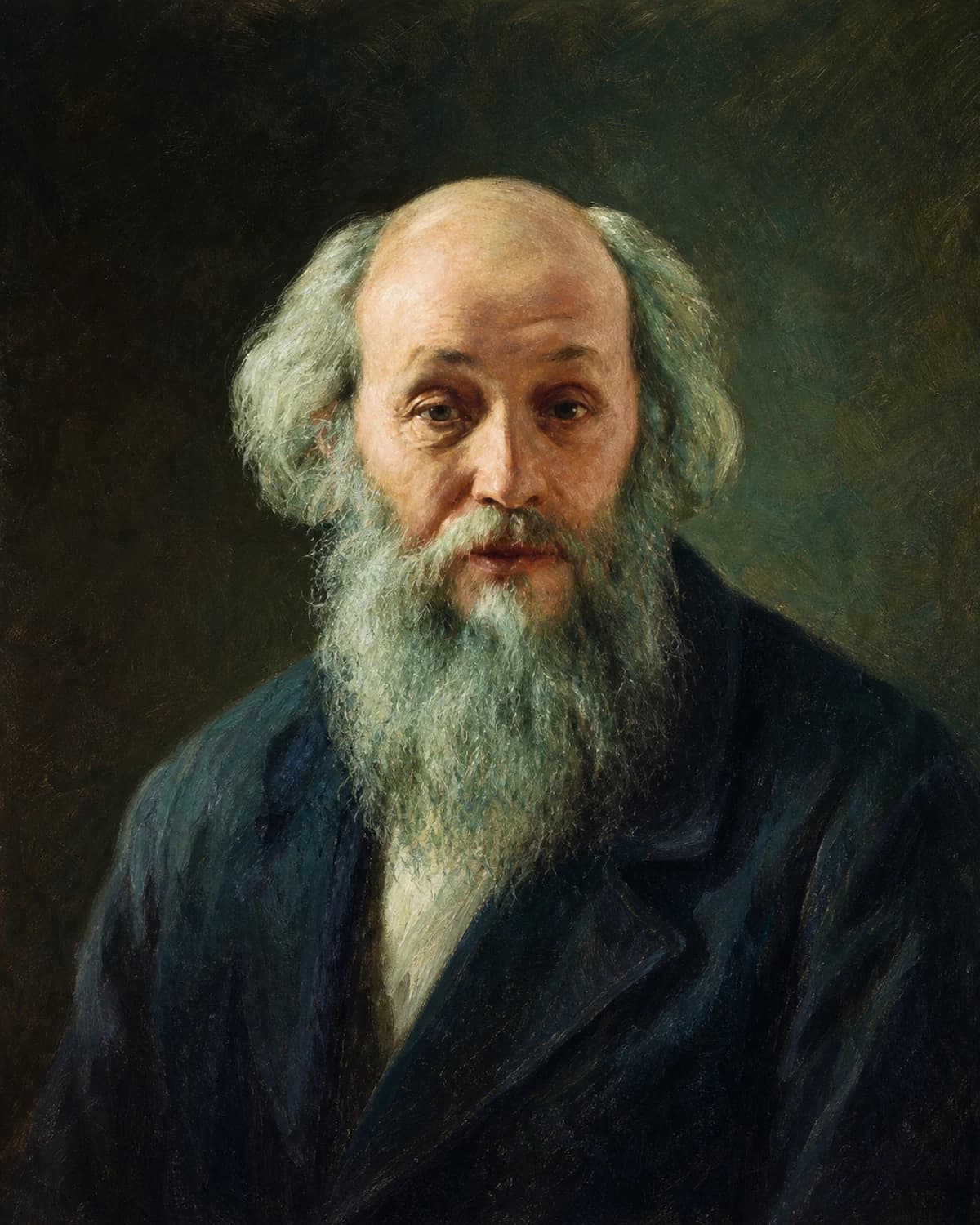
На основе открытого изображения: Nikolai Yaroshenko; Wikimedia Commons; Public domain.
