
02.10.1865–23.09.1918
Nikolai Clodt von Jürgensburg
Nikolai Clodt von Jürgensburg, grandson of the sculptor Peter Clodt, graduated from the Moscow School of Painting in 1886 and travelled widely with his sketching box: the Russian North, the Volga, the Caucasus and Crimea, then Europe. From 1901 he worked in the theatres of Moscow and Saint Petersburg, among others together with Konstantin Korovin. Igor Grabar called him an underrated master.
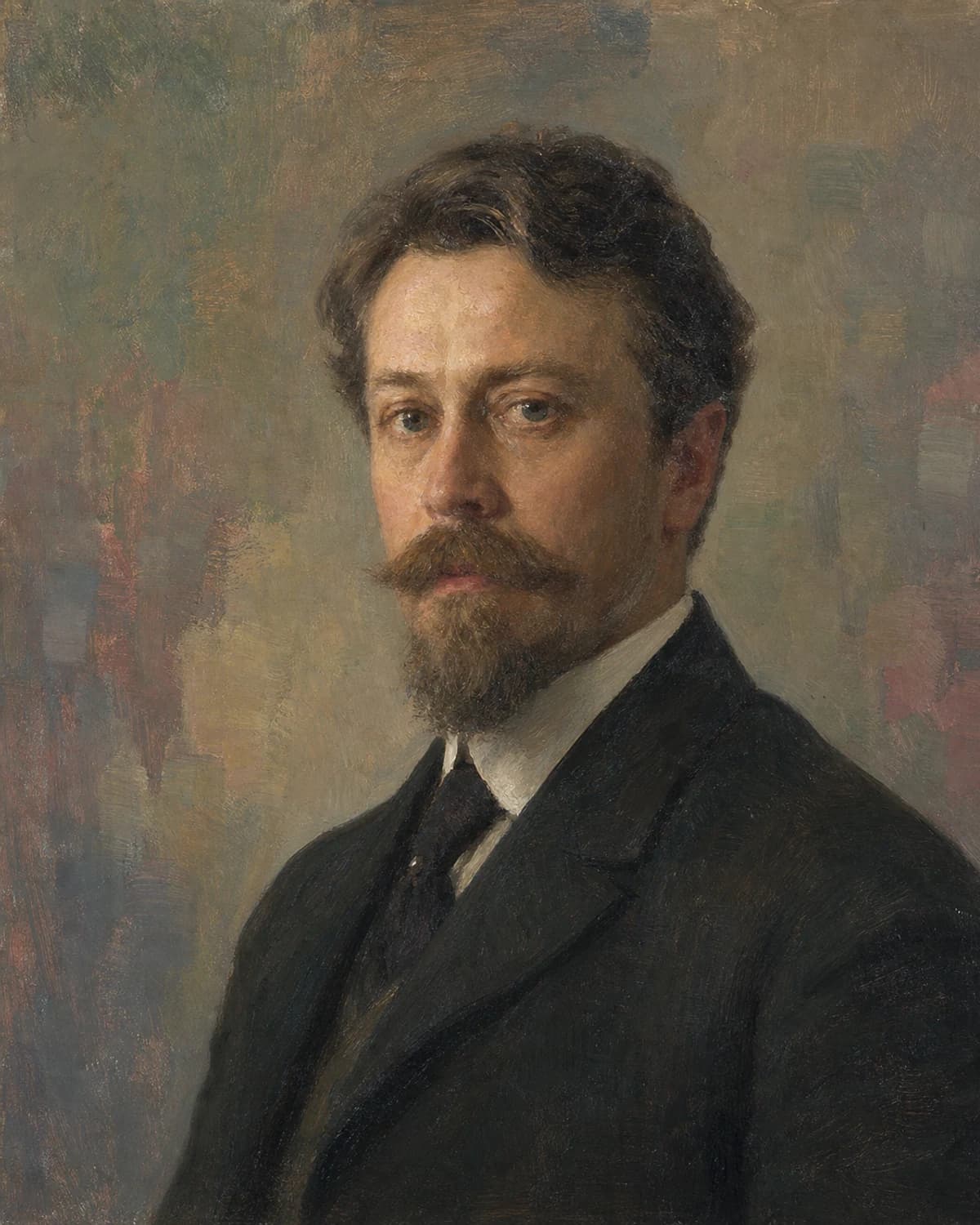
Biography
In 1900, when the World’s Fair was being prepared in Paris, Nikolai Clodt worked with Konstantin Korovin on the design of the Russian pavilion. Korovin did the main part of the work, but Clodt’s name stands beside his in this story, and that says a good deal about the circle he had come to move in.
He was born in Saint Petersburg on 14 October 1865 (2 October, Old Style), into a family with a long artistic ancestry. His grandfather, Peter Clodt, was a sculptor and bronze founder, the author of the horses on the Anichkov Bridge. His uncle, Mikhail Petrovich Clodt, was a well-known painter, and a great-uncle, Mikhail Konstantinovich Clodt, painted landscapes in the second half of the nineteenth century.
Nikolai studied at the Moscow School of Painting, Sculpture and Architecture and graduated in 1886. He was taught drawing by Vladimir Makovsky and Evgraf Sorokin. In the late 1880s and early 1890s he himself taught at the Anatoly Gunst Art College.
Those same years he spent on the road. In the 1880s and 1890s he travelled in the Russian North and to the towns on the Volga; in the 1900s he went often to the Caucasus and Crimea. In 1900 he visited Paris, and in 1906 and 1908 he went to Brittany, Geneva, Biarritz, Nervi and Genoa. These journeys left titles that read like an itinerary: “In the North. Finland”, “Solovetsky Bay”, “Taiga near Lake Baikal”, “The Samoyeds’ Train”, “Tundra”, “In Samarkand”, “The Sher-Dor Madrasa on the Registan Square in Samarkand”, “On Lake Geneva”, “Yalta”. Beside them stand pictures with no geography, built on the mood of a day or a season: “April”, “Thaw”, “A Grey Day”, “Evening Shadows”, “Summer Evening”. It seems to me that the list shows an interest not in the exotic but in weather and light; but one cannot judge painting by titles alone, and I have no reproductions at hand.
From 1901 Clodt worked as a stage designer in Moscow and Saint Petersburg. That year, with Korovin, he designed the ballet “The Little Humpbacked Horse” for the Bolshoi Theatre. In 1903, working from sketches by Alexandre Benois, he made the sets for Wagner’s “Götterdämmerung” at the Mariinsky Theatre. In 1914 at the Mariinsky he took part in designing “The Sleeping Beauty” with a group of artists: Korovin, Pyotr Ovchinnikov, Vladimir Yakovlev and Sergei Petrov. He worked with Korovin and Alexander Golovin together more than once.
Clodt exhibited a great deal and with various groups. These were the exhibitions of the Moscow Society of Art Lovers (1889, 1892–1895, 1897), the Moscow Association of Artists (1893–1895, 1899, 1901), the Wanderers (Peredvizhniki), the association of artists who toured their shows around Russia (1894), the “Exhibition of the Thirty-Six Artists” (1901, 1902) and the Union of Russian Artists, where his work appeared from 1903 to 1917.
Igor Grabar called him an “underrated master of painting”. Clodt’s works are held in the Russian Museum, the Vologda Regional Art Gallery and the Plyos State Museum-Reserve.
He died in Moscow on 23 September 1918 and was buried in the Vagankovo Cemetery.
Related context
Associations
Works connected through artistic movements, cultural context and period. Priced works available in this market appear first.








Profile notes
Profile and sources
Image
Artist image
На основе открытого изображения: Nikolai Clodt von Jürgensburg; Wikimedia Commons; Public domain.
