
12.11.1850–1921
Nikolai Bodarevsky
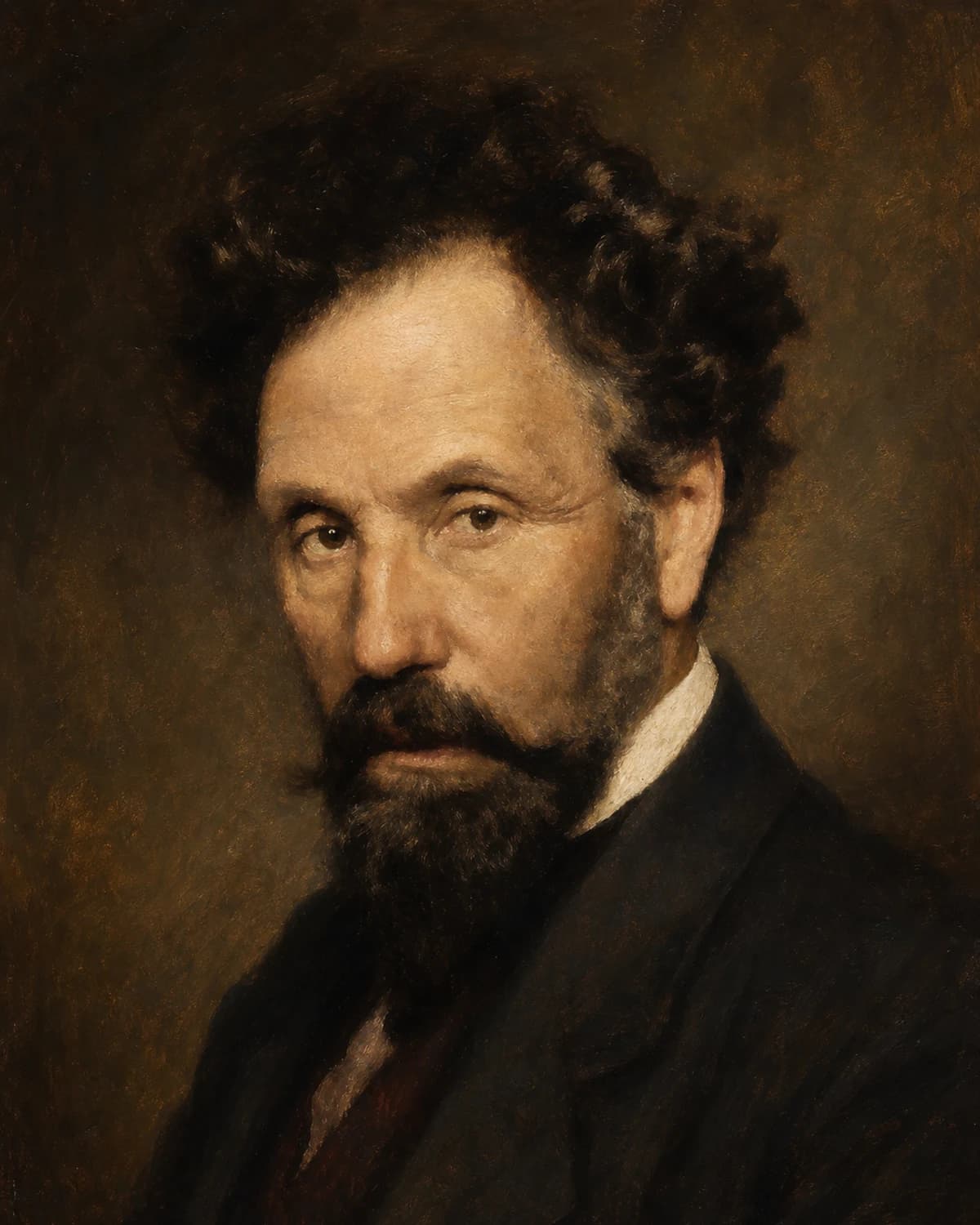
Nikolai Bodarevsky (1850–1921) was born in Odesa, studied at the Imperial Academy of Arts in St Petersburg and from 1880 exhibited with the Wanderers. He painted fourteen portraits of composers for the Great Hall of the Moscow Conservatory and made sketches for sixteen mosaics in the Church of the Savior on Blood in St Petersburg. Four of the conservatory portraits were removed in 1953, and two of them were found only in 1999.
Biography
In 1953 four portraits were taken down from the Great Hall of the Moscow Conservatory: Mendelssohn, Haydn, Gluck and Handel. A campaign against “cosmopolitanism” was under way, and in their place hung Rimsky-Korsakov, Mussorgsky, Dargomyzhsky and Chopin, painted by other artists. The earlier canvases were thought lost until 1999, when the hall’s caretaker found Mendelssohn and Haydn by chance. They were the work of Nikolai Bodarevsky.
He was born in Odesa. The date of his birth is given differently: 6 December 1850 (24 November, Old Style) or 24 November 1850 (12 November, Old Style); I leave the discrepancy as it is. His father was a titular councillor, a mid-ranking civil service post, and traced the family to the Moldavian princes; his sister Ekaterina Petrokokino also became a painter. Bodarevsky began at the drawing school of the Odesa Society for the Encouragement of the Fine Arts, and from 1869 studied at the Imperial Academy of Arts in St Petersburg under Pyotr Shamshin, Timofey Neff and Vasily Vereshchagin.
During his studies he received several silver medals for drawing and two minor gold medals for the painting “David Playing the Harp Before Saul”. In 1875 came the programme for the major gold medal: the subject was “The Apostle Paul Explaining the Doctrines of the Faith Before King Agrippa”. His rivals included Vasily Surikov, Nikolai Zagorsky and Ivan Tvorozhnikov. The Academy council judged the works of all of them unworthy of the prize, and Bodarevsky received the title of Artist of the first class.
From 1880 he showed work at the exhibitions of the Wanderers (Peredvizhniki, the association of artists who organised travelling exhibitions), in 1884 became a member of the association, and exhibited with it until 1918. From 1900 he belonged to the Society of South Russian Artists (by some accounts, already from 1894). He worked mainly in easel painting: genre scenes, religious subjects and portraits. His sketches for the paintings “A Wedding in Little Russia” and “The First Savior Feast in Little Russia: the Feast of the Maccabees” are held in the National Art Museum of Ukraine. He lived in Odesa, Moscow and St Petersburg, travelled to Switzerland in 1895 and to France in 1895–1896. There are reports that after becoming acquainted with Whistler’s painting he painted female portraits in a similar manner, among them one of Empress Alexandra Feodorovna.
His best-known commission came from Moscow. In 1889 Vasily Safonov, director of the conservatory, asked him for fourteen portraits of eminent composers for the future Great Hall, which seats 1,700. The hall opened in March 1901, and the pictures were already hanging in oval moulded frames by Alexander Aladin. After the discovery of 1999 Mendelssohn and Haydn were restored and hung by the central entrance to the stalls, and in 2008 marble plaques were placed beneath them. Where Gluck and Handel are, and whether they survive at all, is not known.
At the same time, in 1894–1897, he made sketches for mosaics for the Church of the Savior on Blood in St Petersburg, working alongside Viktor Vasnetsov, Mikhail Nesterov, Andrei Ryabushkin and Nikolai Kharlamov. Sixteen mosaics were made from his sketches: Saint Vladimir, Mary Magdalene, Saint Empress Alexandra, Saint Nicholas the Wonderworker, the Virgin with two angels, Archdeacon Lawrence, Christ Emmanuel, Archdeacon Stephen, two seraphim and four archangels for the iconostases, as well as “The Betrayal of Judas” and “Christ Before Pilate” for the south-west pier. In 1908 the Academy awarded him the title of Academician. Among his portraits of these years are one of a member of his family named Bodarevskaya (1890), the ballerina Lyubov Roslavleva, his sister Ekaterina Petrokokino (1896), the writer Ippolit Vasilevsky (1906) and the singer Lydia Lipkovskaya (1916). In 1889 an exhibition of his work together with Afanasy Rozmaritsyn was held in Odesa, and in 1913 a solo show in St Petersburg.
After the Revolution he returned to Odesa and died there in 1921; the exact date is unknown. He was buried in the old city cemetery, but in 1935 the cemetery was demolished together with its church, and no grave remains.
Related context
Associations
Works connected through artistic movements, cultural context and period. Priced works available in this market appear first.








Profile notes
Profile and sources
Image
Artist image
На основе открытого изображения: Unknown author Unknown author; Wikimedia Commons; Public domain.
