
15.05.1838–21.07.1907
Nicolae Grigorescu
At fourteen Nicolae Grigorescu was painting icons for the church at Băicoi, and at thirty he showed “Young Gypsy Girl” at the Paris Salon. He studied in France, worked alongside the Barbizon painters, accompanied the Romanian army as an artist in 1877, and from 1890 lived in Câmpina, painting peasant women and country roads.
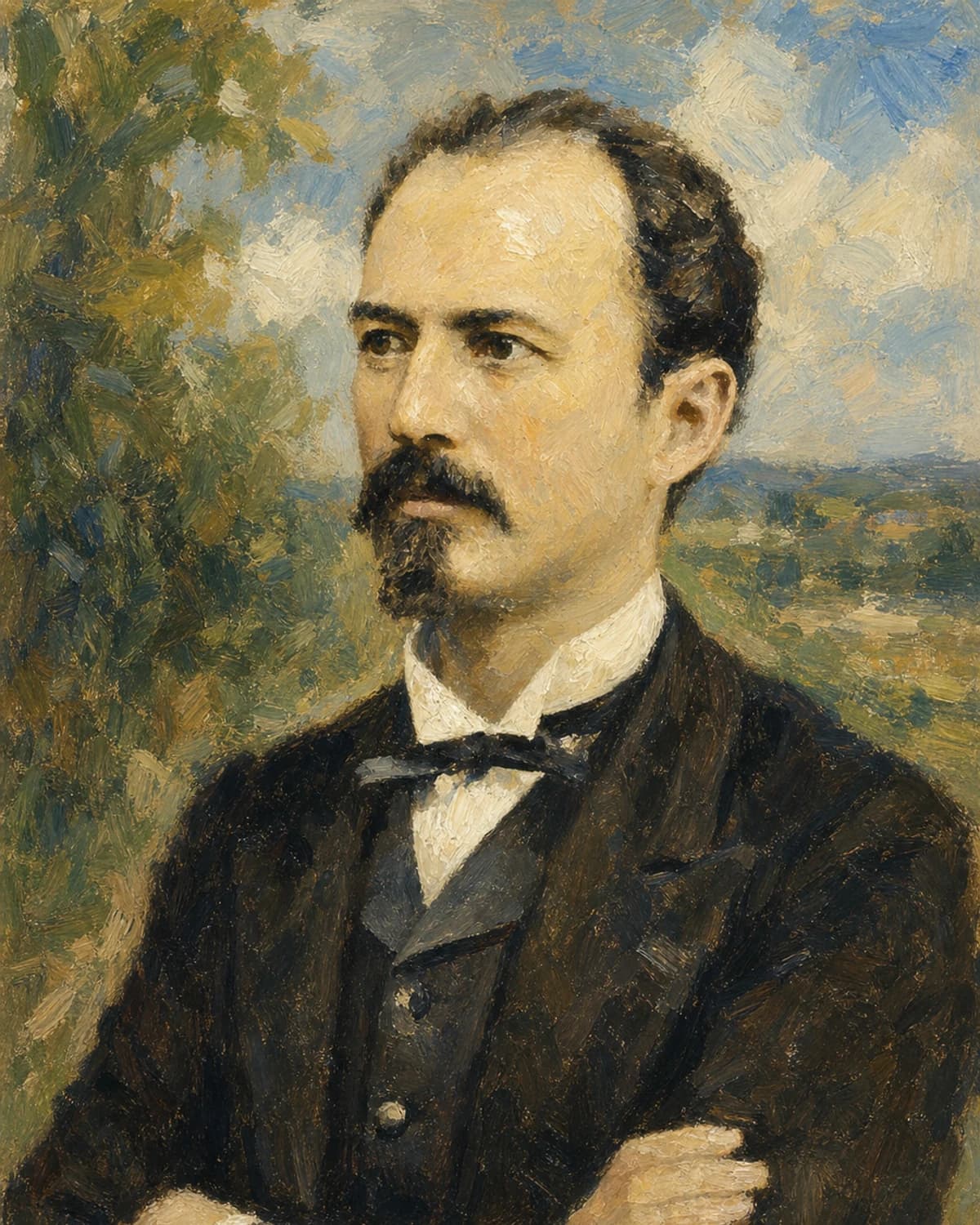
Biography
At fourteen Nicolae Grigorescu made eleven festival icons for the church in the village of Băicoi, in Prahova County. At about the same time, according to his biographers, he painted seven large icons for Princess Cleopatra Trubetskaya.
He was born on 15 May 1838 in Pitaru, in Dâmbovița County, the sixth of seven children. His father, Ion Grigorescu, died when the boy was seven; in 1843 the family moved to Bucharest. His older brother Gheorghe was learning a trade, and Nicolae followed him: as an apprentice he entered the workshop of Anton Chladek, a miniaturist and icon painter of Czech origin who worked in Romania and tried to bring church painting closer to Western models. Chladek painted in the Biedermeier manner, and Grigorescu at first imitated it, while studying the old masters from prints and engravings and trying to paint as they did. The sources disagree on dates: by some accounts the apprenticeship began in 1848 and he left the workshop in 1850. He earned his living by painting icons. For the Căldărușani Monastery he made icons (later destroyed in a fire), in 1856–1857 he painted the church of the Zamfira Monastery, and in 1858 he made frescoes and icons for the Agapia Monastery, commissioned by Iosif Gheorghian, the future Metropolitan Primate of Romania. He painted about a hundred canvases for the church at Pucheni-Mari near Bucharest. In 1856 he produced a historical composition, “Michael the Brave Saving the Flag”, which he presented to the Wallachian Prince Barbu Știrbei together with a petition for help with his studies. His early portraits survive; they are painted in a strict, canonical manner.
At Agapia his work was seen by the inspector Mihail Kogălniceanu. He recognised the talent and helped him obtain a scholarship, and in the autumn of 1861 Grigorescu left for Paris.
There he studied at the École des Beaux-Arts and attended the studio of Sébastien Cornu, where his fellow student was Pierre-Auguste Renoir. Drawing and composition were, as he himself understood, his weak points, and he worked above all on them. He soon left the studio: he was drawn to the idea of painting outdoors, and went to Barbizon, where he became close to Jean-François Millet and Gustave Courbet; among those he met there are also named Corot and Théodore Rousseau. At the Universal Exposition of 1867 in Paris he showed seven works, and at the Salon of 1868 he exhibited “Young Gypsy Girl”. From 1870 Grigorescu, returning to Romania from time to time, took part regularly in exhibitions, among them those organised by the Society of the Friends of the Fine Arts. In 1873–1874 he visited Italy, Greece and Vienna.
In 1877 he was invited to accompany the Romanian army in the war of independence, known in Russia as the Russo-Turkish War. He was present at the battles of Grivitsa and Oryahovo and made drawings and sketches; later he painted large canvases from them. I think this experience shows in his work of the 1880s, though it is hard to check against documents.
From 1879 to 1890 he again worked in France, chiefly at Vitré in Brittany and in his Paris studio. In 1889 his work was shown at the Universal Exposition in Paris and at the Romanian Athenaeum in Bucharest. Further exhibitions of his work followed at the Athenaeum in 1891, 1895, 1897, 1902 and 1905.
In 1890 he settled in Câmpina. From then on he painted mainly portraits of peasant women, ox carts on dusty country roads and other rural landscapes. In 1899 he was elected an honorary member of the Romanian Academy.
Grigorescu died in Câmpina on 21 July 1907. An unfinished canvas, “The Return from the Fair”, was left in his studio. In 1957 his house in Câmpina was opened as a memorial museum.
Related context
Associations
Works connected through artistic movements, cultural context and period. Priced works available in this market appear first.








Profile notes
Profile and sources
Image
Artist image
На основе открытого изображения: Unknown author Unknown author; Wikimedia Commons; Public domain.
