
27.09.1874–13.12.1947
Nicholas Roerich
Nicholas Roerich began as a painter and archaeologist of early Rus: he studied under Kuindzhi, led excavations, and designed the “Polovtsian Dances” and “The Rite of Spring” for Diaghilev. After the revolution he found himself abroad, crossed Central Asia and Tibet with an expedition, and proposed a pact for the protection of cultural property. He spent his last twelve years in India's Kullu Valley, painting the Himalayas.
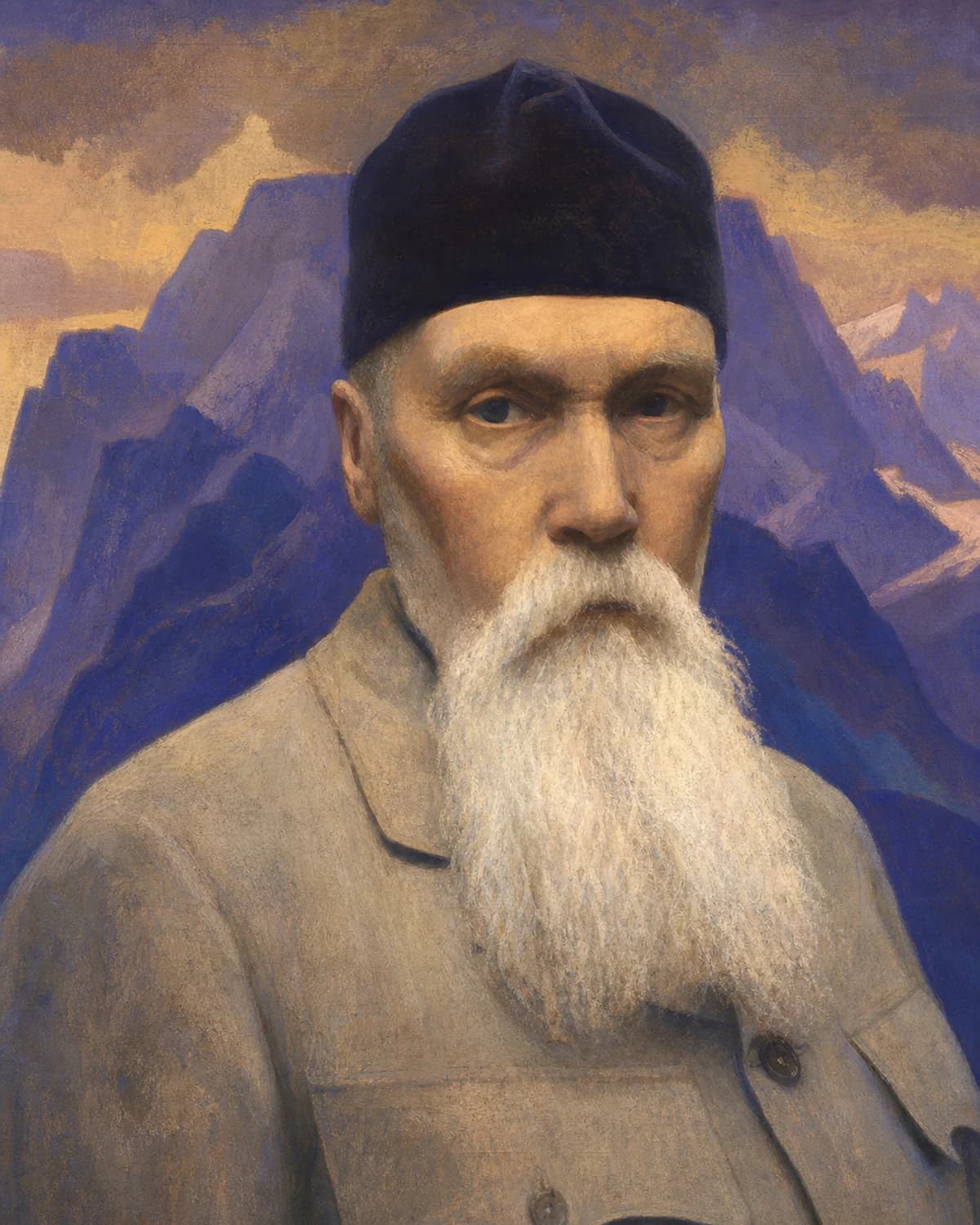
Biography
His diploma painting, “The Messenger” (1897), was bought by Pavel Tretyakov, and Vladimir Stasov told the young artist that he simply had to visit Leo Tolstoy. Tolstoy, as Roerich himself told it, spoke to him about a boat on a fast river: “You must always steer above the place you need to reach, or the current will carry you down.”
Roerich was born on 27 September (9 October) 1874 in St Petersburg. His father, Konstantin Fyodorovich, was a well-known notary, his mother came from the Kalashnikov merchant family, and Mendeleev and Kostomarov were visitors to the house. After Karl May's gymnasium he enrolled in 1893 in two places at once: the law faculty of the university and the Higher Art School of the Academy of Arts. From 1895 he studied in Arkhip Kuindzhi's studio. His university diploma thesis of 1898 was titled “The Legal Status of Artists in Ancient Rus”.
He had started digging while still a schoolboy, in 1892.
Then came the Russian Archaeological Society, a course on “Artistic Technique as Applied to Archaeology” at the Archaeological Institute (1898–1903), excavations in the St Petersburg, Pskov, Novgorod and Tver governorates, and the first excavations in Novgorod in the summer of 1910. By 1910 his collection of Stone Age tools numbered more than thirty thousand items; it is now in the Hermitage. I think his early paintings cannot be understood without this. “Idols” (1901), “Building the Boats” (1903) and “The Elders Gather” were painted by a man who had held flint arrowheads and potsherds in his hands and had not merely read the chronicles.
In 1899, at Prince Putyatin's estate, he met Helena Shaposhnikova, and they were married on 28 October 1901. In 1902 their son Yuri was born, the future orientalist, and in 1904 Svyatoslav, the future painter. In 1903–1904 the couple travelled to more than forty old Russian towns; Roerich brought back some ninety architectural studies and was one of the first to speak about the artistic value of old icons and churches. At Maria Tenisheva's Talashkino he painted the Church of the Holy Spirit (“Queen of Heaven”), for the Kazansky railway station in Moscow he made the panels “The Battle of Kerzhenets” and “The Conquest of Kazan” (neither survives), and he took part in decorating the Buddhist temple in St Petersburg. Around 1906 he almost gave up oil for tempera, laying tone over tone.
From 1906 he directed the Drawing School of the Society for the Encouragement of the Arts and opened workshops there for icon painting, ceramics, weaving and metal chasing. In 1909 he became an academician, and from 1910 he headed the World of Art. For Diaghilev's Russian Seasons he designed the “Polovtsian Dances” from “Prince Igor” (1909), and for Stravinsky's “The Rite of Spring” (1913) he made the sets and costumes and acted as librettist. Before the war came the uneasy “Glow”, “The Last Angel” and “Human Deeds”. In 1915 he reported to Nicholas II on the need for state protection of historical monuments.
In 1916, on his doctors' insistence, the Roerichs moved to Serdobol on Lake Ladoga, in the territory of the Grand Duchy of Finland. In the spring of 1917 Roerich joined the commission for the protection of artistic treasures formed at Gorky's. After the October Revolution the border with Finland closed. Then came exhibitions in Malmö and Stockholm (1918) and in Copenhagen and Helsinki (1919), then London, where he designed Russian operas and became friends with Rabindranath Tagore, and an invitation from the Art Institute of Chicago. Roerich's exhibition opened in New York in December 1920 and travelled to some thirty American cities. In November 1921 his Master Institute of United Arts opened in New York.
In December 1923 the family arrived in India. From here the Central Asian Expedition set out: Kashmir, Ladakh, Xinjiang, a detour to Moscow, the Altai, Mongolia, Tibet. Officially it counted as an American expedition. In the autumn of 1927 the Tibetan authorities stopped the caravan on the approaches to Lhasa, and for five months the expedition was stranded in winter on the Changtang plateau before forcing its way through to India. Roerich brought back some five hundred paintings and the books “Heart of Asia” and “Altai–Himalaya”. The expedition also had commercial and political plans, up to a project for concessions in the Altai, and historians still argue about its aims. In 1928, in the Kullu Valley in the Western Himalayas, the Roerichs founded the Urusvati Himalayan Research Institute, with Yuri as director.
In the same year, 1928, Roerich and the lawyer Georges Chklaver drew up a draft treaty for the protection of cultural property and proposed a sign for protected buildings, the Banner of Peace: a white cloth, a red ring, and inside it three red circles. The Roerich Pact was signed on 15 April 1935 at the White House in the presence of Franklin Roosevelt, and in 1954 its ideas formed the basis of the Hague Convention. An expedition to Manchuria in search of drought-resistant grasses, organised in 1934–1935 by the US Department of Agriculture, ended early and in scandal.
From the end of 1935 he lived in Naggar, in the Kullu Valley, and never left it. In twelve years he painted more than a thousand pictures there, mostly mountains: the series “Himalayas”, “Shambhala” and “Kuluta”. In 1942 Jawaharlal Nehru and Indira Gandhi came to visit him. During the war he and Svyatoslav sold paintings and sent the money to the Soviet Red Cross. From 1936 Roerich asked for permission to return to the USSR; in 1938 People's Commissar Litvinov reported this to Stalin, and the report came back with the resolution “Do not reply.” He sent his last visa request after the war.
Roerich died in Naggar on 13 December 1947. Two days later his body was cremated in the Kullu Valley, and on the site of the pyre a stone was set up with an inscription about the “great friend of India”.
Related context
Associations
Works connected through artistic movements, cultural context and period. Priced works available in this market appear first.








Profile notes
Profile and sources
Image
Artist image
На основе открытого изображения: Unknown author Unknown author; Wikimedia Commons; Public domain.
