
09.05.1828–15.03.1902
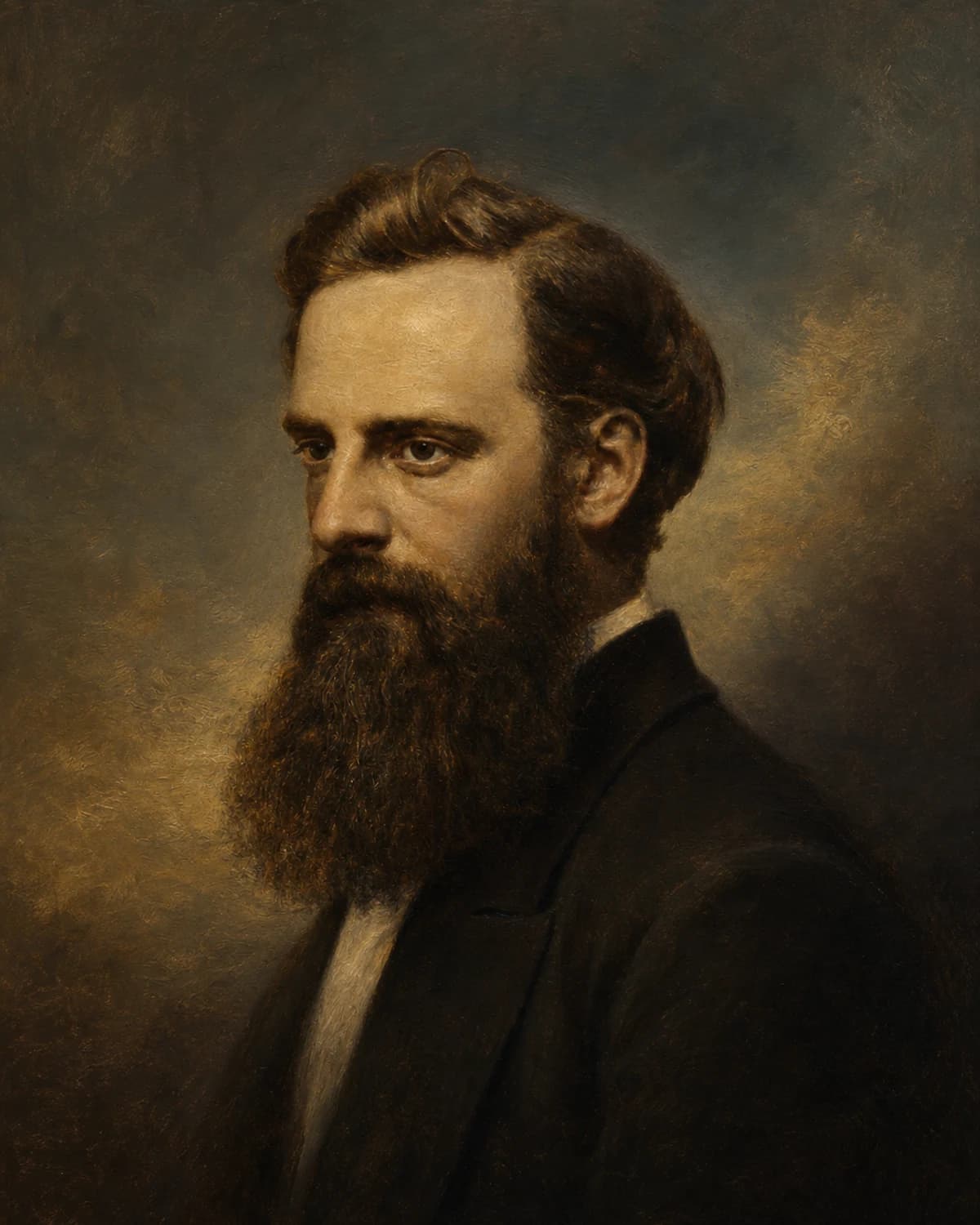
Nicholas Chevalier
Nicholas Chevalier was born in St Petersburg into a Swiss-Russian family, studied in Lausanne and Munich, and became best known for his Australian and New Zealand landscapes. In Melbourne he drew for the magazine “Melbourne Punch” and went on expeditions in Victoria; in 1869 he sailed on HMS Galatea with the Duke of Edinburgh, and in London he painted on commission for Queen Victoria.
Biography
In December 1854 Nicholas Chevalier sailed for Australia on the Swallow and went ashore in Melbourne on Christmas Day. His father and brother were already living there.
He was born on 9 May 1828 (28 April, Old Style) in St Petersburg. His father, Louis Chevalier, came from the canton of Vaud and worked on the estate of Prince Wittgenstein; his mother, Tatiana Onufrievna, was Russian. In 1845, at seventeen, Nicholas left Russia for Lausanne. He studied there at the Musée Arlaud under Guignard, then studied architecture in Munich under Ludwig Lange (the years in Munich are given differently: from 1848, or for three years after Lausanne). He spoke French, English, Russian, German, Italian and Portuguese fluently.
In 1851 he moved to London, painted in watercolour and learned lithography. For Austen Henry Layard’s book on the excavations at Nineveh and Babylon he made some of the lithographed illustrations, and two of his watercolours were accepted by the Royal Academy for its exhibition of 1852. Then his family helped him go to Rome, where he spent most of 1853 and 1854.
In Melbourne Chevalier first worked as a caricaturist for “Melbourne Punch”, then made illustrations for the “Illustrated Australian News”. In 1855 he married Caroline Wilkie. From 1860 he accompanied the German meteorologist and explorer Georg von Neumayer on journeys into the interior of Victoria. The material from these journeys produced the best-known works of his Australian period, among them his painting of Mount Arapiles in the west of the state. In 1864, at an exhibition of work by Victorian artists, the government bought one of his landscapes, which became the first Australian-painted picture in the collection of the newly founded National Gallery of Victoria. For the governor’s wife, Lady Barkly, he designed a dress with the Southern Cross and a fan in the form of a lyrebird; she apparently never dared to wear the dress. Later they made a present together for the newly married Princess of Wales: a silver and gold flower stand from the women of Victoria.
In 1865 Chevalier travelled to New Zealand. He journeyed widely through the country, and the Canterbury provincial legislature paid him £200 for a pictorial survey of the interior. On his return he showed paintings at the Melbourne Intercolonial Exhibition of 1866–1867 and, in 1868, at the Paris Salon.
When the Duke of Edinburgh came to Australia, Chevalier was invited to join his suite in Tasmania in January 1868; the duke liked the transparencies he had painted for the festive illuminations. In 1869 he boarded HMS Galatea and returned to London by way of the East and the Pacific islands, calling, among other places, at China and Japan. For Queen Victoria he made about 120 drawings and a great many watercolours. On board he played second violin in an amateur orchestra in which the duke played first.
From 1871 he had a great many commissions, royal ones among them. He painted pictures from the studies of his earlier journeys, and besides exotic subjects he depicted English landscape, buildings and life. From 1871 to 1887 he exhibited regularly at the Royal Academy of Arts in London. Among his best-known works are “The Thanksgiving Procession to St Paul’s Cathedral, 27 February 1873”, commissioned by Queen Victoria, and its companion picture of the interior of the cathedral; the wedding of the Duke of Edinburgh and Grand Duchess Maria Alexandrovna (in St Petersburg he was in the bridegroom’s suite); and the opening of the Vienna World Exhibition of 1873.
From 1882 he was the London adviser to the National Gallery of New South Wales. He painted his last picture in 1895 and gave up painting, turning to poetry and music.
Chevalier died in London on 15 March 1902. His widow wrote a short book about his life and gave many of his New Zealand works to the National Art Gallery in Wellington. His works are held by the Museum of New Zealand Te Papa Tongarewa, the National Gallery of Victoria, the Art Gallery of New South Wales, the National Library of Australia and other collections; in Canterbury, New Zealand, Mount Chevalier is named after him.
Related context
Associations
Works connected through artistic movements, cultural context and period. Priced works available in this market appear first.








Profile notes
Profile and sources
Image
Artist image
На основе открытого изображения: Johnstone, O'Shannessy & Co.; Wikimedia Commons; Public domain.
