
21.06.1881–17.10.1962
Natalia Goncharova
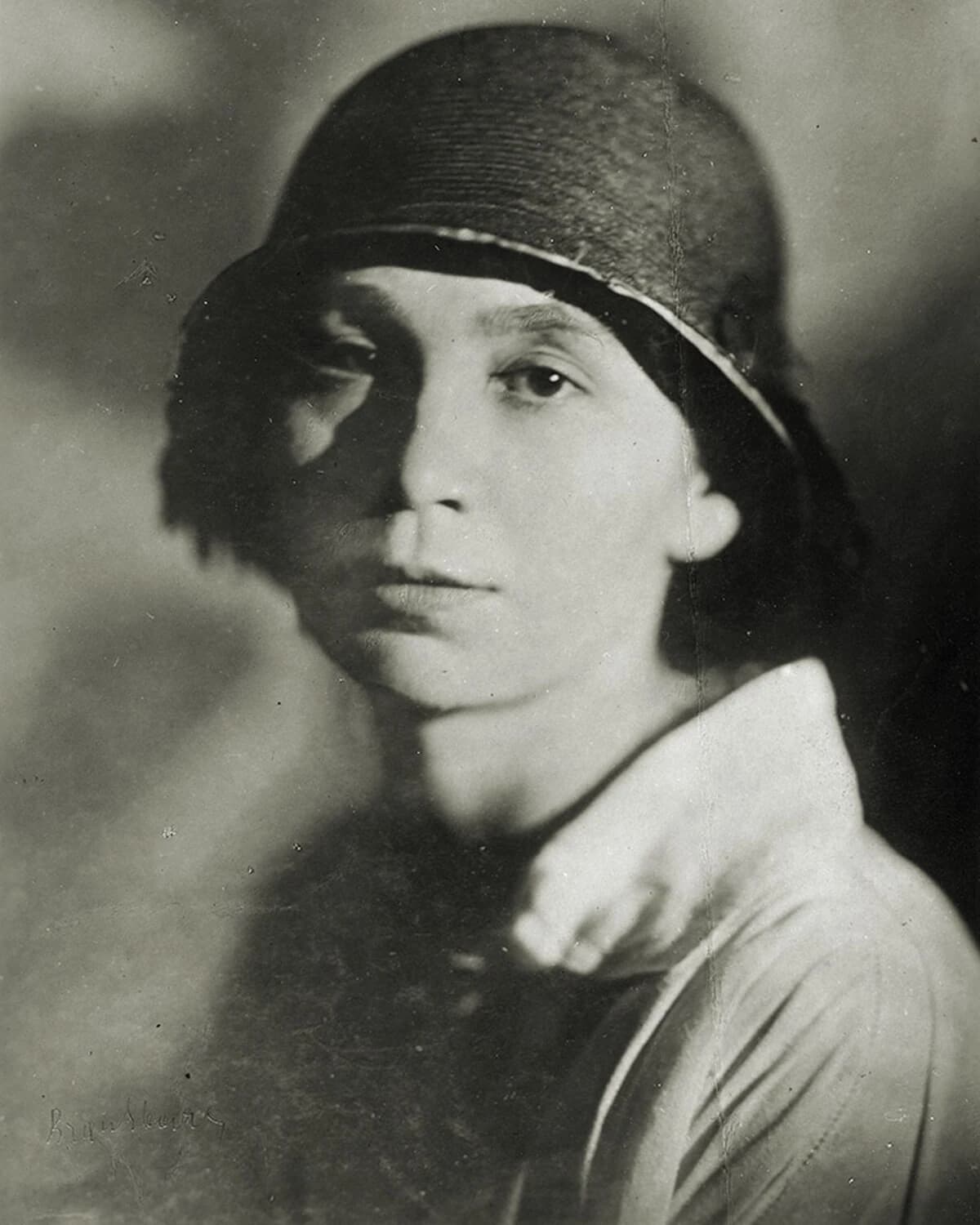
Natalia Goncharova (1881–1962) invented Rayonism together with Mikhail Larionov and organised the Jack of Diamonds, Donkey’s Tail and Target exhibitions. She painted peasants, icons and cyclists, illustrated Futurist books, and twice faced prosecution and the seizure of her paintings. From 1915 she worked for Diaghilev’s Ballets Russes, lived in Paris, designed ballets and created clothing designs.
Biography
On 24 March 1910 Goncharova’s first solo exhibition, twenty-two paintings, opened at the Society of Free Aesthetics. It lasted one day. The newspaper Golos Moskvy printed an anonymous note calling two of her “Models” pornography and the picture “God” worse still, and the next day the police seized them. The artist was charged with distributing “manifestly seductive pictures”, and the organisers, among them Bryusov and Serov, were charged as well. The court acquitted her, accepting that the one-day exhibition had been a private one. Historians regard this case as unusual for pre-revolutionary Russia: the article on pornography had never before been applied to works of artistic value.
After the trial she never painted the nude again.
Goncharova was born on 21 June (3 July) 1881 in Tula Governorate, in the village of Ladyzhino, or by other accounts in Nagaevo. Her father, Sergei Mikhailovich, was a Moscow architect; her mother, Ekaterina Ilyinichna, née Belyaeva, was the daughter of a professor at the Moscow Theological Academy. The artist’s grandfather was a nephew of Natalia Nikolaevna Goncharova, Pushkin’s wife, and her grandmother was a sister of the mathematician Pafnuty Chebyshev. The girl spent her first ten years on her father’s estates and later regretted having to live in big cities. In 1891 or 1892 the family moved to Moscow. In 1898 Natalia finished her gymnasium with a silver medal, tried medical courses and fled them after three days, and spent half a year in the history department of the Higher Women’s Courses.
In 1901 she enrolled as an auditor in the sculpture department of the Moscow School of Painting, Sculpture and Architecture, under Paolo Troubetzkoy, and at about the same time she met Mikhail Larionov. From 1904 she studied painting with Konstantin Korovin. Larionov, as she later told Tsvetaeva, said to her: “You have eyes for colour, yet you are busy with form.” She twice won medals for sculpture, but in 1909 she stopped paying her fees and was expelled.
She took up painting more and more seriously from 1906, when she saw the Gauguin retrospective in Paris. Within a few years she passed through Fauvism, Cubism and Primitivism. She took her material from the village, the icon and the lubok: “Sheep Shearing” and “Peasant Women with Rakes” (1907), “Round Dance” (1910), “The Blue Cow” (1911). With Larionov she organised the Jack of Diamonds (1910), the Donkey’s Tail (1912), the Target (1913) and No. 4 (1914), and in 1912 she exhibited with the Munich Blue Rider. The censor removed her four-part “Evangelists” from the Donkey’s Tail: a religious subject, in his view, did not sit well with the exhibition’s name. Around 1912 she and Larionov invented Rayonism, in which the object dissolves into beams of coloured lines, as in “Yellow and Green Forest” (1913), while the Cubo-Futurist “Cyclist” (1913) became one of her best-known works. In the same years she painted her face for Futurist strolls around Moscow, appeared in the film “Drama in the Futurists’ Cabaret No. 13” and illustrated books by Kruchenykh and Khlebnikov, “Worldbackwards” and “A Game in Hell”.
In the autumn of 1913 in Moscow, and in the spring of 1914 in St Petersburg, she had large solo exhibitions, more than seven hundred works from 1900–1913 in all. The preface to the catalogue declared that the West had been left behind and that her path lay “towards the East”; who wrote those words, Goncharova herself or Ilya Zdanevich, is still disputed. In St Petersburg twenty-two paintings were seized on the authority of the Chief Procurator of the Synod, even though the church censor had passed them beforehand, and they were returned only after Count Ivan Tolstoy, Baron Nikolai Wrangel and Mstislav Dobuzhinsky intervened. In my view her icons and evangelists today look more like a continuation of peasant faith, lubok and all, than a provocation; it is no accident that she is also judged the least radical figure of the avant-garde.
In 1914, on Alexandre Benois’s recommendation, Diaghilev invited her to Paris to design “Le Coq d’Or”. The war broke out, she and Larionov went back, and Goncharova produced the lithographs “Mystical Images of War” and in 1915 designed Goldoni’s “The Fan” for Tairov’s Chamber Theatre. In June 1915 Diaghilev summoned them for permanent work, and they left Russia for good. They lived in Switzerland, in the summer of 1916 travelled around Spain with Diaghilev and Massine, which gave rise to her Spanish women, spent the winter of 1917 in Rome, and in May 1919 finally settled in Paris. “I wanted to go East and ended up in the West,” she said later.
In Paris she designed ballets for the Ballets Russes, among them “The Firebird”; in 1922–1926 she drew designs for embroidered dresses for the Paris house of Myrbor; with Larionov she organised masked balls in aid of the Union of Russian Artists; and she illustrated books, among them a French edition of “The Tale of Tsar Saltan” (1921). In a letter to the poet Sergei Bobrov she wrote that she was beginning to understand the Chinese, who when they leave home sew a handful of their native soil into the soles of their shoes. In 1938 she and Larionov took French citizenship, but they officially married only in the mid-1950s. The 1940s and 1950s passed in poverty and obscurity; interest returned towards the end of the 1950s, and in 1961 the Arts Council of Great Britain mounted a large retrospective of the two of them in London.
Natalia Goncharova died in Paris on 17 October 1962 and is buried in the cemetery of Ivry-sur-Seine.
Related context
Associations
Works connected through artistic movements, cultural context and period. Priced works available in this market appear first.








Profile notes
Profile and sources
Image
Artist image
Anonymous photographer from Russian Empire (before 1917) Public domain image (according to PD-Russia-expired ); Wikimedia Commons; Public domain.
