
20.07.1932–29.01.2006
Nam June Paik
Nam June Paik, as he is known in the West (Baek Nam-jun in Korean), studied music in Tokyo and Munich, joined Fluxus and in 1963, in Wuppertal, first exhibited television sets as a material for art. In New York he worked with the cellist Charlotte Moorman, made “TV Buddha” (1974) and built a video synthesizer with the engineer Shuya Abe. He is regarded as the founder of video art.
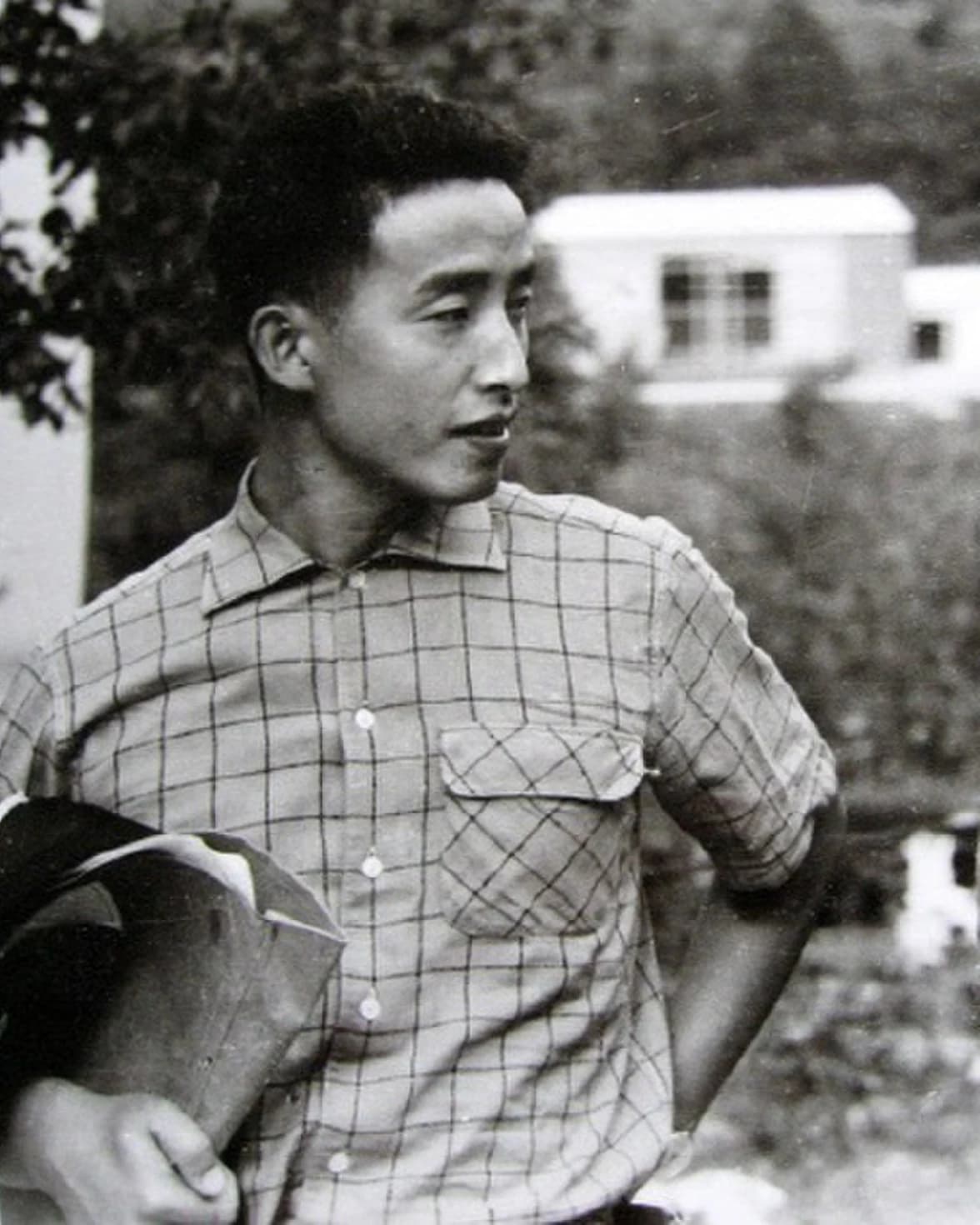
Biography
At a concert in Cologne in 1960 a young Korean played Chopin on the piano, then threw himself at the instrument, jumped down into the audience, cut the clothes of John Cage and the pianist David Tudor with scissors and, to finish, poured shampoo over their heads. By then Cage was already his friend. To my mind, this act explains well why there is so much humour in Paik’s video art: he started out as a musician who wanted to shake up the ritual of the concert.
He was born on 20 July 1932 in Seoul (then Keijō, in Korea under Japanese rule), the youngest of five children of the owner of a large textile firm. The boy was taught classical piano, and thanks to private tutors he came to know Western music early and well. In 1950, when the Korean War broke out, the family fled first to Hong Kong and then to Japan. In 1956 Paik graduated in aesthetics from the University of Tokyo with a thesis on Schoenberg and left for West Germany: he studied music history at the University of Munich under Thrasybulos Georgiades, by some accounts studied composition in Freiburg, and worked at the electronic music studio in Cologne. In Germany he met Stockhausen, Cage, George Maciunas, Joseph Beuys and Wolf Vostell.
Fluxus, which Paik joined in 1962, grew out of Cage’s ideas about everyday noise in music. It was Cage, too, who advised him to take a closer look at Zen Buddhism, and Paik, who had grown up around Buddhism in Korea and Japan, looked afresh at what he had known since childhood.
His debut in the visual arts was the exhibition “Exposition of Music – Electronic Television” at the Galerie Parnass in Wuppertal in 1963. Television sets stood all over the space, and magnets distorted the images on their screens. In 1963–1964 the Japanese engineers Hideo Uchida and Shuya Abe showed him how to interfere with the movement of electrons in a colour picture tube; out of this grew the Paik–Abe video synthesizer. In 1964 Paik put out a leaflet with the provocative phrase “Yellow Peril! C’est moi”.
That same year, 1964, he moved to New York and began working with the cellist Charlotte Moorman, combining music, performance and video. In 1967 Moorman was arrested for performing topless in his “Opera Sextronique”; in 1969 she played in “TV Bra for Living Sculpture”, and in 1971 she drew her bow across “TV Cello”, built from three television sets with strings. From 1965 Paik had his own Sony video recording equipment, and he began to record and rework television broadcasts. In 1974, in a report for the Rockefeller Foundation, he wrote about “electronic super highways” that would link New York with Los Angeles; hence the view that the phrase “information superhighway” is his as well. In the same year, 1974, came “TV Buddha”: a statue of the Buddha sits in front of a television set and watches its own image, filmed by a camera trained on it. A year later followed “Video Fish”, a row of aquariums with live fish in front of a row of monitors with fish on their screens.
From 1979 to 1996 he was a professor at the Düsseldorf Art Academy. In 1982 the Whitney Museum gave him a retrospective. On 1 January 1984 the programme “Good Morning, Mr. Orwell” went out on air, a live television link between New York, the Centre Pompidou and South Korea, with Cage, Beuys, Laurie Anderson, Merce Cunningham and Allen Ginsberg taking part. Orwell’s Big Brother, as Paik saw it, had not come after all. In June of that year he visited Korea for the first time in almost thirty-five years, and from then on he was a prominent figure there: he brought over Cage and Beuys, made live television links for the 1986 Asian Games and the 1988 Olympics, and helped to found the Gwangju Biennale and the Korean Pavilion in Venice. The tower “The More, the Better” (1988) at the National Museum of Modern and Contemporary Art in Gwacheon is built from 1,003 monitors; the number refers to 3 October, the day Korea was founded by its mythical forefather Dangun. In 1993, together with Hans Haacke, he represented Germany at the Venice Biennale, filling the pavilion with robots in the shape of historical figures from Catherine the Great to Dangun, and the pavilion won the Golden Lion.
“Electronic Superhighway: Continental U.S., Alaska, Hawaii” (1995), a map of the country made of neon outlines and a mass of screens, is now on permanent display at the Smithsonian American Art Museum. After a serious illness in 1996 he could hardly walk, but in 2000 the Guggenheim Museum mounted a large retrospective of his work, and in the same year he produced the satellite broadcast “Tiger Is Alive”.
Nam June Paik died in Miami on 29 January 2006. That same year his heirs gave his archive to the Smithsonian American Art Museum: videotapes, letters to Cage, Moorman and Maciunas, old television sets, radios, toys and the desk from his studio in SoHo.
Profile notes
Profile and sources
Image
Artist image
김언호; Wikimedia Commons; Public domain.
