
20.05.1844–22.09.1909
Mykola Murashko
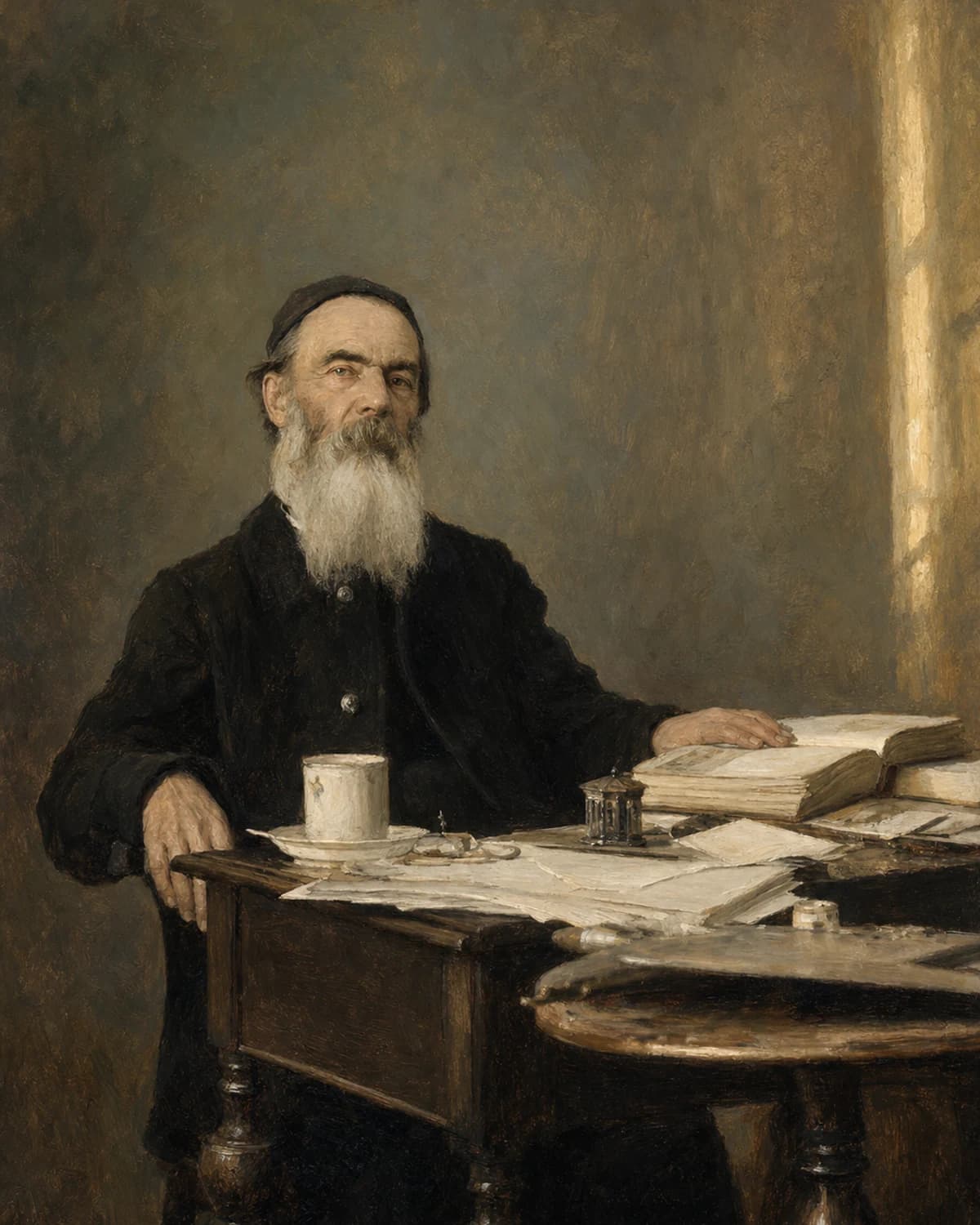
Mykola Murashko (1844–1909) opened a drawing school in his own home in Kyiv in 1875 and ran it until 1901; Mykola Pymonenko and Valentin Serov studied there. He painted landscapes of the Dnipro and the countryside around Kyiv, as well as a portrait of Nikolai Ge, and near the end of his life published “Memoirs of an Old Teacher” in two instalments.
Biography
The school in question began not in classrooms but in his house. In 1875 Mykola Murashko gathered his first pupils there: adults and children, amateurs and those preparing for a drawing examination. It was closed on 22 May 1901, after more than twenty-five years.
He was born on 20 May 1844 (8 May, Old Style) in Hlukhiv, the son of a carver who made church iconostases. His interest in drawing showed early: as a boy he copied pictures from books. From 1858 the family lived in Kyiv. In 1863, on the advice of Ivan Soshenko, a drawing teacher at a gymnasium, Murashko went to Saint Petersburg and began attending the Imperial Academy of Arts. Adrian Prakhov is named among his teachers, and his closest friend became Ilya Repin. A lithographed portrait of Taras Shevchenko (1864–1867) survives from those years.
He did not finish the course: illness prevented it, and he left Saint Petersburg for the south, for Voronezh. In October 1867 he sent the Academy his drawings with a request to be recognised as a drawing teacher on the strength of that work. The request was granted, and he received his diploma in absentia. From 1868 he taught in Kyiv, first at a gymnasium and then at a secondary school for science and technical subjects. Teaching remained the main business of his life. In 1879 the Academy gave him the title of Artist, 3rd Degree, for a picture of the countryside around Kyiv.
He organised the school by his own rules: draw from nature, move from the easy to the difficult, work with each pupil individually, and combine specialist subjects with general education. For copying he made lithographed models himself: ornaments, buildings, landscapes, genre scenes. In 1869 his drawing manual for children appeared, and in 1875 it was reissued. The school was helped by the geographer Pyotr Semyonov-Tyan-Shansky, by Kyiv collectors, among them Ivan Tereshchenko, and by artists including Repin, Ivan Kramskoi and Vladimir Makovsky. The school moved several times: from Trokhsviatytelska Street to premises in the city council building, then to what is now Ivan Franko Street and on to Volodymyrska Street. Mikhail Vrubel and Ivan Seleznyov taught there, and Pymonenko, Serov, Khariton Platonov and Konstantin Kryzhitsky studied there. Murashko persuaded Tereshchenko to admit the gifted Pymonenko free of charge. Later, graduates of the school followed the principles of the Wanderers (Peredvizhniki), the realist painters who broke away from the academic establishment.
He painted himself as well. In the late 1870s he took up landscape in earnest; later came “The Teteriv River”, “Korostyshiv” (1886), “Crimea” (1892), “The Shore at Alupka” (1894) and “View of Boyarka”. Some pieces were bought for the Academy’s museum. His best portrait is considered to be that of Nikolai Ge. “Over the Dnieper”, with its high bank and the distant spread of the river, is usually called his most successful landscape.
From 1877, on his initiative, annual exhibitions were held in Kyiv. In 1873 he made eleven illustrations for the first Ukrainian translation of Andersen’s tales. From the 1880s he wrote in newspapers and journals, explaining to readers why the Wanderers mattered. In 1885, 1891 and 1894 he travelled to Kraków, Vienna, Paris, Bologna, Florence and Rome to see how teaching was organised in the schools and academies there. On the way to Rome in 1885 he called on Jan Matejko; in his memoirs he wrote that when founding the school he had ruled out any national quotas.
After the school closed he lived on his own farmstead near Bucha and wrote “Memoirs of an Old Teacher”. Two instalments appeared in his lifetime, with the account of the school brought up to 1884. Illness prevented him from finishing the book.
Murashko died on 22 September 1909. He was buried at the Lukianivka Cemetery in Kyiv.
Related context
Associations
Works connected through artistic movements, cultural context and period. Priced works available in this market appear first.








Profile notes
Profile and sources
Image
Artist image
На основе открытого изображения: Unknown author Unknown author; Wikimedia Commons; Public domain.
