
28.04.1865–25.11.1937
Mykola Ivasyuk
Mykola Ivasyuk, a native of Bukovina, spent two decades on the huge canvas “The Entrance of Bohdan Khmelnytsky to Kyiv”, whose reproductions hung in Ukrainian homes in Galicia. In 1919 he designed postage stamps for the Ukrainian People’s Republic, and in 1926 he moved to Soviet Kyiv at the government’s invitation. He was arrested in September 1937 and shot in November.
Biography
The sentence on Ivasyuk was passed on 14 November 1937 and carried out eleven days later. He was seventy-two. All his personal property was confiscated; the charge named him as a member of a Ukrainian nationalist terrorist organisation and an agent of German intelligence. He did not admit guilt, and the investigators had to record this in the file.
The road to that point began in Zastavna in Bukovina, then part of the Austrian Empire. His father was a carpenter. The date of birth differs between sources: some give 28 April 1865 (16 April, Old Style), but others give 14 April, 28 March, and even July. I take 28 April, but checking it against a parish register is hard.
At the school in Zastavna the teaching was in German and Romanian. For his upper grades he went to Chernivtsi, to the higher Realschule (a secondary school with a scientific and technical curriculum), where drawing and painting were taught by Yustyn Pigulyak, the first professional Ukrainian painter of Bukovina. Pigulyak noticed the boy’s ability, by some accounts gave him free lessons, and helped him enter the Academy of Fine Arts in Vienna. Ivasyuk was admitted in 1884. In Vienna he chose history painting; by one account it was then that he conceived a picture about Bohdan Khmelnytsky, and the work took him about twenty years. During his studies he took part in student excursions to the Ternopil region (in August 1885) and more than once visited the estate of Volodyslav Fyodorovych in the village of Vikno, where he painted portraits of the family. After that, as one of the best in the historical genre, he was recommended to the Academy of Fine Arts in Munich. The years of study are given differently: by one account, 1885 to 1888 in Vienna and 1890 to 1896 in Munich; his Munich teacher is said to have been Alexander Liezen-Mayer.
In Munich, in 1893, he met Ilya Repin and showed him the first sketch of “The Entrance of Bohdan Khmelnytsky to Kyiv”. Repin, as the story goes, advised him to return to Kyiv. There too, by some accounts, he found a close friend, the Polish battle painter Józef Brandt, and his future wife, a German, the sister of an artist he knew.
In 1897 Ivasyuk returned to Chernivtsi and devoted himself to teaching at the Realschule, to exhibitions and to public work. His first solo show in the city gave his countrymen both history (“Bohun at Berestechko”, “The Battle of Khotyn”) and genre pieces such as “Mother” and “Without Bread”. In 1899, together with Pigulyak, he founded in Chernivtsi the first drawing school in Bukovina, “for talented but poor youth”. In 1910 he painted the ceiling of the savings bank with an allegory, “Thrift”; under Soviet rule the building housed the city committee of the Communist Party. On the eve of the First World War the provincial diet granted him a thousand crowns for an art school. He kept studios in the People’s House, where pupils painted icons for iconostases; his iconostases survive in Zastavna, Kitsman and some Bukovinian villages.
“The Entrance of Bohdan Khmelnytsky to Kyiv in 1649”, about four by six metres, was finished in 1912 and is kept in the National Art Museum of Ukraine. Before the war a colour reproduction could be seen in almost every peasant house in Western Ukraine. According to his pupil Evzebiy Lipetskiy, it was painted in Chernivtsi and not in Lviv, as had been thought.
The sources tell the events of 1915 to 1926 differently. By one account, in 1915 Russian troops arrested him as a “German spy” (his wife was German) and held him in Rostov-on-Don. After the February Revolution he moved to Kyiv, and from 1919 he lived now in Lviv, now in Chernivtsi. His battle compositions about the Cossack campaigns and the fighting of the Ukrainian Sich Riflemen, by some accounts, were lost in the move.
In 1919 the government of the Directorate of the Ukrainian People’s Republic commissioned him to design postage stamps. He made drawings for eight of the fourteen and the overall design of the “Vienna series”. Printing was completed on 31 May 1921, but the Directorate’s troops had by then been pushed out of Ukraine, and the stamps never entered use.
In the autumn of 1926 Vlas Chubar, chairman of the Council of People’s Commissars of Soviet Ukraine, invited Ivasyuk and his pupil Lipetskiy to become professors at the Kyiv Art Institute. Lipetskiy refused and tried to dissuade his teacher, knowing from refugees what the regime there was like. Ivasyuk did not listen. From the end of 1926 he lived in Kyiv, his family received Soviet citizenship, and he was asked to paint pictures about the revolutionary movement. From 1927 he worked for the All-Ukrainian Photo-Cinema Administration, making film posters and drawings for the magazine “Kino”. At first he was praised; then, it is said on instructions from Moscow, he began to be criticised for “bourgeois deviations” and was transferred to Odesa, and later it was forbidden to mention his name. Vasyl Krychevsky related that before his death Ivasyuk was destitute and disillusioned.
In September 1937 officers of the NKVD, the Soviet secret police, came to search his home. They found nothing incriminating, but arrested him and sent him to Lukyanivska Prison. He was shot on 25 November 1937: by one account at Bykivnia, by another in the October Palace in Kyiv. He was buried at Bykivnia. In 1980 he was rehabilitated, that is, officially cleared, for lack of evidence of a crime.
He painted more than five hundred pictures. In Ukraine no more than fifteen are now known; the fate of the rest is unknown.
Related context
Associations
Works connected through artistic movements, cultural context and period. Priced works available in this market appear first.








Profile notes
Profile and sources
Image
Artist image
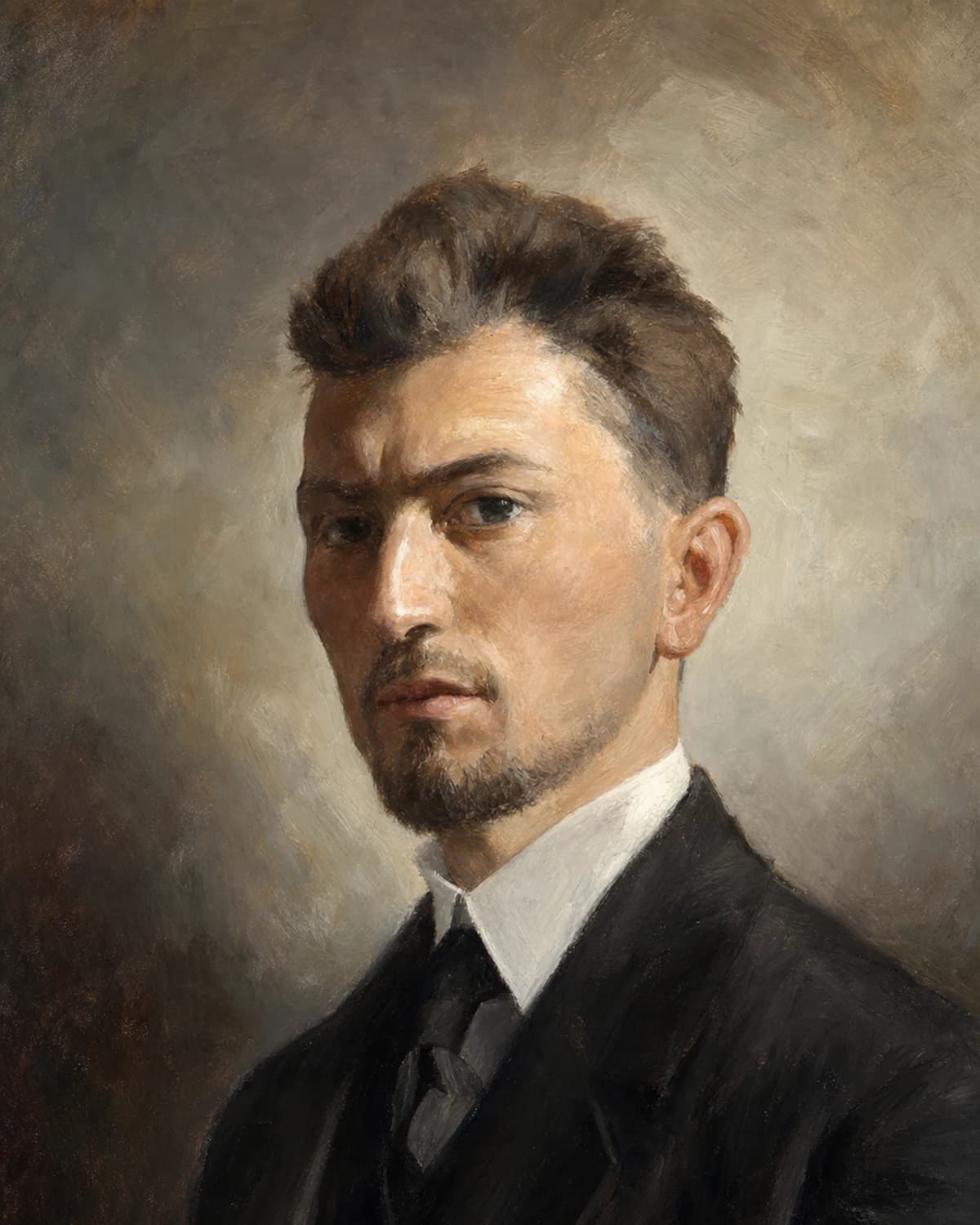
На основе открытого изображения: Івасюк Микола Іванович 1887 автопортрет (Self-portrait 1887); Wikimedia Commons; Public domain.
