
16.03.1871–12.08.1942
Mykola Burachek
Mykola Burachek (1871–1942) came to painting by way of the stage: until the age of thirty he acted in provincial theatres, and only then went to study in Kraków and later in Paris. He painted mostly Ukrainian landscapes, was among the founders of the Ukrainian Academy of Arts in 1917 and taught in Kharkiv. Later he turned to studying the legacy of Taras Shevchenko.
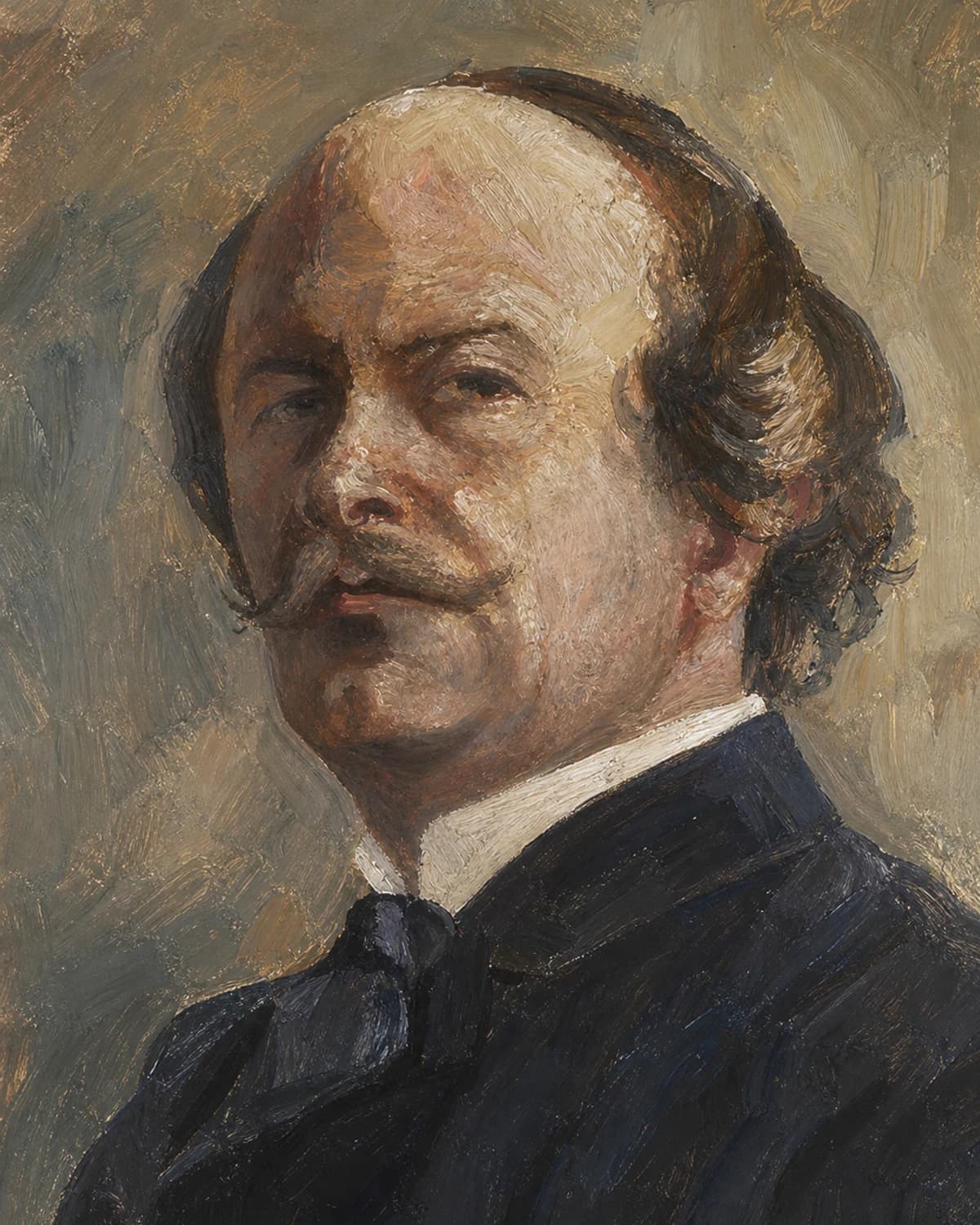
Biography
Burachek’s first profession was not painter but actor. In 1890, on the recommendation of Maria Savina, he became an actor in the Russian-language company at Kamianets-Podilskyi. On stage he used the pseudonym Solomin and played, among other parts, Raspluyev in “Krechinsky’s Wedding” and Neschastlivtsev in Ostrovsky’s “The Forest”.
He was nineteen then, and gave little thought to painting.
He was born on 16 March 1871 (4 March, Old Style) in the small town of Letychiv in Podillia, into the family of a postal clerk; his father soon received the post of postmaster in Kamianets-Podilskyi, and the family moved there. His father gave him his first drawing lessons, and at the gymnasium (secondary school) drawing was taught by the painter Ivan Vaskov. In 1888 Burachek entered Kyiv University, but the following year he was expelled for taking part in student unrest and exiled to Simbirsk Governorate. On his return he lived in Kyiv and briefly studied at the Murashko drawing school, with Mykola Pymonenko and Kharyton Platonov. Then the stage again: he acted in Ryazan, Kostroma, Minsk, Poltava, Kyiv and Kharkiv, and made set sketches for Tolstoy’s “The Power of Darkness”, for “The Forest” and for Gerhart Hauptmann’s “The Sunken Bell”. At the same time he painted studies and watercolours; in March 1905 his landscapes were shown in Lviv at the First All-Ukrainian Exhibition of Ukrainian Artists. In 1905 he left the theatre and lived by writing: Kyiv newspapers readily took his stories, essays and reviews. In Kyiv in the same year he met the Polish painter Jan Stanisławski, who persuaded him to get a proper art education. Burachek studied at the Kraków Academy of Fine Arts under Stanisławski himself and, after his death, under Ferdynand Ruszczyc; his first exhibition took place in 1907. During his student years he travelled to Germany, Austria, Italy, France and Switzerland, and exhibited in Kraków and Vienna. In 1910–1912 he lived in Paris, on Boulevard du Montparnasse, attended the studio of Henri Matisse and later the Académie Ranson, where Maurice Denis and Paul Sérusier taught. His early works show traits of Post-Impressionism; later he moved to Impressionism.
From 1912 he was again in Kyiv. In 1914 he helped organise the Kyiv Salon exhibition; in 1915–1917 he belonged to the literary and artistic “Circle of Nine” with Les Kurbas, Heorhiy Narbut, Mykhail Semenko and Pavlo Tychyna, and taught mime drama at the Mykola Lysenko music and drama school. In 1917 he became one of the founders of the Ukrainian Academy of Arts: in its first year he served as acting president, taught and headed the landscape department. In 1920 he directed the mural decoration of the House of the Peasant in Kyiv. In 1921–1924 he worked as a schoolteacher, drew and staged amateur plays in the Uman area.
From 1925 Burachek lived in Kharkiv. He taught at the art technical school, then at the art institute (a professor from 1927), and in 1926–1929 headed the Central Bureau of Art Workers. Accounts of his post at the institute differ: according to some, he was its rector, according to others only a teacher. He belonged to the Association of Revolutionary Art of Ukraine and to the Shevchenko Committee, took part in setting up the Shevchenko museum and in 1926 joined the committee for the care of the poet’s grave. In 1934 a solo exhibition was held in Kharkiv, and in 1936 in Kyiv; for Kharkiv theatres he designed “Marusia Churai” by Ivan Mykytenko and “Set Your Heart Free” by Marko Kropyvnytsky, and in 1937 he worked with theatres in the Donbas. From 1931 Burachek was a research fellow at the Shevchenko Picture Gallery. He found many previously unknown works by the poet, was the first to establish the authenticity of hundreds of watercolours and paintings, and compiled a chronology of the legacy. The result was the monograph “The Great National Artist” (1939). Earlier, in 1930, his book on Mykola Samokysh had appeared, and in 1937 his memoirs, “My Life”; his essay on Oleksandr Murashko was printed only in 1983. To my mind, this turn from landscape to archival work explains why his biography has so many committees and so few large canvases.
He himself painted mostly Ukrainian landscapes: “Morning on the Dnieper” (1934), “Apple Trees in Bloom” (1936), “The Broad Dnieper Roars and Moans” (1941). His painted legacy is estimated at about ten thousand works, some of which were lost during the war. He received the title of Honoured Art Worker of the Ukrainian SSR in 1941; in the same year his large exhibition was held.
He refused to be evacuated from Kharkiv. Burachek died on 12 August 1942 in the occupied city and was buried in the 13th City Cemetery; the bust on his grave, by the sculptor Olha Kudriavtseva, was put up in 1954.
Related context
Associations
Works connected through artistic movements, cultural context and period. Priced works available in this market appear first.








Profile notes
Profile and sources
Image
Artist image
На основе открытого изображения: Burachek_N; Wikimedia Commons; Public domain.
