
23.10.1919–15.01.1996
Mykhaylo Khmelko
Mykhaylo Khmelko was born in Kyiv into the family of a worker at the Arsenal factory, served in the war as a sapper-cartographer, and then joined a brigade of front-line artists. He became known for the multi-figure canvases “Drink a Toast for the Great Russian People” (1947) and “Triumph of the Victorious Motherland” (1949), both awarded Stalin Prizes. For a quarter of a century he taught painting at the Kyiv Art Institute.
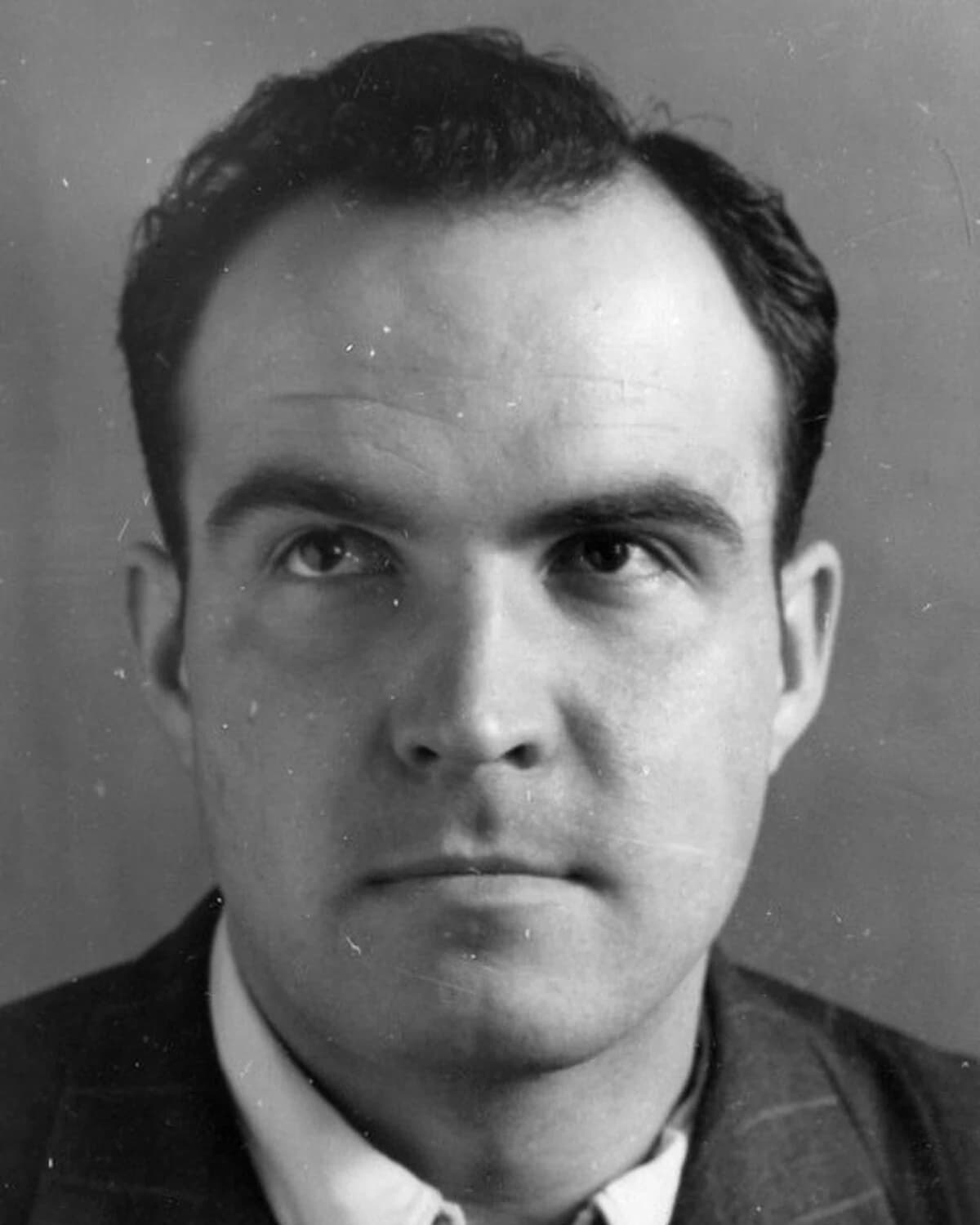
Biography
In 1948 Khmelko received a Stalin Prize, second class, for a painting whose title is given in two ways: “For the Great Russian People!” and “A Toast to the Great Russian People”. The subject is well known: a victory feast and a raised glass. He painted it in 1947, when he was twenty-eight.
He was born on 23 October 1919 in Kyiv, the son of Ivan Khmelko, a worker at the Arsenal factory and a participant in the revolutionary movement. He drew from childhood and from about the age of ten attended the studio of Mykhailo Yarovyi. In 1933 he entered the Kyiv Art Technical School and at the same time worked as an engraver at the First State Printing House. He later studied at the Odesa Art Technical School, from which he graduated in 1940. The sources disagree about when he began there, so I give only the year he finished.
Almost immediately after graduating he was called up into the Red Army. The war found him in the west of the country; his unit broke out of encirclement and reached Nizhyn, where he retrained as a sapper-cartographer. He was then badly wounded, and having been taken to a hospital in Lubny, he found himself in occupied territory. He could not get back to the front and returned to Kyiv, to his mother. He lived on odd jobs, painting portraits to order and helping with farm work in villages near the city. After the liberation of Kyiv he joined a brigade of front-line artists attached to the political directorate of the 1st Ukrainian Front.
In 1946 Khmelko graduated from the Kyiv State Art Institute, where he had studied under Karp Trokhymenko. That year he painted “The Crossing of the Dnieper”, a war subject. The following year came the toast.
From 1948 to 1973 he taught at the institute, and from 1962 he was a professor. By some accounts, he headed the painting department from 1960 to 1970 and directed the studio of historical painting. He taught painting and composition and studied the methods of painting and the principles of building a composition. From 1951 to 1957 (by other accounts, until 1955) he headed the Union of Artists of Ukraine, the official professional body of Soviet-era artists. In that post he travelled on working trips, including to the United States, Canada, Great Britain and Japan. From 1954 he was a member of the Communist Party of the Soviet Union.
His main works are large compositions with dozens of figures, with party and military leaders in the foreground. “Triumph of the Victorious Motherland” (1949) is devoted to the Victory Parade and brought him a Stalin Prize, first class, in 1950. “Forever with Moscow, Forever with the Russian People” (1951) depicts the Pereiaslav Council. Later came “The Kyiv Breakthrough. Khrushchev and Vatutin near Kyiv” (1956), “Taras Shevchenko and Mikhail Shchepkin in Moscow” (1956), “The Miners’ Wedding” (1957) and “Pledge of Loyalty to the Party. The First Congress of the Komsomol” (1958). For “The Motherland Welcomes the Hero” (1961) he was invited that same year to a meeting with Yuri Gagarin, and the finished canvas, it is reported, Gagarin praised highly. He also made things unusual for him: the diorama “Medical Help in the Army of Bohdan Khmelnytsky” is kept in the museum of medicine in Kyiv. He kept returning to the war theme to the end: “The Victory Banner over Kyiv” (1975), “1941: The Defence of Kyiv. Holosiivskyi Forest” (1988). From 1947 Khmelko regularly took part in republican and all-Union exhibitions, and his works are held in the National Art Museum of Ukraine, the Tretyakov Gallery and museums in Lviv.
The honours came one after another: Honoured Art Worker of the Ukrainian SSR in 1951, People’s Artist of the Ukrainian SSR in 1963. Among his decorations are the Order of the Red Banner of Labour (1951), the Order of Lenin (1960) and the Order of the Patriotic War, second class (1985).
In the 1970s he left the institute. From 1986 he worked on an autobiography, but it remained a draft. When demand for paintings of party and military figures vanished after the changes of the late 1980s, he almost stopped working. Khmelko died on 15 January 1996.
Profile notes
Profile and sources
Image
Artist image
Unknown author Unknown author; Wikimedia Commons; Public domain.
