
22.08.1861–20.12.1919
Mykhaylo Berkos
Mykhaylo Berkos, a native of Odesa from a Greek family, graduated from the Imperial Academy of Arts in St Petersburg and spent three years travelling in Europe as an Academy pensioner. In Kharkiv he painted flowering fields of flax and buckwheat, and in 1912 he secured the opening of an art college. Almost all the works kept at his home were burned after his death; the rest are scattered across museums.
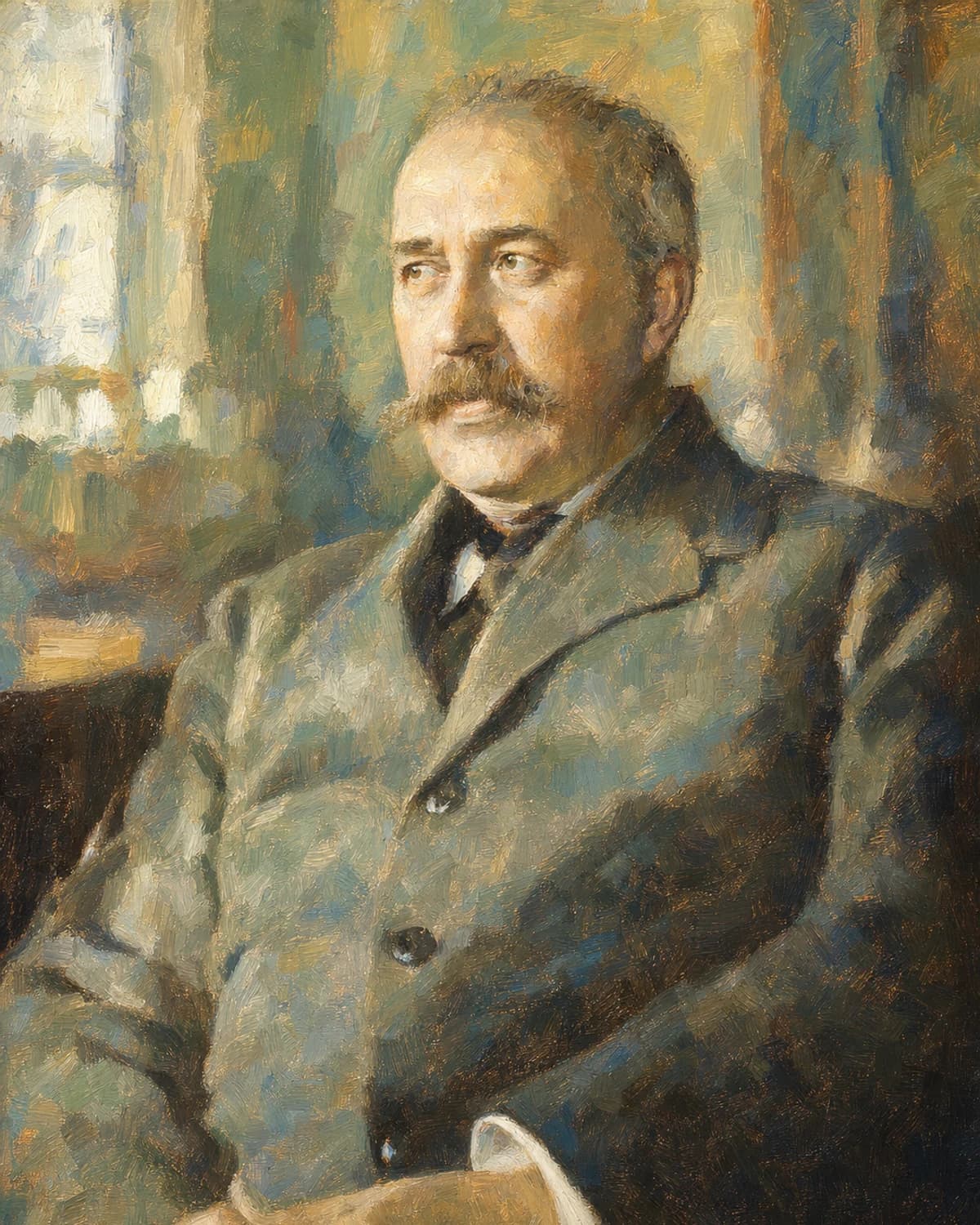
Biography
When Mykhaylo Berkos died in Kharkiv in December 1919, about 350 paintings and sketches were left at his home. His wife burned them. What we know of the artist today has been pieced together from works that had by then found their way into museums or private hands.
He was born in Odesa, the son of Andrey Ignatievich Berkos, a subject of Greece who worked for the trading firm Bellino Fender; his mother, Martha Ivanovna, came from a Russian noble family. The sources disagree on the date of his birth: they give either 22 August, Old Style, or 3 September. These are most likely the same date in two calendars. The family lived in their own house on Pushkinskaya Street. Berkos studied drawing at the Odesa Drawing School and graduated in 1877.
In 1878 he entered the Imperial Academy of Arts in St Petersburg and studied there until 1889 in the studio of Mikhail Clodt and Volodymyr Orlovsky. Awards followed one after another: small and large silver medals in 1884–1886, a small gold medal for “View of One of the Oldest Parks in St Petersburg” in 1887, and a large gold medal for “Landscape. Forest in the Swamp” in 1888. During the holidays he came to Kharkiv with fellow students and painted landscapes there; one such sketch, “Full Poppies”, is dated 1885. He left the Academy in 1889 with the rank of first-degree class artist and the right to travel abroad at state expense. “The Stream” (1889, oil, 120 × 177 cm), now in the Russian Museum, dates from the same year.
From 1890 to 1893 he travelled through France, Germany, Spain, Italy and Switzerland, visiting museums and painting a great deal himself. In these years, as is generally held, he came under the influence of Impressionism and open-air painting. When his pension term ended, Berkos lived in St Petersburg for a while longer and sent works to the exhibitions of art societies.
In the late 1890s he moved to Kharkiv, to the suburb of Mala Danylivka, and settled with Maria Reinicke, a general’s widow. Of the sketches made there, “Greenhouses” (1895) and “Landscape with a Church” (1897) survive. From 1904 he taught at the Kharkiv drawing school. At his initiative the Kharkiv Art College opened in 1912, and he remained one of its leading teachers until 1917. He worked to enlarge the collection of the Kharkiv Art and Industry Museum, the first of its kind in Ukraine; in the early 1900s he worked in the Kharkiv Literary and Artistic Circle, and from 1906 he chaired the Society of Kharkiv Artists. In 1907 he took part in decorating the interiors of the Poltava Zemstvo building (the Zemstvo being the elected provincial council) in the Ukrainian Art Nouveau style.
He exhibited widely: at the shows of the Academy of Arts, the St Petersburg Society of Artists, the societies of Russian watercolourists, and of southern Russian and Kharkiv artists; at the All-Russian Exhibition in Nizhny Novgorod in 1896; and at the Exposition Universelle in Paris in 1900. Solo exhibitions took place in Kharkiv in 1906 and 1908, and in 1911 in Kyiv his works were shown together with those of Serhii Vasylkivsky.
His favourite motifs were village streets with white houses and lush trees, and flowering fields of flax and buckwheat. The titles say as much: “Flax in Bloom” (1893), “Buckwheat in Bloom” (1894), “July. Poppies Are Blooming” (1913), “Apple Tree in Bloom” (1919). He painted with a round, dense, dotted brushstroke, and the surface of the canvas flickers. “Street in Uman” (1895) shows the dusty roads and tilting houses of a provincial town. In the Italian landscapes “Rome” and “Sorrento” (1899) and in the sketch “Haven. Amalfi” of the same year there is more blue sky and bright light. “Winter” (1907), painted in the Poltava region, is kept in white and blue tones with pink flashes. To my mind, in such works an ordinary corner of Sloboda Ukraine easily reads as an image of the whole of Ukraine.
Berkos died in Kharkiv on 20 December 1919. In October 1938 the Kharkiv picture gallery showed about 120 of his paintings made between 1890 and 1919, and later exhibitions were held at the Kharkiv Art Museum in 1962, 1990 and 1996. A street in Kharkiv is named after him.
Related context
Associations
Works connected through artistic movements, cultural context and period. Priced works available in this market appear first.








Profile notes
Profile and sources
Image
Artist image
На основе открытого изображения: Unknown author Unknown author; Wikimedia Commons; Public domain.
