
30.10.1882–13.07.1937
Mykhailo Boychuk
Mykhailo Boychuk (1882–1937), a native of the Galician village of Romanivka, studied in Vienna, Kraków and Munich, and in Paris gathered pupils who set out to revive Byzantine monumental painting. In Kyiv he became one of the founders of the Ukrainian Academy of Arts and, with his school, the Boychukists, painted murals in theatres, institutes and sanatoriums. In 1936 he was arrested.
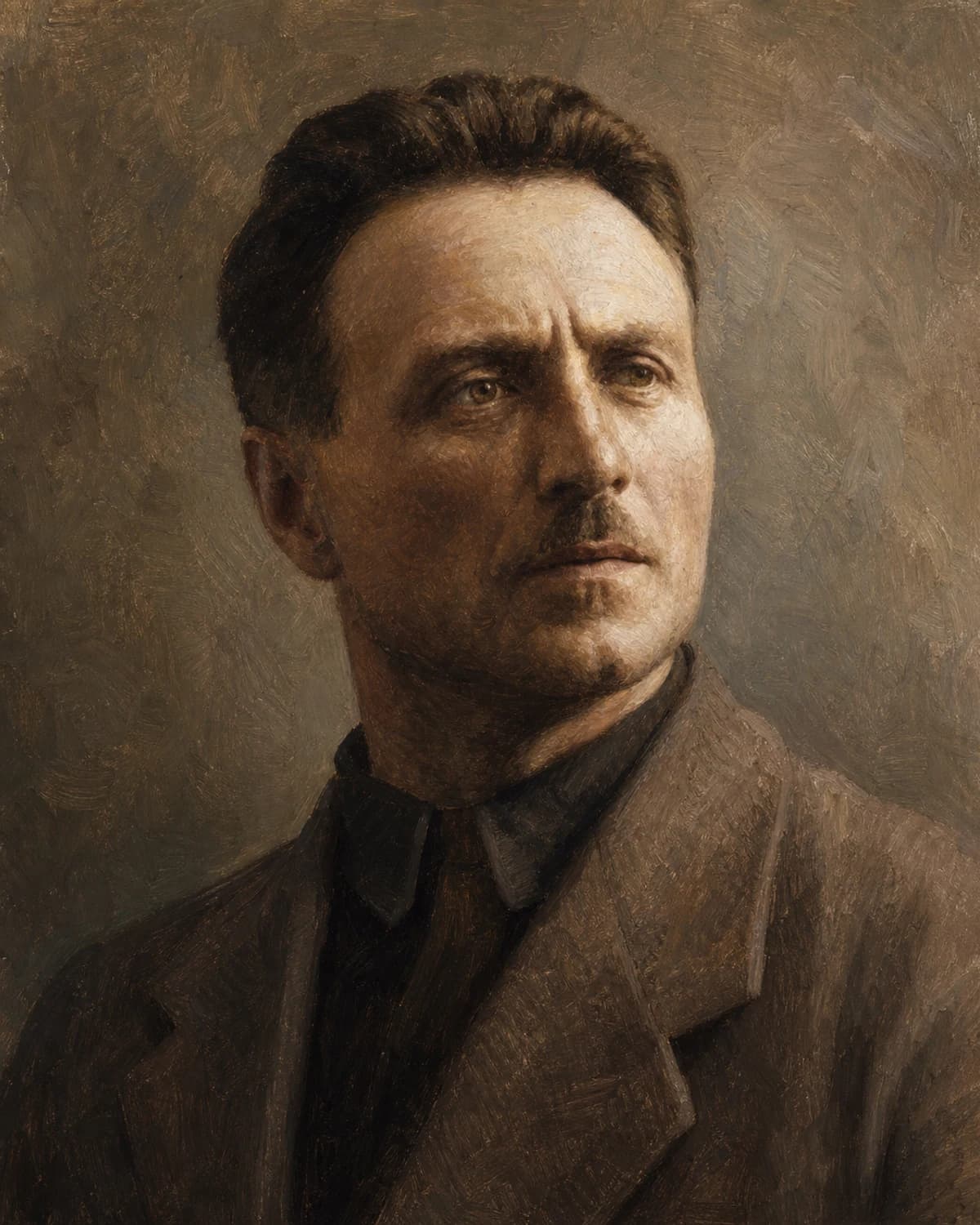
Biography
In 1910 a small group of Ukrainian artists exhibited at the Salon des Indépendants in Paris with a programme that was unexpected in the Paris of the day: to bring Byzantine monumental painting back to life. The works, his own and his pupils’, were shown by Mykhailo Boychuk. He was twenty-seven; Vienna, Kraków and Munich lay behind him, and in Paris he had already been running his own studio-school for a year.
His pupils would later be called the Boychukists.
He was born on 30 October 1882 in the village of Romanivka in Galicia, then part of Austria-Hungary. He drew from childhood, and his school drawing teacher placed a notice in a newspaper about the gifted boy; that was how the Lviv painter and teacher Yulian Pankevych came to take an interest in him. In 1898 Boychuk came to Lviv to study with him and worked on icon painting and book miniatures. From 1899, with funds from the Shevchenko Scientific Society and later from Metropolitan Andrey Sheptytsky as well, he studied at the Vienna Academy of Fine Arts, then at the Kraków Academy under Leon Wyczółkowski, from which he graduated with a silver medal. In 1905 his work was shown at the Latour gallery in Lviv. In 1905–1906 he served in the Austrian army in Dalmatia, in 1906–1907 he studied at the Munich Academy of Fine Arts, and in 1907 he exhibited in Munich.
He spent the following years in Paris, where he met Pablo Picasso and Diego Rivera, worked alongside Félix Vallotton, Paul Sérusier and Maurice Denis, and came under their influence. In 1909 he opened a studio-school. It was there too that he married the painter Sofia Nalepinska, who in 1909 was studying painting at the Académie Ranson.
In 1910 Boychuk returned to Lviv and began restoring icons at the National Museum, while also taking commissions for church murals. In 1911 he travelled to the Russian Empire. When the First World War began and the Russian army occupied Galicia, he, as a subject of Austria-Hungary, was exiled to Arzamas. After the war he remained in Kyiv.
In 1917 he worked on the frescoes of St Sophia Cathedral and became one of the founders of the Ukrainian Academy of Arts, whose status the Central Rada confirmed at the end of that year. He taught fresco and mosaic, and in 1920 he was rector. He built his programme on the systematic study of Byzantine and Old Rus church painting, the Italian Proto-Renaissance, Ukrainian book engraving and folk pictures, out of which he hoped to forge a new monumental style. In 1922 he told his students that an artist is mistaken “who regards the art of the past as archaeology”. To my mind, that phrase holds his whole teaching method: the old models were studied as working rules, not as museum antiquities, and his pupils were to fill them with new meaning.
The school worked above all on walls. With his pupils Boychuk painted the Lutsk Barracks in Kyiv (1919), the Kharkiv Opera Theatre (1921), the pavilion of the Ukrainian SSR at the First All-Russian Agricultural and Cottage Industry Exhibition in Moscow, the Co-operative Institute in Kyiv (1922–1923), a peasant sanatorium on the Khadzhibey estuary near Odesa (1927–1929) and the foyer of the Chervonozavodsky Theatre in Kharkiv (1933–1935). In 1924 he became a professor at the Kyiv Art Institute, and in 1925 one of the founders and intellectual leaders of the Association of Revolutionary Art of Ukraine; the tendency that dominated it took his name, Boychukism. Among his pupils were his younger brother Tymofiy Boychuk, Ivan Padalka, Vasyl Sedliar, Oksana Pavlenko, Mykola Rokytsky, Okhrim Kravchenko and Manuil Shekhtman. From November 1926 to May 1927 Boychuk travelled through Germany, France and Italy with his wife and his pupils Padalka and Sedliar. Later this journey became the official pretext for his arrest. In 1930–1931 he taught at the Institute of Proletarian Art in Leningrad.
On 25 November 1936 Boychuk was arrested by the NKVD and accused of “bourgeois nationalism”. Together with several of his pupils he became a victim of the Great Terror: he was shot in Kyiv on 13 July 1937. Sofia Nalepinska-Boychuk, from whom he was by then divorced, was also arrested and shot that December.
Most of the school’s frescoes were destroyed after this, and Boychuk’s paintings held in the Lviv museums were destroyed after the Second World War. He was rehabilitated in 1958, but his works began to come out of storage and return to exhibitions only from 1991; today his painting is in the National Art Museum of Ukraine. In 1992 a monument to the Boychuk brothers was put up in Romanivka, and in 2000 the Kyiv Institute of Decorative and Applied Arts and Design was named after Mykhailo Boychuk.
In 2016 Kikvidze Street in Kyiv was renamed Mykhailo Boychuk Street.
Related context
Associations
Works connected through artistic movements, cultural context and period. Priced works available in this market appear first.








Profile notes
Profile and sources
Image
Artist image
На основе открытого изображения: Unknown author Unknown author; Wikimedia Commons; Public domain.
