
1940–present
Muraina Oyelami
Muraina Oyelami came to painting from the theatre: in 1964 the drummer of Duro Ladipo’s company signed up for the summer classes of the Mbari Mbayo club in Osogbo and became one of the first students of the Osogbo School. His paintings are in the National Museum of African Art in Washington and the National Gallery of Modern Art in Lagos. Since 1993 he has held the title of Eesa in his home town of Iragbiji.
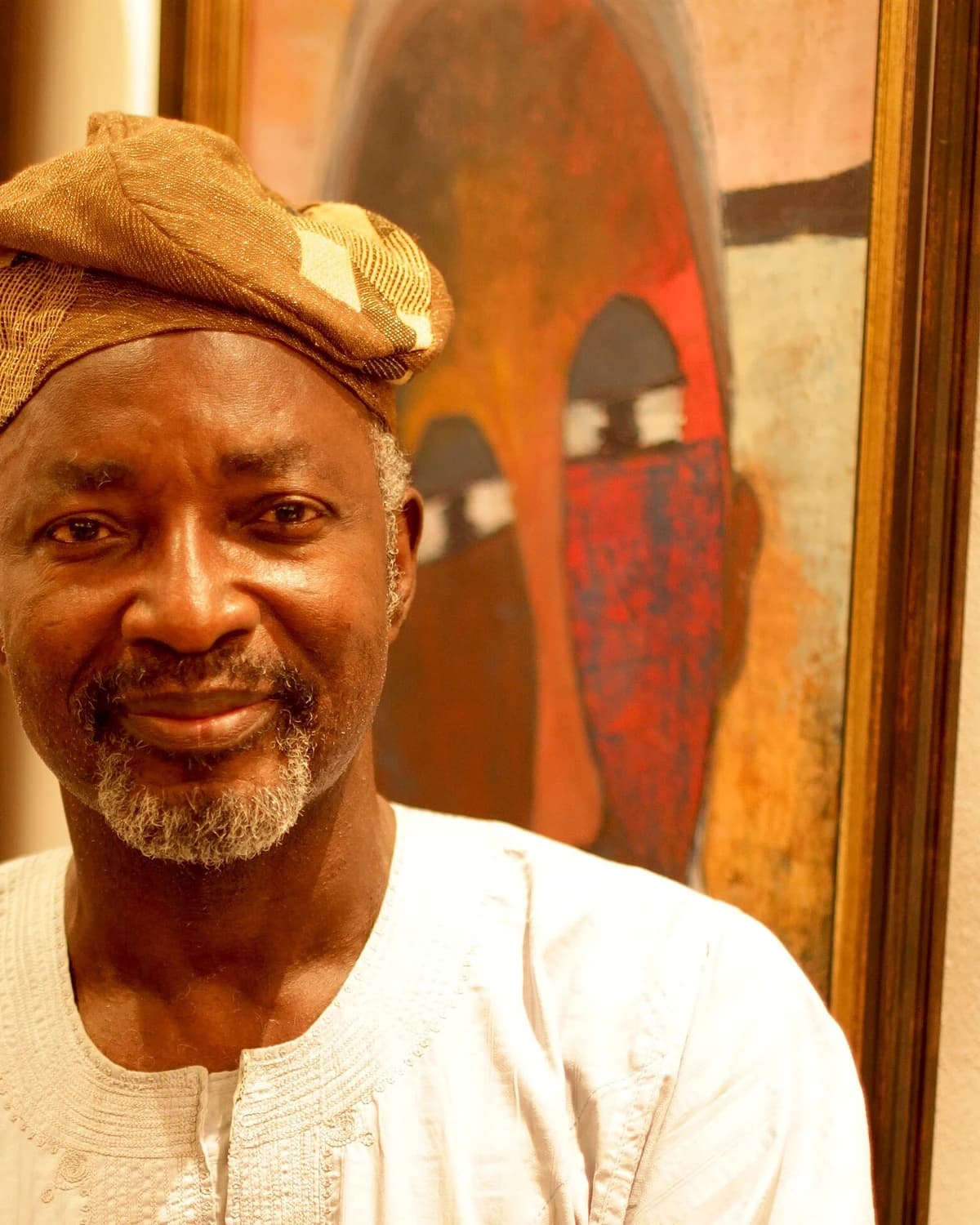
Biography
In the summer of 1964, in Osogbo in south-western Nigeria, the Mbari Mbayo club of artists and writers held a summer art school. The painting classes, led by Georgina Beier, were joined by a young drummer from the theatre company of the dramatist Duro Ladipo. This was Muraina Oyelami.
Three years later his paintings were hanging in Edinburgh.
He was born on 21 February 1940 in Iragbiji, in what is now Osun State. From 1963 to 1965 he learned to play the dùndún, the “talking drum”, from Oba Laoye, ruler of Ede with the title of Timi, and the batá drums from Ayantunji Amoo of Okinni and Abeyefo of Iseyin. In Duro Ladipo’s company he was both drummer and actor, and he toured Europe with it: in 1964 to the Berlin festival of the arts, in 1965 to Britain for the Commonwealth Arts Festival. The Osogbo School was founded by Georgina and Ulli Beier, and Oyelami was among its first students. He took workshops in printmaking and painting there while continuing to appear on stage. In painting and printmaking he drew on the work of the Kenyan printmaker Hezbon Owiti. At his first exhibition, in Edinburgh in 1967, his works were compared to Klee and Modigliani, although he did not know European art at the time; later he was compared to Rouault as well. To my mind, these comparisons say more about the viewers than about the artist. In 1966 and 1972 he attended the printmaking workshops of Ru van Rossem.
Then came the University of Ife (now Obafemi Awolowo University) in Ile-Ife: Oyelami studied technical theatre with a specialisation in theatre design and received a certificate in dramatic arts. In 1973 he went to New York on a fellowship and worked in residence at the National Black Theatre in Harlem. From 1976 to 1987 he taught traditional music and dance at Obafemi Awolowo University, and he was a visiting professor at the University of Bayreuth in Germany. The same university in Ile-Ife commissioned mosaics from him: the first pair, on the Faculty of Health Sciences building, was completed in 1975. In 1983 he finished a mosaic mural in Iragbiji.
He did not give up music. He plays traditional music and fusion; in 1985 he took part in recording an album by the German band Embryo with a Yoruba dùndún orchestra. At the Royal Exchange Theatre in Manchester he was musical director and composer of the score for Wole Soyinka’s play “Death and the King’s Horseman”.
Oyelami’s painting is assigned to the Osogbo movement and to modernism. His oils combine clear design, subtle muted colours and a strong line. His early canvases were abstract images of city life, and by the 1980s he had become more figurative; his themes come from Yoruba culture, and his landscapes and portraits are taken from everyday life and painted from real people. “Birds in the Garden” (1971) is in the Smithsonian Institution’s National Museum of African Art in Washington, and “Village on the Hillside”, from the same year, in the Tyler Collection at the University of Tasmania. His works are also in the National Gallery of Modern Art in Lagos, the Studio Museum in Harlem, the Institute of Contemporary Arts in London and the Staatliche Kunsthalle in Berlin. In 2016 they hung beside the collection of Susanne Wenger in an exhibition in her memory, and in 2017 they were shown at an exhibition of Osogbo art in the United States and at Art Dubai.
He has written books on drumming and Yoruba culture. In 1993 “Abefe” appeared, an autobiography compiled by Ulli Beier from conversations with the artist: about his youth, the theatre in Ile-Ife, the Mbari Mbayo workshop and his work at the Iwalewa-Haus in Bayreuth.
On 14 February 1993 Oyelami received the title of Eesa of Iragbiji. In 2018 he founded the Abeni Visual and Performing Art Institute there and became its artistic director. Students are taught drum making, textile design and printmaking.
Profile notes
Profile and sources
Image
Artist image
Jeremy Weate; Wikimedia Commons; CC BY 2.0.
