
1890–1912
Müfide Kadri
Müfide Kadri (1889/1890–1912) grew up in Istanbul in the household of an adoptive father, was taught at home by private tutors and began drawing seriously at ten. Her pupil was a daughter of Sultan Abdul Hamid II, and at a girls’ school she taught drawing and embroidery. Paintings she sent to Munich won a gold medal. She died young, and her life inspired a novel by Halide Edib Adıvar.
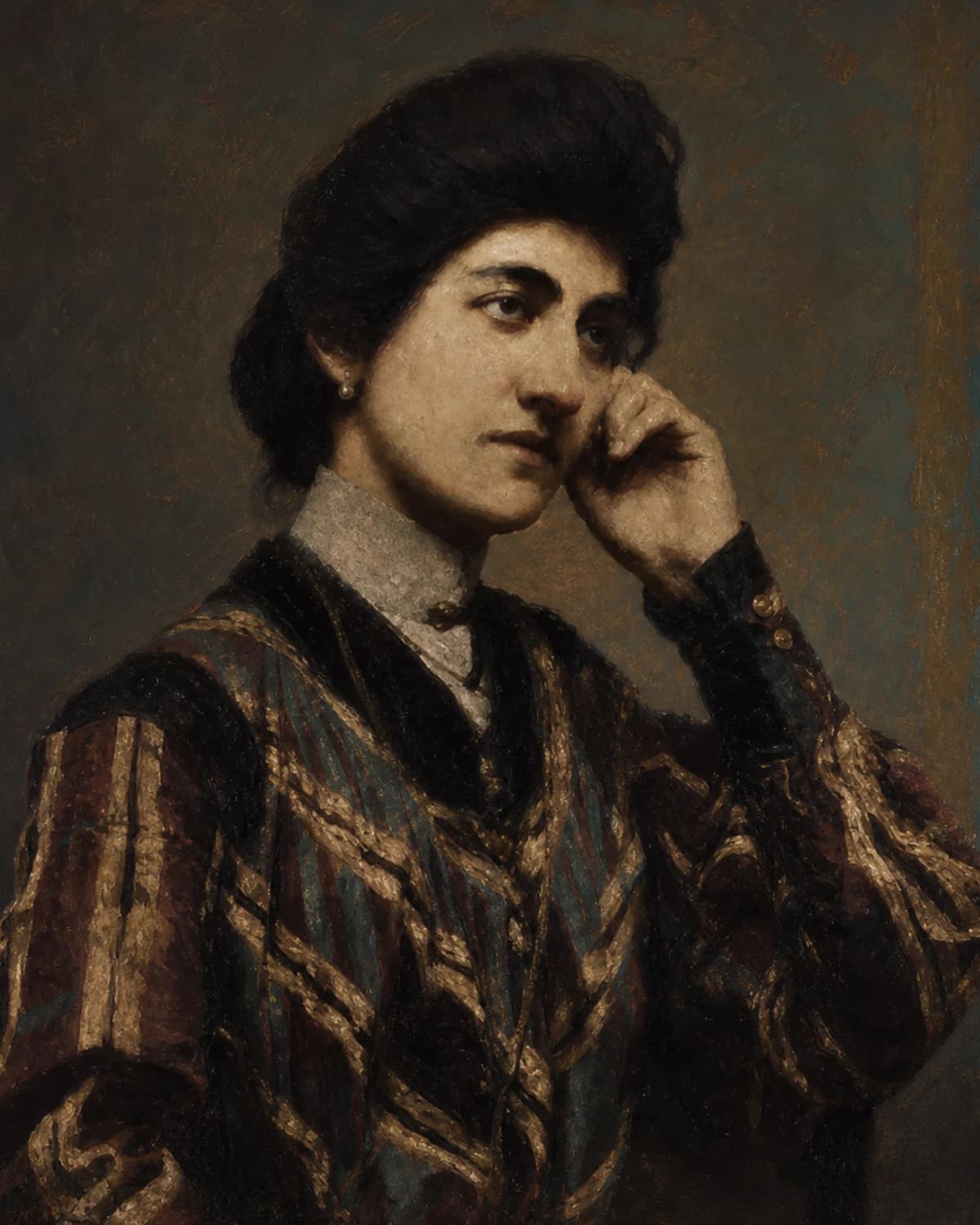
Biography
The inscription on her tombstone in Karacaahmet Cemetery was written by the well-known calligrapher İsmail Hakkı Altunbezer. It is perhaps the clearest sign of how she was regarded even by her contemporaries.
Müfide Kadri was born in Istanbul, in the Ottoman Empire; sources give the year of her birth as 1889 or 1890. She lost her mother as a child. She was taken in by Kadri Bey, a distant relative, a man of some standing in society, whose wife and he had no children. She was educated entirely at home: her private tutors were the first to notice that the girl drew better than most. She began to draw seriously at ten. Her first lessons came from Osman Hamdi Bey, one of the best-known Ottoman painters of the time. Her teacher of drawing and watercolour then became Salvatore Valeri (1856–1946), Italian by birth, a professor at the Sanayi-i Nefise Mektebi, the school of fine arts in Istanbul (now part of Mimar Sinan Fine Arts University). Alongside this she studied music, playing the piano and violin as well as the traditional instruments, the oud and the kemenche.
At Hamdi Bey’s urging she sent several works to an exhibition in Munich. They were awarded a gold medal. Which paintings went to Munich, and in what year, is not recorded, and it is hard to check from the texts available.
Soon afterwards Kadri began teaching music at a girls’ school in Istanbul, and later she was also given drawing and embroidery to teach. According to the sources, she is considered the first professional female art teacher in the Ottoman Empire. She also gave painting lessons to a daughter of Sultan Abdul Hamid II at the Adile Sultan Palace. In the same years she set poems by various poets to music, and these songs were published in cultural magazines. Portraits and scenes with figures predominate among her paintings.
In 1911 three of her works were shown at a large exhibition organised by the Istanbul Opera Society. Soon afterwards she was diagnosed with tuberculosis, but too late for effective treatment. She died in Istanbul: in 1912 according to most sources, in 1911 according to some. After her death forty of her paintings were sold to benefit the Ottoman Painters Society. Kadri Bey, according to some biographies, grieved deeply, went to Mecca and lived there until he was forced to leave the city after the fall of Ottoman rule. Her life became the basis of the novel “Son Eseri” (“Last Work”) by Halide Edib Adıvar, which was published in serial form in the newspaper Tanin.
Related context
Associations
Works connected through artistic movements, cultural context and period. Priced works available in this market appear first.








Profile notes
Profile and sources
Image
Artist image
На основе открытого изображения: Unknown author Unknown author; Wikimedia Commons; Public domain.
