
14.08.1875–20.11.1957
Mstislav Dobuzhinsky
Mstislav Dobuzhinsky (1875–1957) painted the reverse side of St Petersburg: courtyards and back alleys instead of grand views. A member of the World of Art, he illustrated Pushkin, Dostoevsky and Leskov and designed productions for the Moscow Art Theatre, Diaghilev, the Lithuanian State Theatre and the Metropolitan Opera. In 1924 he took Lithuanian citizenship and left the USSR; he lived in Kaunas, Paris and New York.
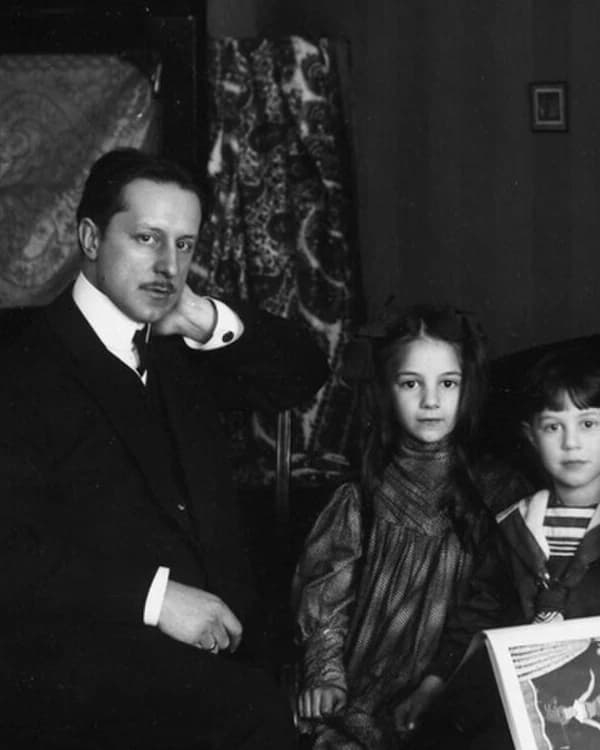
Biography
In 1943, in New York, Dobuzhinsky made a cycle of landscapes of besieged Leningrad. He had not been in the city for almost twenty years, and all these views are imaginary.
He had always known Petersburg from the reverse side. In his own words, what interested him as an artist in his beloved city was not its acknowledged beauties but its back alleys, courtyards and the rest of its underside.
He was born on 2 (14) August 1875 in Novgorod, the son of Lieutenant General Valerian Petrovich Dobuzhinsky, who came from an old Lithuanian family. His mother, a singer and actress, soon left the family; the father took the boy to bring up, but the child divided his childhood between both parents, living now with one, now with the other. The general loved theatre and music, went to exhibitions and drew himself. Father and son spent three years in Kishinev; at nine Mstislav came to Vilna for the first time, and in 1889–1895 he attended the Second Gymnasium there. Earlier still, in 1885–1887, he had studied at the drawing school of the Imperial Society for the Encouragement of the Arts in St Petersburg. Then came the law faculty of St Petersburg University and private studios, and in 1899–1901 Anton Ažbe’s school in Munich and Simon Hollósy in Nagybánya in Hungary. In 1901 he studied engraving under Vasily Mathé.
He began exhibiting in 1902 and joined the World of Art. At first Jugendstil, the influence of Benois and Somov and an affinity with the Symbolists were evident. What set him apart from the other World of Art painters was his interest in the modern industrial city with its bleakness and loneliness; alongside this he made humorous vignettes with little devils. He designed the magazines Mir iskusstva, Zolotoe runo (“The Golden Fleece”) and Apollon, painted the historical picture “Peter the Great in Holland”, and illustrated “The Stationmaster” (1905) and Lermontov’s “The Treasurer’s Wife” (1913). For the Moscow Art Theatre he designed “A Month in the Country” (1909) and “Nikolai Stavrogin” (1913), and for Diaghilev’s company Fokine’s ballets “Papillons” and “Midas” (1914). From 1906 he taught at Elizaveta Zvantseva’s school; among his pupils was the young Vladimir Nabokov, with whom he later corresponded for decades. He was one of the first to recognise Čiurlionis. During the First World War he went to the front with Eugene Lanceray to draw.
After the revolution Dobuzhinsky designed street festivities in Petrograd, sat on arts commissions, in October 1918 became a curator of the Hermitage, helped to set up the Vitebsk Practical Art Institute and the House of Arts in Petrograd, and headed the art department of the Bolshoi Opera Theatre. In 1921 he made the lithograph series “Petersburg in 1921”, and in the same year brought out illustrations to Dostoevsky’s “White Nights”, “Poor Liza”, “The Covetous Knight” and “The Toupee Artist”. For children he designed Andersen’s “The Swineherd” (1917), “The Merry Alphabet” and Mandelstam’s “The Primus Stove” (1924).
In 1924, with the help of Jurgis Baltrušaitis, he took Lithuanian citizenship and left the USSR for good.
For a while he lived in Riga, then in Paris, where until 1929 he worked for Nikita Balieff’s theatre La Chauve-Souris, designed the film “Fertility” after Zola’s novel “The Earth”, helped to organise the World of Art exhibition of 1927, and taught. At the same time he illustrated Olesha’s “Three Fat Men” (1928) for the publishing house Zemlya i Fabrika. In 1929–1935 he lived in Kaunas, taught at the art school, ran a private painting school and, from January 1931, was chief designer of the Lithuanian State Theatre, where he designed 38 productions. It seems to me that the Kaunas years are easily lost in his biography, though thirty-eight productions in a few seasons is a very large number.
In 1938 Michael Chekhov invited him to design “The Possessed”, after Dostoevsky’s “Demons”. In the spring of 1939 the work went on in England, and in July Dobuzhinsky left for the United States to continue working with Chekhov’s theatre studio. In New York he designed productions for the Metropolitan Opera and other theatres, worked in film, did Fokine’s “Russian Soldier” (1941), and illustrated “The Steel Flea” (1943), Bunin’s “The Night Tavern” (1946) and “The Tale of Igor’s Campaign” (1950).
He spent his last years mostly in Europe, living for long periods in Paris, Rome and London and travelling in Italy, and shortly before his death he returned to America. Mstislav Dobuzhinsky died on 20 November 1957 in New York, in the home of his younger son Vsevolod, and was buried in the Sainte-Geneviève-des-Bois cemetery near Paris. His “Memoirs” were published only after his death.
Related context
Associations
Works connected through artistic movements, cultural context and period. Priced works available in this market appear first.








Profile notes
Profile and sources
Image
Artist image
Karl Bulla; Wikimedia Commons; Public domain.
