
1861–1939
Mohammed ben Ali R'bati
Mohammed ben Ali R'bati (1861–1939) was born in Rabat and from the age of twenty-five lived in Tangier, where he worked as a carpenter and a cook and sold handmade postcards. In 1903 the Irish painter John Lavery noticed him, and R'bati began painting watercolours of Tangier and its people. His first exhibition was held in London in 1916.
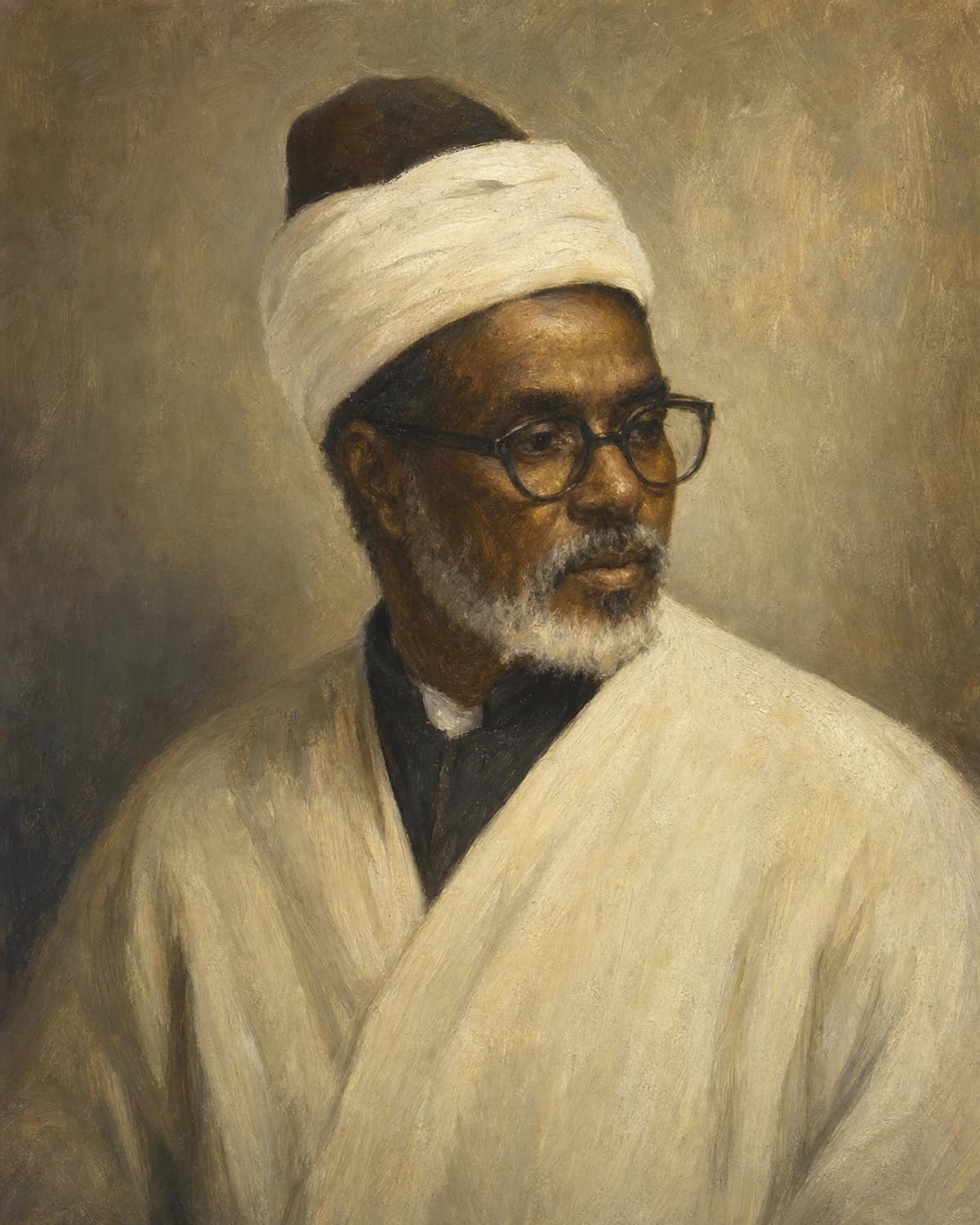
Biography
In 1903, in the Petit Socco square in Tangier, the Irish painter Sir John Lavery saw a man selling postcards he had made himself. The man turned out to be a cook well known among foreigners. Lavery took him into his service and noticed that he drew well in watercolour.
His name was Mohammed ben Ali R'bati.
He was born in 1861 in Rabat, into a modest family; the name R'bati, a nisba meaning “from Rabat”, stayed with him all his life. In his youth he attended a madrasa, where he memorised the Quran, and scenes from school life later appeared more than once in his paintings. According to his daughter, he disliked school but saved money for watercolours, coloured pencils and pens. He never received any formal art training. In 1886, at twenty-five, he moved with his family to Tangier and worked there as a cabinetmaker and a cook.
Lavery had settled in Morocco in 1890. He introduced R'bati at the British Legation in Tangier, presented him to Sir Harry Maclean and encouraged him to paint watercolours, which R'bati sold to well-off residents of the city. In Lavery’s articles and notes he is called “Ben Ali Rabbati” or simply “Ben Ali”. R'bati most often painted in watercolour on paper, less often in oil on canvas, on wood and on the clay bodies of tbilat drums. He took his subjects from close to home: Tangier, its kasbah, its inhabitants. His figures are simplified, his compositions often crowded and bright, and he always signed his works in Arabic. He was reluctant to sell them and gave many away, spending his money on materials, and so lived in poverty.
In 1916 he travelled to London with Lavery, and his first exhibition was held there at the Goupil Gallery. That same year he moved to Marseille and worked at a sugar refinery belonging to Saint-Louis Sucre; he returned to Tangier in 1922. His second exhibition took place in Marseille in 1919, and his third in 1922 at the Mamounia hotel in Marrakesh. In 1925, in unclear circumstances, he joined the Spanish army as a firefighter in the native regular units; according to his daughter, he disliked the service, and two years later he was discharged.
Later he worked as a messenger and guard at the Tangier branch of the Banco de Bilbao; he used his night shifts for painting, and sold his work and postcards in a souvenir shop. In December 1929 his paintings were shown at the Oudayas Museum in Rabat.
In 1933 he moved to the Riad Sultan quarter, where the authorities (the makhzen, the traditional Moroccan government) gave him a permanent gallery near the palace of the caid of Tangier. The only known photograph of R'bati was taken in that gallery. His works were bought by Sultan Moulay Abdelaziz, King Manuel II of Portugal, Charles de Beaupoil and Barbara Hutton. That same year he opened a restaurant and a bakery in Tangier.
He had seven children; his first wife died in 1920, and on his return from London he married again. Two of his sons, Abdelkader and Abdelmalek (1900–1978), also painted and often put their father’s signature on their pictures. R'bati died in Tangier in 1939; his daughter thought the circumstances of his death unclear. Vogue called him the “father of Moroccan painting”. Moroccan critics of later generations disagreed about his work: some saw naive art in it, others reproached it for a simplified view that suited colonial taste. I think these arguments are best read alongside the pictures, which remain a rare view of Tangier in the early twentieth century made by a local resident. Some of his watercolours are on display at the Abderrahman Slaoui Museum in Casablanca.
Related context
Associations
Works connected through artistic movements, cultural context and period. Priced works available in this market appear first.








Profile notes
Profile and sources
Image
Artist image
На основе открытого изображения: Unknown photographer Unknown photographer; Wikimedia Commons; Public domain.
