
12.11.1936–28.10.2020
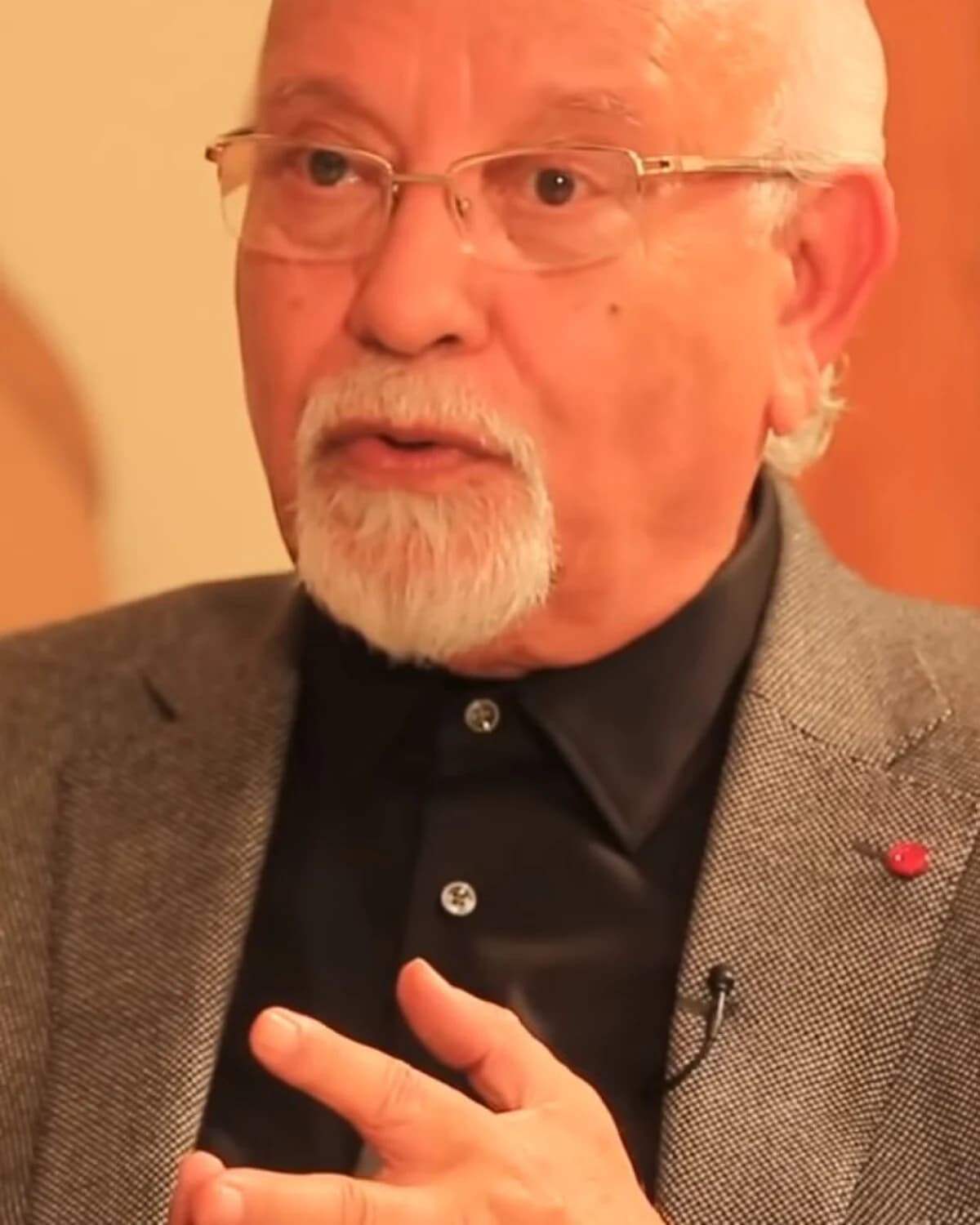
Mohamed Melehi
Mohamed Melehi (1936–2020), a native of Asilah in Morocco, studied painting in Tetouan, Seville, Madrid, Rome, Paris and New York, and from 1964 to 1969 taught at the School of Fine Arts in Casablanca. There, with Farid Belkahia and Mohamed Chabâa, he created the “Casablanca school” of Moroccan modernism. His signature is the geometric wave in bright colours; he also designed the magazine Souffles.
Biography
In 1969, in Jemaa el-Fnaa square in Marrakesh, abstract paintings stood for a whole week in the sun and the wind. The exhibition, called “Présence plastique”, was organised by teachers at the School of Fine Arts in Casablanca: Mohamed Melehi, Farid Belkahia, Mohamed Chabâa, Mohamed Ataallah, Mohamed Hamidi and Mustapha Hafid. They pointedly bypassed the official Moroccan salon that was taking place at the same time. Melehi later explained that it was an ideological position, a statement about what art could be. This exhibition in the square is regarded as the moment when modernism was born in Morocco.
Melehi was then just over thirty, and he had already studied in five countries.
He was born in Asilah, a small town on Morocco’s Atlantic coast, in November 1936. According to some records it was on the 12th, according to others on the 22nd. In 1953–1955 he studied at the School of Fine Arts in Tetouan, in 1955 at the Academy of Fine Arts of Santa Isabel de Hungría in Seville, in 1956 at the Academy of San Fernando in Madrid, in 1957–1960 at the Academy of Fine Arts in Rome, and then at the École nationale supérieure des Beaux-Arts in Paris. After that he went to Minneapolis, hoping to study architecture, but instead began teaching painting at the Minneapolis School of Art. A Rockefeller Foundation fellowship allowed him to study at Columbia University in New York in 1962–1964. In 1964 he returned home, and until 1969 he taught painting, sculpture and photography at the School of Fine Arts in Casablanca, which was headed by Farid Belkahia. With Belkahia, Chabâa and other colleagues he formed the “Casablanca school”, which set out to free Moroccan painting from the orientalist gaze of outsiders.
His manner is described as geometric abstraction. In it Amazigh and Islamic ornament meet what he had seen in New York: Op Art and hard-edge painting. His main motif became the wave, a curving band that he linked to the Atlantic surf of his native Asilah and understood as a sign of continuous movement and of the ties between East and West, Africa and Europe. His colours are strong: red, orange, blue, yellow. It seems to me that this wave is what makes his work recognisable at first glance, although individual paintings are hard to date and describe from the information available.
He did not confine himself to the studio. Melehi designed the magazines Souffles and Intégral, around which cultural and political debates took place in Morocco, and made posters and emblems for state institutions. In 1978, together with his friend Mohamed Benaissa, mayor of Asilah and later minister of culture and minister of foreign affairs, he founded an international cultural festival in Asilah; following his idea, artists from all over the world painted murals on the walls of the old town. From 1985 to 1992 he was director of the arts at the Ministry of Culture, and from 1999 to 2002 cultural adviser at the Ministry of Foreign Affairs. His work was shown by the Centre Pompidou and the Institut du monde arabe in Paris and by the Bronx Museum of the Arts in New York.
Mohamed Melehi died on 28 October 2020 at the Ambroise Paré hospital in Boulogne-Billancourt, near Paris.
Profile notes
Profile and sources
Image
Artist image
Le360; Wikimedia Commons; CC BY 3.0.
