
09.02.1852–28.11.1936
Modesto Brocos
Modesto Brocos (1852–1936) was born in Santiago de Compostela, left for Argentina at eighteen and then went on to Brazil, where he began as an illustrator for the weekly O Mequetrefe. He studied in Rio de Janeiro, Paris, Madrid and Rome, and from 1890 taught drawing at the National School of Fine Arts. He wrote several books on painting and a science fiction novel, “Viaje a Marte”.
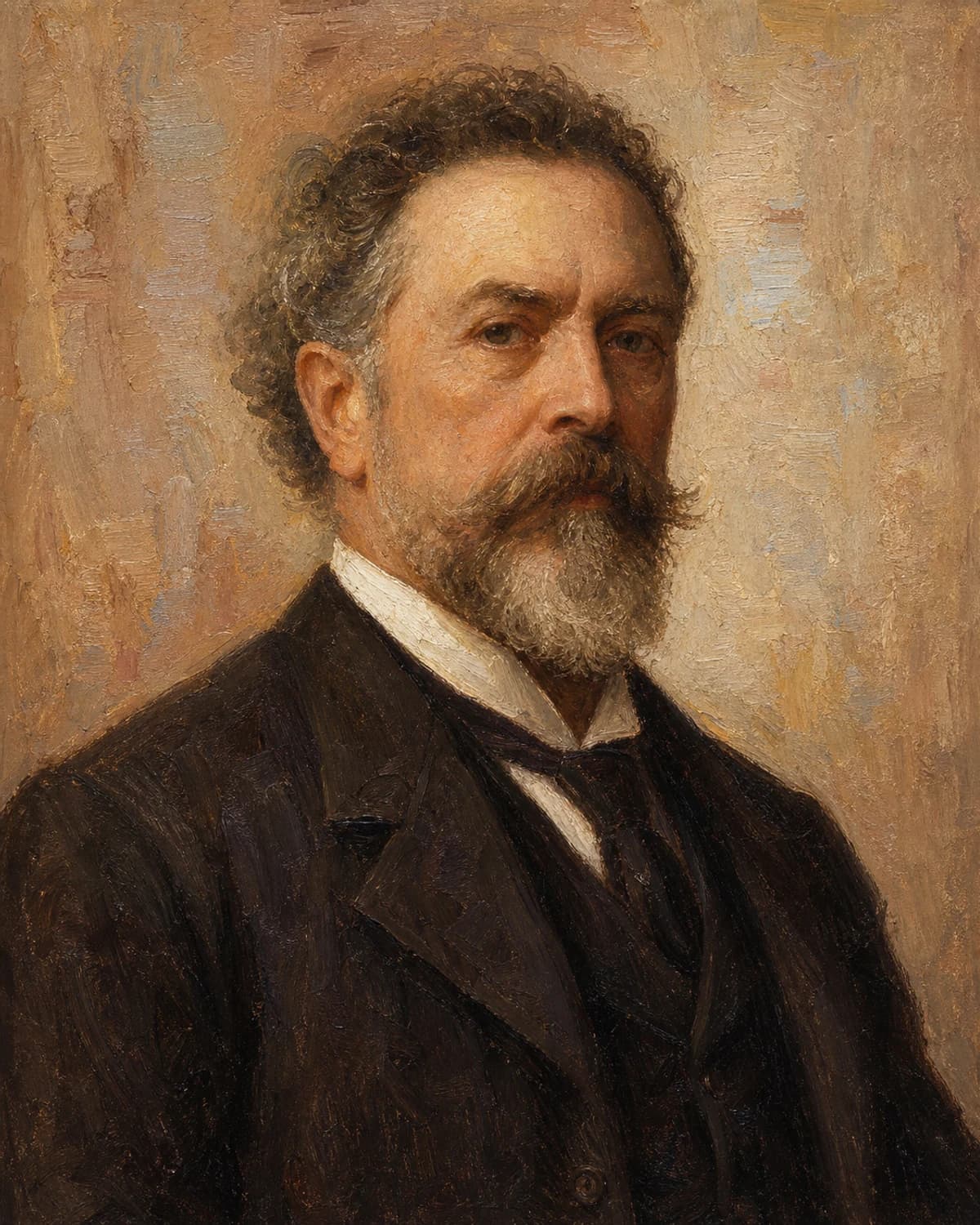
Biography
The post that Brocos received in Rio de Janeiro in 1890 remained his for the rest of his life. It had not begun that way: behind him were two failed attempts to settle, in Argentina and in Paris, and a whole decade of study in four countries.
He was born on 9 February 1852 in Santiago de Compostela, in Galicia, into a modest family with artistic leanings: his grandfather and father were writers, and his older brother Isidoro became a sculptor. Isidoro was also his first teacher at the Academy of Fine Arts in A Coruña. After finishing the course, at eighteen Modesto left for Argentina, but things did not go well there. Two years later he was in Brazil and found work in Rio de Janeiro: he drew for the weekly O Mequetrefe, a mildly satirical magazine of republican leanings. For his illustrations he used woodcut, and in Brazil he is regarded as one of the first notable practitioners of that technique. The income allowed him to enter the Imperial Academy of Fine Arts, where his teachers were Victor Meirelles and João Zeferino da Costa; according to some accounts, in 1875 he enrolled there as an external student. He did not stay in Brazil even two years. In Paris he entered the École des Beaux-Arts under Henri Lehmann, but the teaching did not satisfy him. He moved to Madrid, where he studied briefly at the Real Academia de Bellas Artes de San Fernando, then, according to some accounts, returned to Paris, and in 1883 he arrived in Rome: the municipal authorities of A Coruña had granted him a fellowship. In Rome he worked alongside his fellow Spaniard Francisco Pradilla and for five years attended the Accademia Chigi.
By 1890 he was already exhibiting at the Paris Salon and considered his education complete. Then Rodolfo Bernardelli, director of the National School of Fine Arts, the successor to the Imperial Academy, invited him to teach. Brocos obtained Brazilian citizenship without difficulty. He was appointed professor of drawing, and he held that post all his life, leaving it only briefly to make decorations for the cathedral of Santiago de Compostela. The sources differ on the name of the subject: figure drawing or anatomical drawing.
His best-known painting, “The Redemption of Ham”, is in the National Museum of Fine Arts in Rio de Janeiro. In a humble room it shows four figures: a Black old woman standing, her gesture of thanks directed to heaven, beside her a young mulatto woman, apparently her daughter, a white man, possibly the son-in-law, and their child. The title refers to the biblical Ham, cursed by his father Noah; the racist theories of the time derived from this story the dark skin and enslavement of Ham’s descendants. The painting is linked to the idea of “whitening” the nation through immigration, which João Baptista de Lacerda advocated. I would read it as a document of the views of its day, not as a judgement of them.
Many of his paintings and prints show Brazilian types and scenes in a realist manner. He also wrote books: “A questão do ensino de Bellas Artes” (1915), “Retórica dos pintores” (1933) and the science fiction novel “Viaje a Marte” (1930), which describes Martian society in detail as a socialist utopia.
Brocos died in Rio de Janeiro on 28 November 1936.
Related context
Associations
Works connected through artistic movements, cultural context and period. Priced works available in this market appear first.








Profile notes
Profile and sources
Image
Artist image
На основе открытого изображения: Sailko; Wikimedia Commons; CC BY 3.0.
