
1584–05.06.1645
Miyamoto Musashi
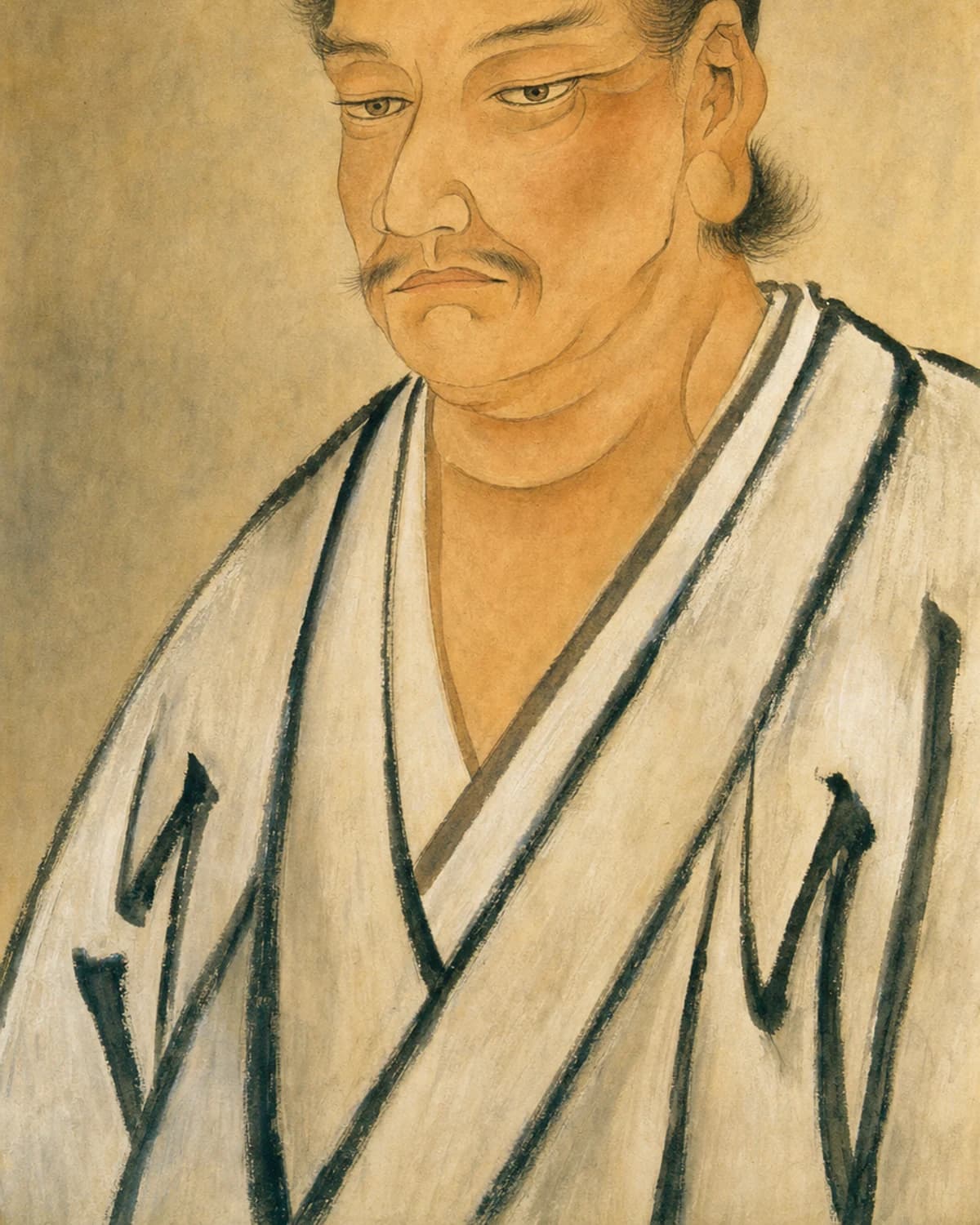
Miyamoto Musashi (1584–1645) became famous as a master swordsman, the founder of the two-sword school Niten Ichi-ryū and the author of “The Book of Five Rings”. In his last years, living in Kumamoto under the patronage of the Hosokawa clan, he painted in ink and practised calligraphy; his works include “Shrike Perched on a Withered Branch” and “Hotei Watching a Cockfight”.
Biography
In the second month of 1645, in the Reigandō cave on Mount Kinpō near Kumamoto, Miyamoto Musashi finished “The Book of Five Rings”. Among its reflections on tactics and strategy is an admission that seems to me the key to the man: applying the principle of strategy to the various arts and crafts, he no longer needs a teacher in any field. In the same book he recommended calligraphy and the other arts as an exercise in the art of war.
His paintings show that this was no empty phrase. He painted in ink in the sumi-e manner, with washes and few strokes, and was particularly adept at the “broken ink” technique of landscape painting, which he carried over to other subjects. This is how he painted “Shrike Perched on a Withered Branch” (part of a triptych with “Hotei Walking” and “Sparrow on Bamboo”), “Hotei Watching a Cockfight” and “Wild Geese Among Reeds”. It was said that his way of the warrior also took in the tea ceremony, writing and painting.
Little is reliably known about his early years. According to the early biography Niten Ki, he was born in the twelfth year of Tenshō, that is, in 1584 (by other reckonings, in 1583). “The Book of Five Rings” names Harima Province as his birthplace, while the historian Kamiko Tadashi believed that Musashi was born in the village of Miyamoto in Mimasaka Province, where his father, Shinmen Munisai, a master of the sword and the jutte, lived. As a child he was called Bennosuke, later Shinmen Takezō; his full name with title appears in the book as Shinmen Musashi-no-Kami Fujiwara no Genshin, and his Buddhist name was Niten Dōraku.
His first duel, by his own account, took place when he was thirteen: his opponent was Arima Kihei of the Shintō-ryū school. At sixteen he defeated Akiyama of Tajima Province; in 1599 he left his native village, and at twenty-one, in Kyoto, he overcame several students of a well-known fencing school. In all there were said to be sixty-two duels, and he lost none of them. The most famous, against Sasaki Kojirō, took place on Ganryū Island before a crowd of spectators; according to legend, Musashi arrived late on purpose, and on the way over in the boat he carved a wooden sword from an oar and ended the fight with it in a single blow. The technique of fighting with two swords, the long katana and the short wakizashi, he may have picked up from temple drummers working with both hands, though more likely it grew out of his experience in duels. He regarded the wooden sword, the bokken, as a real weapon. From his father he learned techniques with the jutte, and he was a skilled thrower of the short sword. His school is now called Hyōhō Niten Ichi-ryū.
In 1600 he served in the army of Kuroda Yoshitaka on the side of the Eastern Army; whether he was at Sekigahara or fought in the battle of Ishigakihara is debated by historians. In 1611 he practised zazen at the Myōshin-ji monastery; in 1614 he took part in the siege of Osaka in the army of his friend Mizuno Katsunari; and in 1638 he apparently took part in the suppression of the Shimabara Rebellion.
From 1633 Musashi lived with Hosokawa Tadatoshi, the lord of Kumamoto Castle, training and painting. In 1640 he formally entered the service of the Hosokawa and received, as the Niten Ki records, seventeen retainers, a stipend of three hundred koku and a residence at Chiba Castle. In the second month of 1641 he wrote the “Thirty-Five Instructions on Strategy” for Tadatoshi, which became the basis of “The Book of Five Rings”. In 1643 he withdrew to the Reigandō cave and lived there as a hermit.
On the twelfth day of the fifth month of 1645 he gave away his possessions and handed the manuscript to the younger brother of his closest disciple, Terao Magonojō. At the same time he wrote the Dokkōdō, some twenty short precepts for his pupils; one of them bids them revere the Buddhas and the gods without counting on their help. Miyamoto Musashi died on the nineteenth day of the fifth month of the second year of Shōhō, in June 1645. Where exactly is disputed: according to the Niten Ki, in the Reigandō cave; according to the earlier Bukōden, in his house on the site of Chiba Castle in Kumamoto, to which Nagaoka Yoriyuki had persuaded him to return.
A tomb was raised for him on Mount Iwato by order of the lord.
Related context
Associations
Works connected through artistic movements, cultural context and period. Priced works available in this market appear first.
Profile notes
Profile and sources
Image
Artist image
На основе открытого изображения: Unknown author Unknown author; Wikimedia Commons; Public domain.
